🔥 TDEE Calculator — Free & Accurate
Calculate your Total Daily Energy Expenditure using the Mifflin-St Jeor formula. Get calorie targets for your goal.
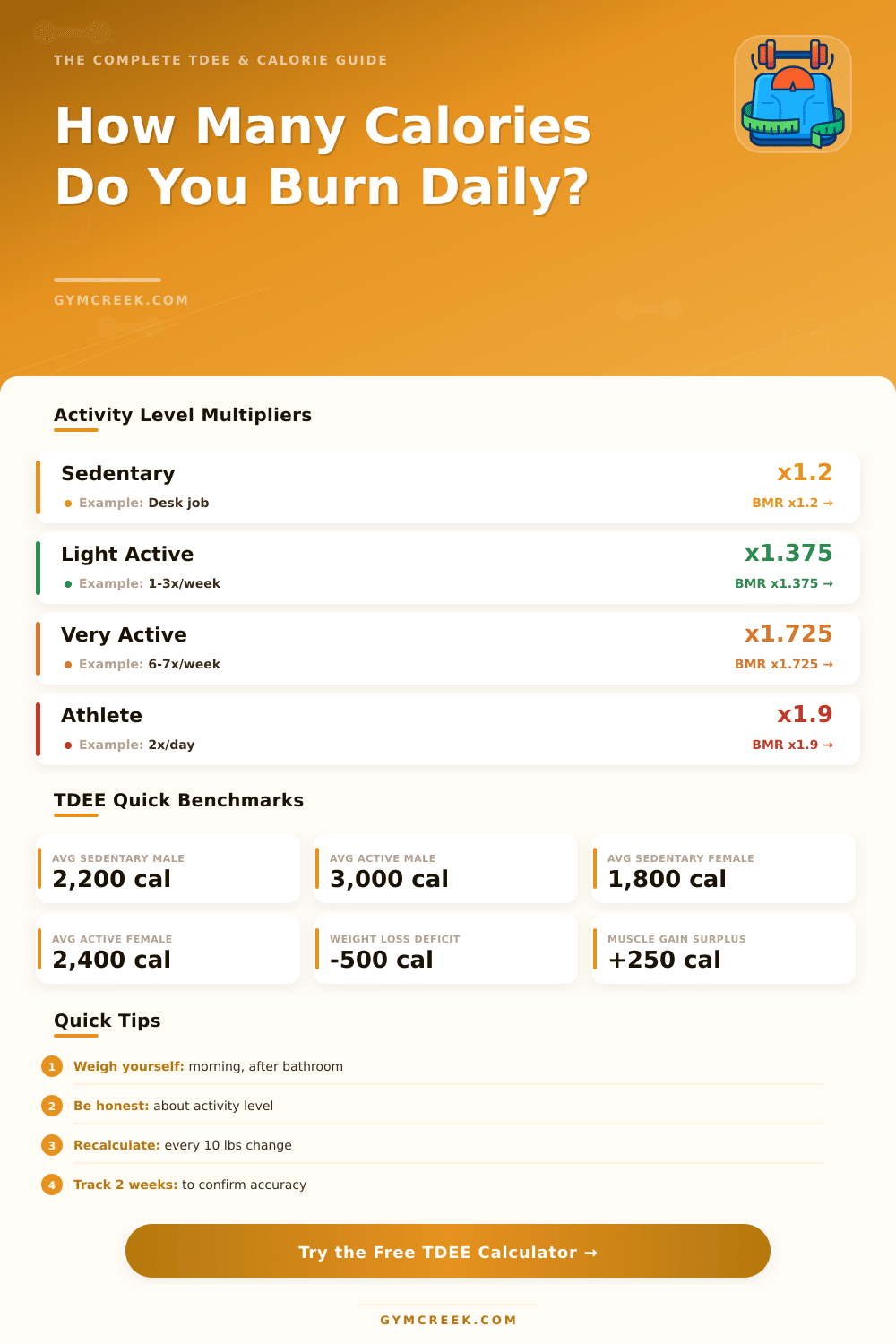
| Activity Level | Multiplier | Description | Typical Example |
|---|---|---|---|
| Sedentary | x 1.2 | Little/no exercise | Desk job, no workouts |
| Lightly Active | x 1.375 | Light exercise 1–3 days/wk | Casual walks, light yoga |
| Moderately Active | x 1.55 | Moderate exercise 3–5 days/wk | Gym 4x/week |
| Very Active | x 1.725 | Hard exercise 6–7 days/wk | Daily training, sports |
| Extra Active | x 1.9 | Very hard exercise + physical job | Athletes, 2x/day training |
| Goal | Calorie Adjustment | Expected Rate | Notes |
|---|---|---|---|
| Extreme Weight Loss | −1,000 cal | ~2 lbs/week | Not sustainable long-term |
| Weight Loss | −500 cal | ~1 lb/week | Recommended safe rate |
| Mild Weight Loss | −250 cal | ~0.5 lb/week | Easiest to sustain |
| Maintenance | 0 cal | No change | Match TDEE exactly |
| Mild Muscle Gain | +250 cal | ~0.25 lb/week | Lean bulk, less fat gain |
| Muscle Gain | +500 cal | ~0.5 lb/week | Standard bulk protocol |
| Age Group | Male BMR Range | Female BMR Range | Notes |
|---|---|---|---|
| 18–25 | 1,750–2,100 cal | 1,400–1,700 cal | Peak metabolic rate |
| 26–35 | 1,650–2,000 cal | 1,350–1,650 cal | Slight decline begins |
| 36–45 | 1,550–1,900 cal | 1,300–1,600 cal | ~2–3% drop per decade |
| 46–55 | 1,450–1,800 cal | 1,250–1,550 cal | Muscle preservation key |
| 56–65 | 1,350–1,700 cal | 1,200–1,500 cal | Protein intake critical |
| 65+ | 1,250–1,600 cal | 1,100–1,400 cal | Activity level matters most |
| Category | Men (%) | Women (%) | Description |
|---|---|---|---|
| Essential Fat | 2–5% | 10–13% | Minimum for organ function |
| Athletic | 6–13% | 14–20% | Competitive athletes |
| Fitness | 14–17% | 21–24% | Gym-goers, fit individuals |
| Acceptable | 18–24% | 25–31% | Average healthy adult |
| Obese | 25%+ | 32%+ | Increased health risks |
TDEE is short for Total Daily Energy Use, simply said, it shows how many calories you burn during a whole day. Everything this includes: your heartbeat, breathing, digestion and every kind of motion or exercise that you do. The difficult spot?
Almost impossible to exactly estimate it, and it changes from day to day.
How to Find Your Daily Calorie Needs (TDEE)
Three main parts meet to form your TDEE. Biggest of them is your Basal Metabolic Rate, or BMR, that is the energy that your body requires only to exist, as if sitting still. Usually BMR involves between 60 and 75 percent of your whole daily energy burning.
Later comes the warm impact of food, what simply is the cost to process that what you take. And obviously, your physical motion and training sessions form the last bit of that jigsaw.
Here something what maybe will surprise you: the amount of lean mass better predicts your metabolic speed than your whole body mass. Because fat tissue does not require lot of energy to stay inactive. The more muscle you have, the higher becomes your TDEE.
So, if you regularly lift weights, remember to check your daily calorie targets now and then… Otherwise you risk to fall in unwanted deficit without you even noticing.
To estimate your TDEE, start with your BMR. Later multiply that value by a factor of activity. The multipliers range according to your daily life: for homebody folks it is 1.2, for a bit active 1.375, for medium active 1.55, for very active 1.725 and for extremely active 1.9.
The most many website calculators care about that math, if you only enter your age, weight, height and activity level.
The key is that those tools require you to honestly judge your own motion. The groups that they offer, are very broad, and easily you wrong choose the wrong one. Because the calculations base on averages of crowds and statistics, probably the result does not exactly answer for your personal case.
A safer way? Note everything what you eat, weigh yourself every morning first and observe your weekly averages during some weeks. Actual data about your nutrition and weight changes beat any formula.
Recall that TDEE does not stay unchanged, it changes according to the stability of your life. Regular daily routine helps it stay steady, but big changes in life will straight up throw it off.
When you set your TDEE, that becomes your calories to keep weight. If you eat under it, you create a deficit to loose mass. Add around 500 calories above it, and that works well for growing muscles.
One nasty truth: those last stubborn pounds become more difficult to remove, because your TDEE shrinks as you loseweight, what strengthens the need for a careful deficit.