🏋 Weightlifting Percentage Calculator
Calculate exact training loads from your 1-rep max — build strength, hypertrophy, or endurance zones
| % of 1RM | Load (lbs) | Rep Range | Zone | Goal |
|---|
| % of 1RM | Intensity Zone | Reps per Set | Sets | Primary Goal | Rest Period |
|---|---|---|---|---|---|
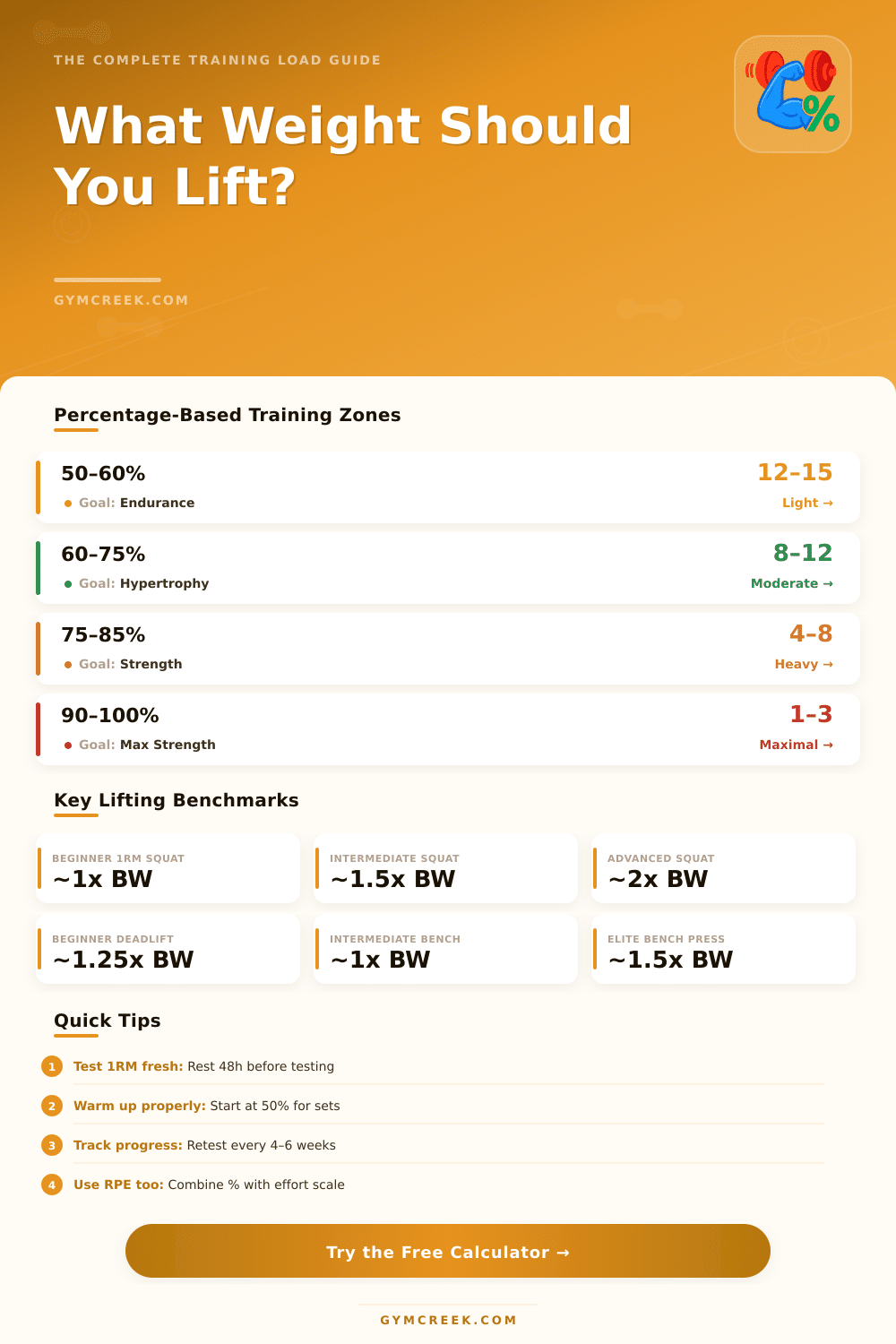
| 50–60% | Very Light | 15–20+ | 2–3 | Active Recovery / Warm-Up | 30–60 sec |
| 60–65% | Light | 12–15 | 2–4 | Muscular Endurance | 60–90 sec |
| 65–75% | Moderate | 8–12 | 3–4 | Hypertrophy (Size) | 60–90 sec |
| 75–80% | Moderate-Heavy | 6–10 | 3–5 | Hypertrophy / Strength | 90–120 sec |
| 80–85% | Heavy | 4–6 | 3–5 | Strength | 2–3 min |
| 85–90% | Very Heavy | 2–4 | 3–6 | Maximal Strength | 3–5 min |
| 90–95% | Near-Maximal | 1–3 | 2–5 | Strength / Peaking | 4–5 min |
| 95–100% | Maximal | 1 | 1–3 | Competition / Testing | 5+ min |
| Lift | Untrained | Beginner | Intermediate | Advanced | Elite |
|---|---|---|---|---|---|
| Back Squat | 0.75x BW | 1.0x BW | 1.5x BW | 2.0x BW | 2.5x BW |
| Bench Press | 0.5x BW | 0.75x BW | 1.0x BW | 1.5x BW | 1.75x BW |
| Deadlift | 1.0x BW | 1.25x BW | 1.75x BW | 2.25x BW | 2.75x BW |
| Overhead Press | 0.35x BW | 0.5x BW | 0.75x BW | 1.0x BW | 1.25x BW |
| Barbell Row | 0.5x BW | 0.75x BW | 1.0x BW | 1.25x BW | 1.5x BW |
| Formula | Equation | Best For | Notes |
|---|---|---|---|
| Epley (1985) | w × (1 + r/30) | General use | Most widely used; accurate 1–10 reps |
| Brzycki (1993) | w × (36 / (37 – r)) | Lower rep ranges | Accurate for 1–6 reps |
| Lander (1985) | w / (1.013 – 0.0267123 × r) | Moderate reps | Good for 1–8 reps |
| O'Conner (1989) | w × (1 + 0.025 × r) | Higher reps | Conservative estimate |
weightlifting helps to count how many weight one raises, according to one-repeated maximum. That maximum is the biggest weight, that some folk fits to raise for only one single repetition. Later one chooses parts from that maximum, to find right load during the training.
DISCLOSURE: This post may contain affiliate links, meaning when you click the links and make a purchase, I receive a commission. As an Amazon Associate I earn from qualifying purchases.

Percentage charts for weightlifting point the weight according to share of the one-repeated maximum. They commonly show values of 40% until 95%, with steps each 5%, and cover highs of 40 until 600 pounds. Some of those charts even are printed on tough vinyl strips with metal eyes, so that one can hang them in the gym.
How to Use Percentages to Pick the Right Weight
To start, first find your one-repeated maximum in complex exercise, for example shoulder press or bench press. Then choose a share, as 65%, 75% or 85% from that maximum. The idea is do so many repetitions as possible at that level and note the results.
Like this one safley follows the progress and choose right weight for good strong training.
Percentages and repetitions usually go together. Doing only one repetition at 50% of the maximum would not be useful really. And sets with ten repetitions at 95% simply would not work, because finishing them would be almost impossible.
For muscle building, 80% of the maximum as working weight is good base. First warm up with 40-60%, so that the body feel the move, before start the main sets.
The Russians used their own approach. They chose a share from the one-repeated maximum, assigned repetitions and sets to it, and ordered the lifters to complete the exercises. Later they watched the weightlifting pace, the form of the lifter and the following maximum attempt of that lifter.
In one study won trained participants at the maximum number of repetitions, that they could do at 90%, 80% and 70% of their strongest single effort, and later one looked at the data.
Big trouble of the percentage method is, that one can not exactly predict, how heavy maximum will raise in every training session. As solution, one use strength levels instead of simple single percentage marks. Experienced coaches commonly discuss, where one should set those strength limits.
Technical work purely usually happens at 65-80%, according to the kind of form, that some have. In body building workouts one rather uses sets with 8-12 repetitions at weights of 70-85% from the one-repeated maximum. Programs as 5/3/1 base on percentages, while others apply straight progress rather.
Percentage method is good resource, but building feeling for right weights are equally important. There are online tools, that allows to enter the maximum andimmediately see whole percentage chart.
For competitive weightlifters, some studies show, that basing the program on direct percentage of the squat help. The commonly cited share is 60-65% from the back squat. Clean and pulls at 77% of the squat are seen as good relation.