🏋 Trap Bar Deadlift Max Calculator
Estimate your 1-rep max (1RM) from any working set — with full training load breakdown & strength standards
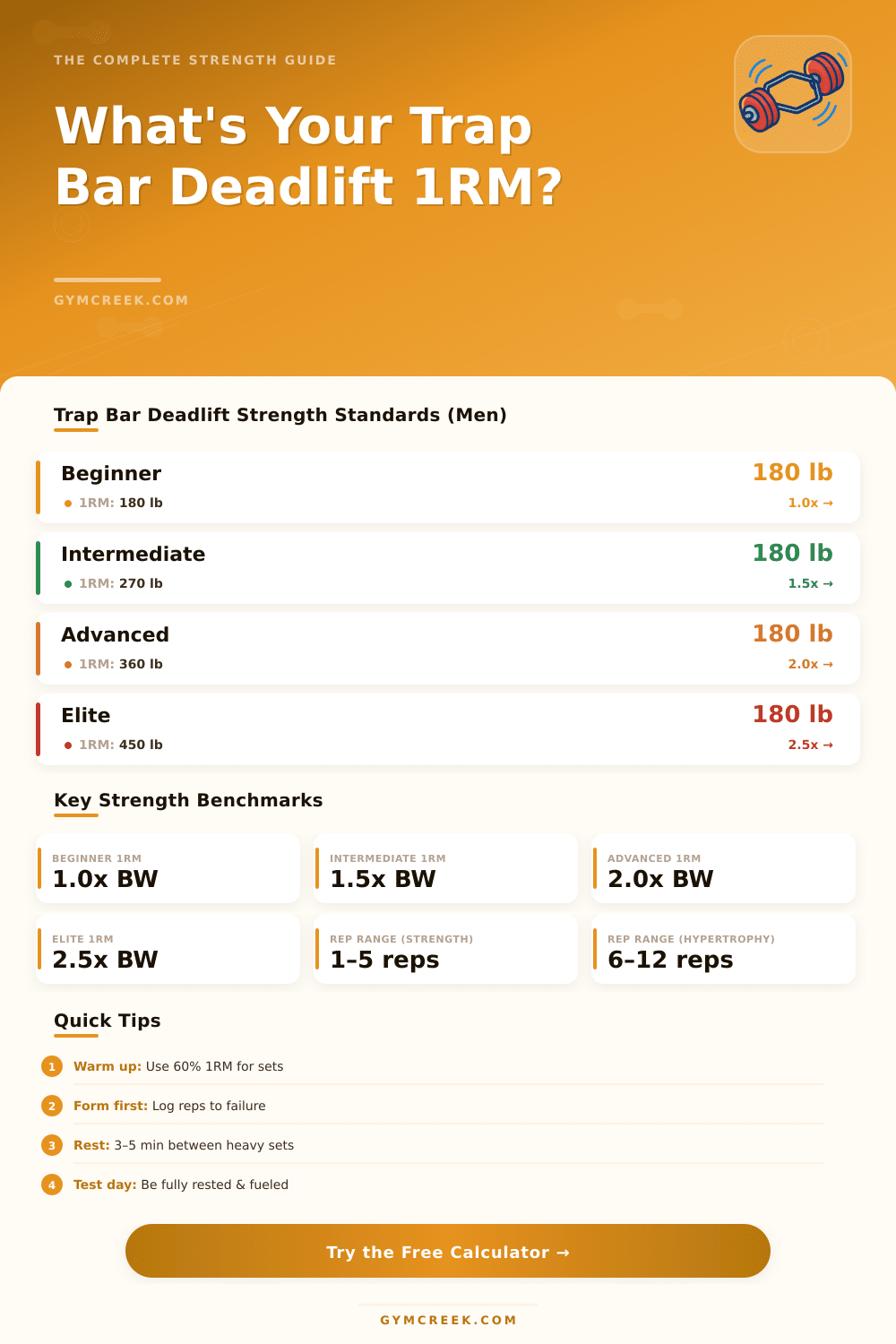
| Level | Men (x BW) | Women (x BW) | Example (180 lb man) |
|---|---|---|---|
| Untrained | 0.75x | 0.5x | 135 lb |
| Beginner | 1.0x | 0.75x | 180 lb |
| Novice | 1.25x | 0.9x | 225 lb |
| Intermediate | 1.5x | 1.1x | 270 lb |
| Advanced | 2.0x | 1.5x | 360 lb |
| Elite | 2.5x | 1.9x | 450 lb |
| Goal | Rep Range | % of 1RM | Sets |
|---|---|---|---|
| Max Strength | 1–3 reps | 90–100% | 3–5 |
| Strength | 3–5 reps | 85–90% | 4–6 |
| Power | 2–4 reps | 75–85% | 4–6 |
| Hypertrophy | 6–12 reps | 65–80% | 3–5 |
| Muscular Endurance | 12–20 reps | 50–65% | 2–4 |
| Active Recovery | 15–20 reps | 40–50% | 2–3 |
| Formula | Best For | Accuracy (Reps) | Notes |
|---|---|---|---|
| Epley | General use | 1–10 | Most widely used |
| Brzycki | Lower rep sets | 1–8 | Conservative estimate |
| Lombardi | Higher reps | 1–10 | Slightly aggressive |
| Mayhew | Bench press validated | 5–10 | Uses power regression |
| O'Conner | General fitness | 1–10 | Simple linear formula |
| Average | Best overall estimate | 1–10 | Recommended default |
The trap bar deadlift is a kind of deadlift using a special bar. To do it, one stands above the device seize one from the two groups of handles and then raise the weight. Those trap bars usually have two levels of handles, where the higher allow easier lifting.
DISCLOSURE: This post may contain affiliate links, meaning when you click the links and make a purchase, I receive a commission. As an Amazon Associate I earn from qualifying purchases.

The grip happens at the sides, what helps to naturally bring heavy loads from the ground.
Why Use the Trap Bar Deadlift
Big difference is about the body position. During the barbell deadlift the bar lays before the body, what forces you to lean forward and less bend the knees. The trap bar centers the weight over the body center.
Because the hands stay at the sides, there is no fear about knees going too far forward. Like this the exercise feels more like a squat tahn the barbell version.
The trap bar deadlift works more the quadriceps, while it loads less the back chain. The classic deadlift mostly touches the hamstring muscles, glutes and lower back, what becomes more needed because of the front position of the weight. In the trap bar, the force spreads more equally between the leg front and back.
It basically mixes elements of squatting and deadlift. Because of the bigger role of quadriceps, one can commonly bare bigger weight than in the normal form.
It also reduces the tension on the lower back. The trap bar removes a lot of force from the spine. That makes it useful for many athletes, that want to work the back chain without too much danger.
The exercise needs less skill and is widely learned more quickly.
One can stand on plates to grow the movement range. From a lower start position, the leg muscles engage more in the lift. Deadlifts with high handles in a trap bar work almost as squat moves and can help the push from the floor.
Starting with a bit higher hips turns the action more to hinge style and less to squat style.
The trap bar does not work the upper back almost as strongly as barbell lifts from the ground. At almost max weights, shaky moves can appear with front lean, what looks a bit scary. Also there is risk to strain the lower back at the top of the move.
The trap bar showed itself to create more power than many other exercises. It well helps to build full body power and is much more open for all. The foot placement lets you change the feeling.
For athletes, that do not take part in powerlifting, the trap bar can fullywell serve. Lifting heavy on it stays however impressive always.