🏋 Strength Workout Calorie Calculator
Estimate calories burned during weight training & strength workouts based on your body & session details
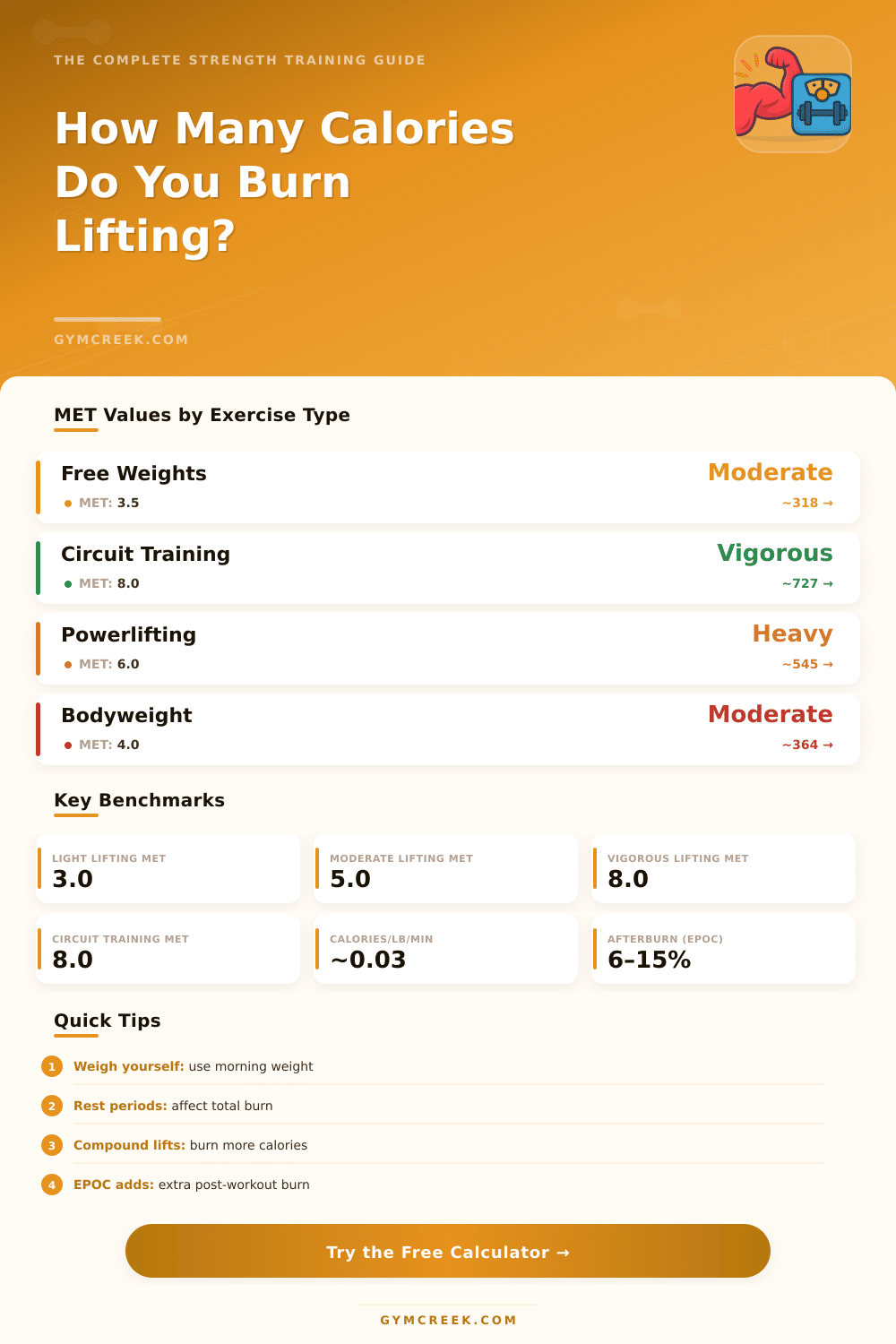
| Exercise Type | Intensity | MET Value | Cal/hr (180 lb) |
|---|---|---|---|
| General Weight Training | Moderate | 3.5 | 318 |
| Free Weights | Light | 3.0 | 273 |
| Free Weights | Moderate | 5.0 | 455 |
| Free Weights | Vigorous | 6.0 | 545 |
| Powerlifting / Heavy Compound | Vigorous | 6.0 | 545 |
| Circuit Training | Vigorous | 8.0 | 727 |
| Bodyweight Exercises | Moderate | 4.0 | 364 |
| CrossFit / Functional | Vigorous | 8.5 | 773 |
| Hypertrophy / Bodybuilding | Moderate | 4.5 | 409 |
| Kettlebell Training | Vigorous | 8.2 | 745 |
| Goal | Rep Range | Sets | Rest Period |
|---|---|---|---|
| Max Strength | 1–5 reps | 3–6 | 3–5 min |
| Hypertrophy (Muscle Growth) | 6–12 reps | 3–5 | 60–90 sec |
| Muscular Endurance | 12–20 reps | 2–4 | 30–60 sec |
| Power | 1–5 reps (explosive) | 3–6 | 2–4 min |
| Circuit / Fat Loss | 10–20 reps | 3–5 | 15–45 sec |
| General Fitness | 8–15 reps | 2–4 | 60–120 sec |
| Training Style | EPOC Duration | Extra Cal Burn | Total Boost |
|---|---|---|---|
| Light Weight Training | 30–60 min | 15–30 cal | ~5% |
| Moderate Strength | 1–3 hours | 30–60 cal | ~8% |
| Heavy Compound Lifts | 3–6 hours | 50–100 cal | ~10% |
| Circuit Training / HIIT | 6–24 hours | 75–150 cal | ~15% |
| High-Volume Bodybuilding | 2–5 hours | 40–80 cal | ~9% |
| CrossFit / Functional | 6–24 hours | 80–160 cal | ~14% |
| Body Weight | 30 Minutes | 45 Minutes | 60 Minutes |
|---|---|---|---|
| 130 lb (59 kg) | ~100 cal | ~150 cal | ~200 cal |
| 155 lb (70 kg) | ~120 cal | ~180 cal | ~240 cal |
| 180 lb (82 kg) | ~140 cal | ~210 cal | ~280 cal |
| 205 lb (93 kg) | ~160 cal | ~240 cal | ~320 cal |
| 230 lb (104 kg) | ~180 cal | ~270 cal | ~360 cal |
| 255 lb (116 kg) | ~200 cal | ~300 cal | ~400 cal |
Weigh yourself: Use your morning weight before eating for the most consistent measurement.
Rest periods matter: Shorter rests = higher continuous heart rate = more calories burned overall.
Compound lifts burn more: Squats, deadlifts, and bench press engage more muscle groups than isolation exercises.
Track your sets: More sets = more total work performed = higher calorie expenditure.
Strength training burns calories in a way that can surprise. A session of 20 to 25 minutes of Strength training can use 300 to 400 calories. Also, the process of muscle repair after the exercises adds 300 to 400 extra calories.
DISCLOSURE: This post may contain affiliate links, meaning when you click the links and make a purchase, I receive a commission. As an Amazon Associate I earn from qualifying purchases.

That extra use is a nice bonus.
How Strength Training Burns Calories
Average folk can burn three to five calories a minute during hard Strength exercise. So the whole amount depends on the length of the session. Workout with heavy weights at high effort burns between 300 and 600 calories during one hour of lifting.
For instance folk weighing 155 pounds, that does medium to heavy exercises like squats, deadlifts and bench press with short pauses, could spend around 400 Calorie in an hour.
Weight of the body, effort of the Workout and length of the session all affect the total energy used. To estimate calories from Strength training is really hard, because it depends on the amount of weight raised per set, the trouble of the exercise and the rest time between sets. That makes it hard to exactly set the right number.
The cause is called EPOC, which means excess post-exercise oxygen use. It simply means that the body still burns calories after the end of the Workout. EPOC can last from 15 minutes to 48 hours, based on the effort, length and body weight or muscle mass.
But for a typical Strength session with four to eight exercises, two to four sets, eight too twelve reps at 60 to 70 percent of the max, EPOC lasts only one hour and burns about 35 extra calories. A really long two-hour Strength Workout can create an EPOC effect of around 150 to 200 calories during the next 24 to 36 hours.
Strength training does more than only burn calories during the session itself. It has a lasting effect on the body over time. Cardio exercise mostly burns calories only during the activity, but Strength training gives more lasting access to Calorie use.
Every pound of muscle gained helps burn 45 to 50 extra calories a day. That adds up quickly.
Some tools for tracking only estimate calories for cardio exercises and do not show values for Strength training. A calculator based on MET values can help estimate the burn based on body weight, level of activity and length of the Workout. Formulas that consider age, weight, heart rate and time also exist for more exact results.
Even so, tracking calories from lifting is not as simple as tracking running or cycling. Many folks simply include Strengthtraining in their daily energy total, instead of tracking every session alone.