🏃 Running Pace Conversion Calculator
Convert pace, speed & finish times — imperial & metric units included
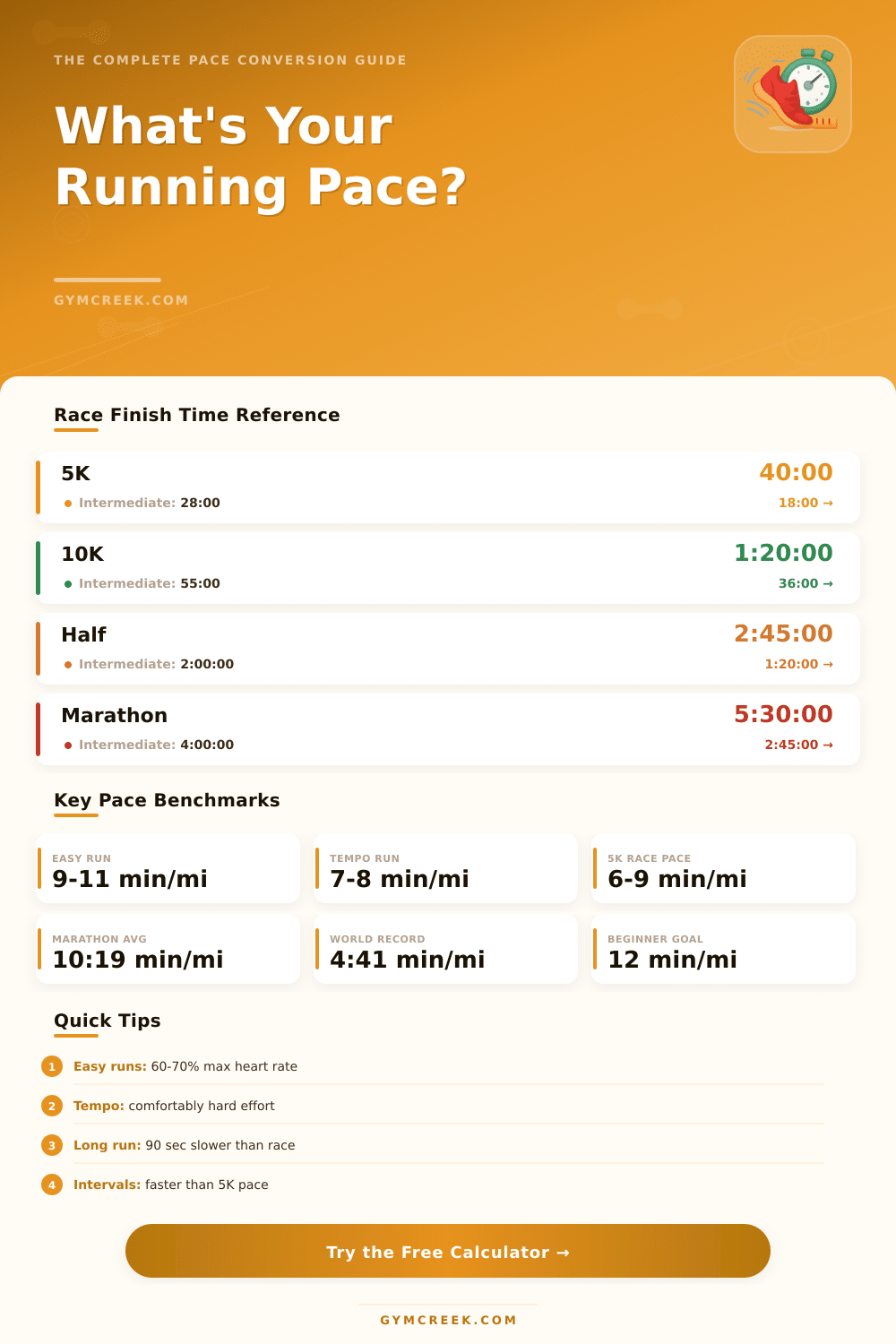
| Race Distance | Beginner | Intermediate | Advanced | Elite |
|---|---|---|---|---|
| 1 Mile | 12:00 min | 9:00 min | 6:30 min | 4:00 min |
| 5K (3.1 mi) | 40:00 | 28:00 | 20:00 | 13:00 |
| 10K (6.2 mi) | 1:20:00 | 55:00 | 40:00 | 27:00 |
| Half Marathon | 2:45:00 | 2:05:00 | 1:35:00 | 1:00:00 |
| Marathon | 5:30:00 | 4:00:00 | 3:10:00 | 2:03:00 |
| min/km | min/mile | km/h | mph | 5K Time | Marathon Time |
|---|---|---|---|---|---|
| 3:30 | 5:38 | 17.1 | 10.6 | 17:30 | 2:27:54 |
| 4:00 | 6:26 | 15.0 | 9.3 | 20:00 | 2:48:22 |
| 4:30 | 7:14 | 13.3 | 8.3 | 22:30 | 3:09:26 |
| 5:00 | 8:03 | 12.0 | 7.5 | 25:00 | 3:31:06 |
| 5:30 | 8:51 | 10.9 | 6.8 | 27:30 | 3:52:26 |
| 6:00 | 9:39 | 10.0 | 6.2 | 30:00 | 4:13:46 |
| 6:30 | 10:28 | 9.2 | 5.7 | 32:30 | 4:35:06 |
| 7:00 | 11:16 | 8.6 | 5.3 | 35:00 | 4:56:26 |
| 8:00 | 12:52 | 7.5 | 4.7 | 40:00 | 5:37:46 |
| Zone | Name | Effort Level | % of Max HR | Relative Pace |
|---|---|---|---|---|
| Zone 1 | Recovery | Very Easy | 50–60% | Race pace + 3+ min/mi |
| Zone 2 | Easy / Aerobic | Conversational | 60–70% | Race pace + 2–3 min/mi |
| Zone 3 | Moderate | Comfortably Hard | 70–80% | Race pace + 1–2 min/mi |
| Zone 4 | Threshold / Tempo | Hard | 80–90% | Near 10K race pace |
| Zone 5 | VO2 Max / Intervals | Very Hard | 90–100% | Faster than 5K pace |
The Running Pace simply points how much time is needed to go across a certain distance. The main calculation is distance divided by time. So if one needs 30 minutes to run 5 km., then the usual Running Pace is 6 minutes per kilometer.
DISCLOSURE: This post may contain affiliate links, meaning when you click the links and make a purchase, I receive a commission. As an Amazon Associate I earn from qualifying purchases.

That sounds quite easy, but there is much more than that during training or when one runs.
What Is Running Pace?
Running Pace does not match to speed. It deals about care about energy reserves. Run too quickly at the start of a race can lead to tiredness.
Start too slowly stops a runner reach his best result. Finding the right balance between effort and final force helps. A good method is run the second part of the run more quickly than the first.
A calculator for Running Pace can give pace, time or distance, if two from those values already are known. Charts for conversion also simplify the sight of Running Pace in kilometers and miles. Such resources are useful for setting targets and making more precise preparation for events as 10 km., half marathon or full marathon.
Different lengths of run require different Running Pace values. Running Pace of 5 km. About 8:30 per mile matches to around 8:50 for 10 km.
And around 9:10 for half marathon. Even so those values are not fixed. Adding yet 10 or 20 seconds are entirely reasonable.
Run two quickly can cause injury, so care matters more than pride.
Running Pace of 5 km. Is almost without oxygen, while Running Pace for 10 km. More depends on steady breathing.
Running Pace for easy run is entirely other cause. It should feel relaxed and pleasant. A runner can be up to 20 seconds per mile slower or faster than the intended easy Running Pace on any day.
The idea of easy run is create firm foundations for more hard training later.
For newcomers, Running Pace between 12 and 15 minutes per mile is a good spot to start training. Run too slowly simply does not work. Slow indeed helps to cover bigger distances.
Increase the length slowly, for instance add 500 metres each week to the long run, build fitness over time.
Run around 80 percent of the total miles in slow easy Running Pace, and 20 percent in more hard fast work, gives good results. Regular and balanced preparation leads to progress over time. Thinking the training amount in time instead of in distance also is useful, because a faster runner can cover bigger ground in the same hour than a less fast one.
A certain Running Pace for middle work is good, but a bit faster or slower also works, if the runner feels comfortable on that day. Running Pace adjusts according to age, level of preparation, sex and weight. The most important thing is stayregular and not too stress the numbers at first.