🏋 Dips to Bench Press Calculator
Estimate your bench press 1RM from your dip performance — bodyweight or weighted
Percentage of 1RM you can lift for a given number of reps (Epley model):
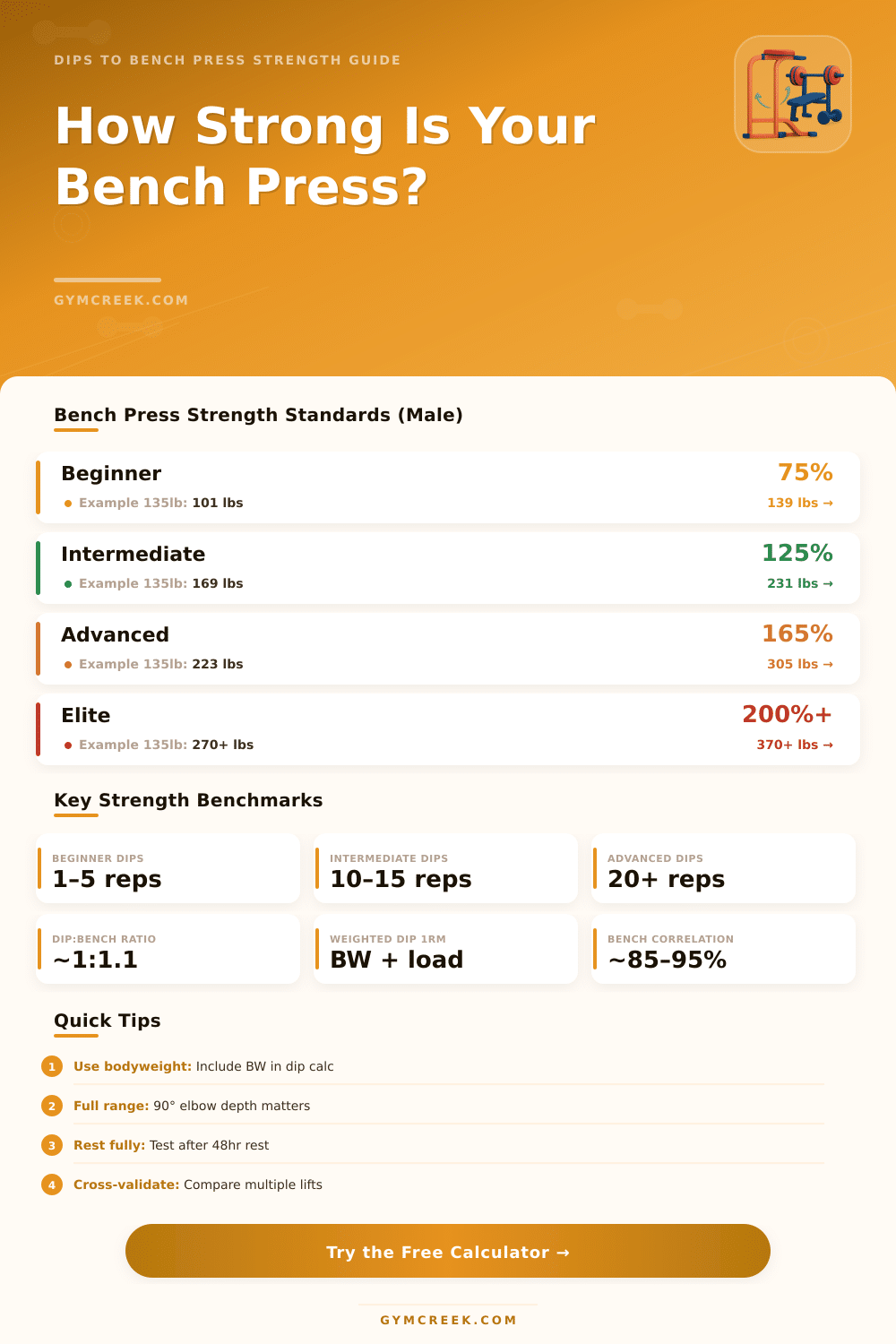
Male Standards (% of Bodyweight)
| Level | 1RM (% BW) | Category |
|---|---|---|
| Beginner | 75% | Beginner |
| Novice | 100% | Novice |
| Intermediate | 125% | Intermediate |
| Advanced | 165% | Advanced |
| Elite | 200%+ | Elite |
DISCLOSURE: This post may contain affiliate links, meaning when you click the links and make a purchase, I receive a commission. As an Amazon Associate I earn from qualifying purchases.

Female Standards (% of Bodyweight)
| Level | 1RM (% BW) | Category |
|---|---|---|
| Beginner | 45% | Beginner |
| Novice | 65% | Novice |
| Intermediate | 80% | Intermediate |
| Advanced | 105% | Advanced |
| Elite | 130%+ | Elite |
| Dip Level | BW Dip Reps | Weighted Dip 1RM (% BW) | Est. Bench Correlation | Notes |
|---|---|---|---|---|
| Beginner | 1–5 reps | 100% | ~85% of bench | Build foundational strength |
| Intermediate | 10–15 reps | 115–130% | ~90–95% of bench | Add weight to progress |
| Advanced | 20+ reps BW | 145–175% | ~95–105% of bench | Dips may exceed bench press |
| Elite | Weighted +BW+ | 200%+ | ~105–115% of bench | Specialist-level chest/tricep power |
2. Test when fresh: Perform your max-rep set after at least 48 hours of rest from heavy upper-body training.
3. Include all weight: For weighted dips, always include your bodyweight plus the added load as your total working weight.
4. Dip style matters: Chest dips (body leaning forward, wide grip) transfer better to bench press than tricep dips (upright torso, narrow grip).
5. Validate with multiple sets: Test across 2–3 rep ranges and average for a more reliable estimate.
Dips and Bench Press rank among the most popular exercises for the upper body, even though they target the muscles a bit differently. Dips more strongly use the triceps, while Bench Press mostly works the chest. Also, Dips touch the upper chest, the shoulders and even the abs at some level.
On the other hand the Bench Press puts more pressure on the front delts than the Dips.
Dips and Bench Press: How They Are Different
The neutral grip of Dips allows the athletes to use more of their tricep muscles during the press. Top Bench Press lifters like Julius Maddox usually choose narrower grip and keep their elbows tucked to keep the triceps actively involved. The strength of triceps seriously affects the output of flat Bench Press.
Close-grip Bench Press and chest Dips well help to expand the maximum Bench Press.
An interesting fact is that Dips are more pratcial than the barbell Bench Press. One can practice them only with body weight, or make them harder by adding weights. Resistance bands however can ease the load for beginners.
They do not require plates, bar or bench. A good pair of parallel bars is enough.
Heavy Dips are a real compound lift with movements similar to those of Bench Press. Even so commonly folks simply jump on the bars and start reps with a loose body, bad form and shoulders that rise and drop. Such bad technique never would pass during Bench Press.
To truly target the triceps, stay straight and make the elbow the main turning point, especially near the elbow joint. Lower the body nice and slow and keep the elbows tucked beside the body, that is the right weigh.
Dips also carry a bit of risk. They can strain the shoulders, and serious injuries of the rotator cuffs are possible because of bad technique. Doing Dips before machine Bench Press is a mistake for beginners.
For advanced athletes, Dips can give less benefit per time compared to other exercises.
The flat barbell Bench Press stays the king for upper press strength. Dips can not fully replace it to build force most effectively. But replacing Bench Press with Dips works well for some body types.
Tall people with very long arms, who hardly progress in Bench Press, sometimes find much better results with Dips as their main press exercise. Dips seem to have better carryover to Bench Press than to overhead presses. Close-grip decline Bench Press indeed most resembles the movement of Dips.
One sometimes calls Dips the squat ofthe upper body, which says a lot about their value as a compound exercise.