🏋 Bench Press 225 Calculator
Estimate your reps at 225 lbs, your one-rep max, and your strength level classification
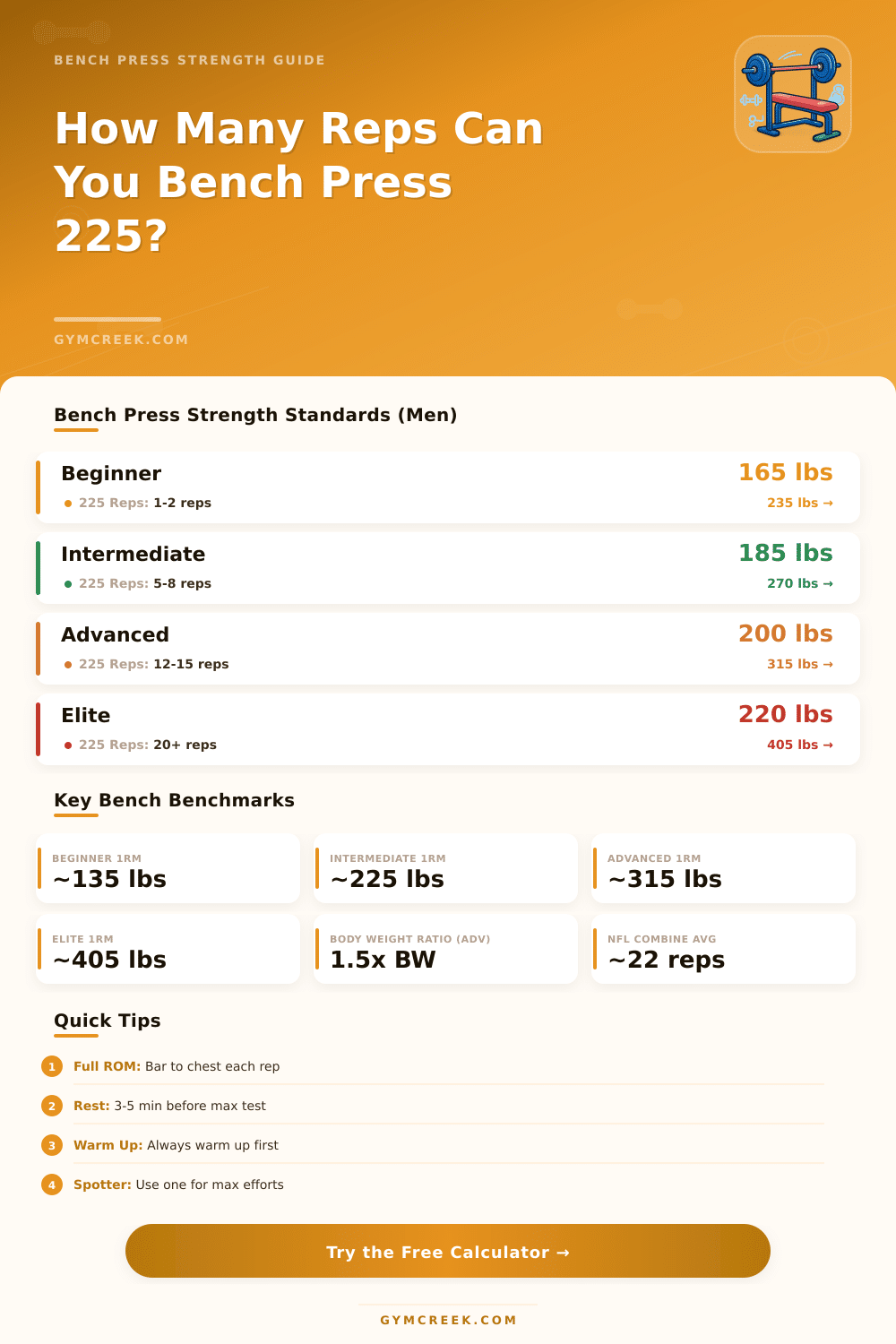
| Reps at 225 | Est. 1RM (lbs) | Est. 1RM (kg) | Strength Level |
|---|---|---|---|
| 1 | 225 | 102 | Baseline |
| 2 | 232 | 105 | Beginner |
| 3 | 240 | 109 | Beginner |
| 4 | 248 | 113 | Novice |
| 5 | 258 | 117 | Novice |
| 6 | 267 | 121 | Novice |
| 7 | 277 | 126 | Intermediate |
| 8 | 287 | 130 | Intermediate |
| 10 | 308 | 140 | Intermediate |
| 12 | 330 | 150 | Advanced |
| 15 | 361 | 164 | Advanced |
| 20 | 413 | 188 | Elite |
| 25 | 464 | 211 | Elite |
| 30 | 516 | 234 | World Class |
| Body Weight | Beginner 1RM | Intermediate 1RM | Advanced 1RM | Elite 1RM |
|---|---|---|---|---|
| 132 lbs (60 kg) | 95 lbs | 155 lbs | 215 lbs | 290 lbs |
| 148 lbs (67 kg) | 110 lbs | 175 lbs | 240 lbs | 320 lbs |
| 165 lbs (75 kg) | 125 lbs | 195 lbs | 265 lbs | 355 lbs |
| 181 lbs (82 kg) | 135 lbs | 215 lbs | 290 lbs | 385 lbs |
| 198 lbs (90 kg) | 145 lbs | 230 lbs | 315 lbs | 415 lbs |
| 220 lbs (100 kg) | 160 lbs | 250 lbs | 340 lbs | 450 lbs |
| 242 lbs (110 kg) | 170 lbs | 265 lbs | 360 lbs | 480 lbs |
| Body Weight | Beginner 1RM | Intermediate 1RM | Advanced 1RM | Elite 1RM |
|---|---|---|---|---|
| 110 lbs (50 kg) | 45 lbs | 75 lbs | 110 lbs | 150 lbs |
| 123 lbs (56 kg) | 50 lbs | 85 lbs | 120 lbs | 165 lbs |
| 132 lbs (60 kg) | 55 lbs | 90 lbs | 130 lbs | 175 lbs |
| 148 lbs (67 kg) | 60 lbs | 100 lbs | 145 lbs | 195 lbs |
| 165 lbs (75 kg) | 65 lbs | 110 lbs | 160 lbs | 215 lbs |
| 181 lbs (82 kg) | 70 lbs | 120 lbs | 175 lbs | 230 lbs |
| Goal | % of 1RM | Rep Range | Sets | Rest Period |
|---|---|---|---|---|
| Max Strength | 90-100% | 1-3 reps | 3-6 | 3-5 min |
| Strength | 80-90% | 3-5 reps | 4-6 | 2-4 min |
| Hypertrophy | 67-80% | 6-12 reps | 3-5 | 60-120 sec |
| Muscular Endurance | 50-67% | 12-20 reps | 2-4 | 30-60 sec |
| Conditioning | 40-55% | 20+ reps | 2-3 | 30-45 sec |
If your 1RM is 225 lbs, that IS your 1RM (100%). If your 1RM is 315 lbs, 225 is ~71% — ideal for hypertrophy sets of 8-10 reps. If your 1RM is 405 lbs, 225 is ~56% — suitable for endurance sets of 15-20+ reps.
The NFL Combine bench press test uses exactly 225 lbs. The all-time combine record is 51 reps (Justin Ernest, 1999). Offensive/defensive linemen typically average 22-35 reps. Skill position players (QB, WR) average 10-18 reps. This test primarily measures muscular endurance, not max strength.
The Bench Press is an exercise with weights, where one presses the weight upward, while one lies on a bench. One lowers the weight until the level of the chest and later pushes it upward, while one extends the arms. For this move one can use a bar or pair of free weights.
DISCLOSURE: This post may contain affiliate links, meaning when you click the links and make a purchase, I receive a commission. As an Amazon Associate I earn from qualifying purchases.

That exercise is compound. It mainly works the big chest muscles, the front shoulder muscles and the triceps. Also the core activates during it.
How to Do the Bench Press
The Bench Press probably uses more muscle mass in the upper body than any other exercise for that part. During the move the main target is to create force at the joint of the elbow.
Good form is key for avoiding injuries. Before removing the bar from the support, prepare everything properly. The blades of the shoulders should be fully squeezed, and the back should be flat.
The feet can press against the bench for help to rise. Deep breath before pressing the bar strengthens the belly wall. If one imagines bending the bar in U-shape by means of the hands, the elbows can move naturally.
That engages the back muscles and protects the shoulders. Hold the breath until past the hard spot of the press, and later breathe out forcefully while you push.
For the position of the feet, narrower step and pressure of the bench by means of the legs strengthen the stability. Turn the toes slightly outside also helps against side moves. The tension in the upper back is much more important than arching of the lower back.
Reaching the farthest back possible and drawing the shoulder blades down, while one pushes the chest toward the ceiling, is a good method.
A station for Bench Press is a basic element in every gym. Benches for training provide firm support and should feel solid and sturdy. There are flat benches and regular benches.
Both work for the usual Bench Press, but regular benches are needed four incline or decline variations.
Using various exercises, like incline barbell Bench Press or decline dumbbell Bench Press, one can reach the chest from different directions. Failing halfway during the press commonly shows weak shoulder muscles. Failing at the chest usually points to weak chest muscles or back muscles, and adding dumbbell Bench Press sets with heavier weights can help.
Training the Bench Press three times weekly with different sets of reps and high volume is an efficient mode. Changing the sets, reps and weights surprises the body and helps to pass plateaus. Controlled reps are more important than too heavy weights with bad form.
Exercises like JM-presses and skull-crushers give better carryover than presses for triceps. Dumbbells are a good replacement for the bar, although one usually can lift less weight because of their reduced stability. You normally use lessweight on incline bench than on flat.
That simply is natural, so do not worry about it.