Calories Burned Tabata Calculator
Estimate Tabata calorie burn from work and rest intervals, rounds, blocks, movement type, intensity, body weight, and EPOC uplift so a classic 20:10 bodyweight circuit does not read the same as an air bike sprint block.
📌Tabata Presets
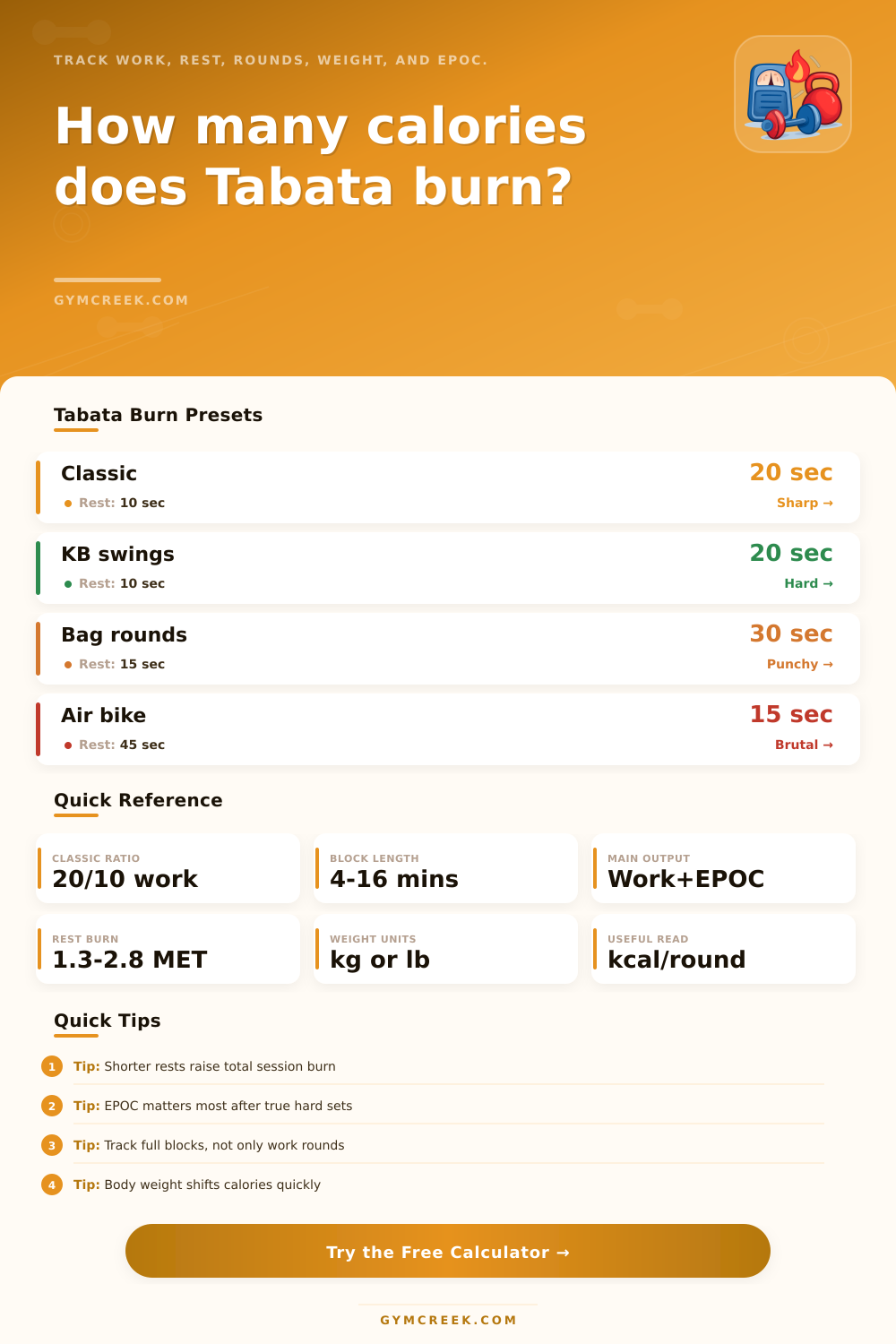
These nine presets load realistic Tabata setups, from classic one-block protocols to repeat sprint blocks with longer between-block recovery, so interval density and EPOC can move with the session.
⚙Tabata Inputs
Tabata calorie snapshot
Enter your interval details to estimate work calories, recovery calories, and EPOC lift.
📊Tabata Metrics
📑Reference Tables
| Blocks | Clock time | Total kcal | Read |
|---|---|---|---|
| 1 | --- | --- | Single |
| 2 | --- | --- | Repeat |
| 3 | --- | --- | Long |
| 4 | --- | --- | Extended |
| Movement | Moderate | Very hard | Best fit |
|---|---|---|---|
| Bodyweight circuit | 8.2 MET | 12.2 MET | Squats, burpees, pushups |
| Kettlebell swings | 8.6 MET | 12.6 MET | Ballistic hip-hinge rounds |
| Air bike sprint | 9.2 MET | 13.8 MET | Full-body fan bike bursts |
| Rowing erg | 8.8 MET | 12.8 MET | Short hard row repeats |
| Battle ropes | 9.0 MET | 13.2 MET | Wave and slam intervals |
| Heavy bag boxing | 8.1 MET | 12.1 MET | Punch flurries and footwork |
| Dumbbell complex | 8.4 MET | 12.4 MET | Continuous loaded combos |
| Hill sprint repeats | 9.5 MET | 14.1 MET | Short uphill accelerations |
| Pattern | Work/rest | Density | Typical use |
|---|---|---|---|
| Classic Tabata | 20 sec / 10 sec | 67% work | Short explosive conditioning |
| Extended push | 30 sec / 15 sec | 67% work | Bag rounds and circuits |
| Sprint saver | 15 sec / 45 sec | 25% work | Peak bike or hill power |
| Strength burst | 20 sec / 20 sec | 50% work | Loaded complexes with control |
| Setting | Base add-on | How it acts | Best when |
|---|---|---|---|
| No extra | 0% | Counts only session minutes | You want direct work only |
| Light | 4% | Small post-work bump | Controlled intervals |
| Standard | 7% | Balanced afterburn lift | True hard Tabata blocks |
| High | 10% | Larger oxygen debt estimate | Very hard repeat efforts |
| Lab-range | 13% | Upper-end estimate | Near-max sprint sessions |
💡Tabata Tips
Tabata is a form of exercise that use specific timing for the work and rest period to create a metabolic effect in the body. One form of Tabata exercises eight rounds of twenty seconds of exercise and ten seconds of rest. Because the length of a Tabata exercise is less than five minute, individuals may wonder if the exercise burn enough calories.
The number of calories burned during a Tabata exercise depend upon the intensity of the exercise, the movements performed, and the metabolism of the body. Izumi Tabata developed the Tabata exercise as a result of scientific research. Tabata performed research on speed skaters, asking the speed skaters to perform high-intensity cycling effort for periods of four minutes.
How Many Calories Does Tabata Burn?
Each of those four-minute periods consisted of twenty seconds of cycling at near-maximum intensity with ten seconds of recovery. As a result of these efforts, the researchers discover that the body entered a state known as Excess Post-exercise Oxygen Consumption, or EPOC. During EPOC, the body continues to burn calorie even after the Tabata exercise has been performed.
Because this state can last for several hour, the five-minute Tabata exercise can burn more calories than longer forms of exercise. An individual can manipulate the density of a Tabata exercise by changing the rest period of the exercise. If an individual reduce the amount of rest performed or increases the amount of effort required during the exercise, the density of the exercise increase.
For instance, an individual could increase the density of the exercise by walking during the ten-second rest periods instead of standing still. The type of exercise performed will also impact the number of calories burned during a session. For instance, performing Tabata exercises with body weight squats will burn a different number of calorie than if the individual performed Tabata exercises on an air bike.
Additionally, the heavier the individuals body weight, the more calorie will be burned. The intensity level of the exercise will impact the number of calories burned. If an individual performs sprint at near-maximum intensity, they will burn more calories than if they perform only moderate intensity movements.
Because the intensity of the exercise impacts the number of calories burned, individuals should choose an aggressive estimate of the intensity of the exercise if they plan to perform Tabata exercises that leave the individuals feeling exhausted. Conversely, individuals should choose a light estimate of the intensity if the exercise involve only controlled movements. Many individuals dont perform only one Tabata exercise block.
Instead, individuals may perform two block of Tabata exercises with a ninety-two second rest period in between the two block. By performing two block of exercises with a rest period in between, the total length of the exercise increases. Additionally, due to the burn out of the bodys energy store during the exercise, the body will begin to adapt to the exercise and burn more calories during the Tabata exercise.
These variable, along with the total length of each block of exercise, the individual performing the exercises can record. The ratio of work to rest period will indicate the density of the exercise. A work period of twenty seconds with a rest period of ten second indicates a high density of exercise.
However, a work period of fifteen second with a rest period of forty-five second indicates a lower density of exercise. Another factor that can impact the calories burned during a Tabata exercise is the recovery style. Standing still during the rest period will result in the lowest metabolic equivalent to the task of performing the exercises.
However, if the individual performs light movement during the rest periods, such as shuffling or cycling at a slow rate, the metabolic equivalent for the rest period will increase. Although the number of calories burned during the rest period is minimal, the additional number of calories will increase over the length of numerous Tabata exercise round. Additionally, an individual’s age will impact their heart rate while performing the exercise.
Athletes of younger age will reach high zone for their heart rate more easily than older athletes. As a result, athletes of an older age may reach high zone for their heart rates without requiring a high level of physical speed. Another factor that can impact the bodys ability to perform efficient during a Tabata exercise is the technique used to perform the exercises.
If the individual performs the exercises with sloppy technique, their intensity will drop. If their intensity drop, the calories that are burned and the EPOC effect will decrease. While there are wearable technology that can measure the intensity of an individuals performance of the exercises, these device may not always accurately measure the calories burned during the exercise.
As a result, individuals can increase their ability to benefit from the Tabata exercise routine if they can increase their consistency in performing these exercises. Additionally, the individual’s population may impact how they experience a Tabata exercise routine. For example, women may burn fewer calorie than men during the same routine due to the mass of the womans body.
However, both men and women experience similar intensity. Additionally, individuals that are just beginning to perform Tabata exercises may experience a higher percentage of EPOC than those of professional athleticism. Finally, the environment in which the exercises are performed may impact the ability of the body to exercise efficient.
For instance, performing the exercise in a hot environment will place more demand upon the body than if the individual were to exercise in a cool environment. Additionally, the nutrition of the individual may impact the performance of the exercises. For instance, performing the exercises in a fasted state will increase the bodys fat oxidation even if the total number of calorie consumed during the day remains the same.
To avoid mistake in performing a Tabata exercise routine, individuals should not attempt to maximize the EPOC during every session. If an individual maximize the intensity of the exercise every day, they may experience overtraining. Instead, individuals can increase the variety of the intensity of the exercise.
Additionally, individuals can keep track of the number of calories burned during the exercise, as well as the total length of the exercise and the calories that are burned per round of exercise. By keeping these variable tracked over several week, individuals can determine if shorter rest periods are increasing the individuals ability to perform the exercise well or if they are making the exercise more difficult to perform. They should of also consider the total calories.