Cycling Cadence Calculator
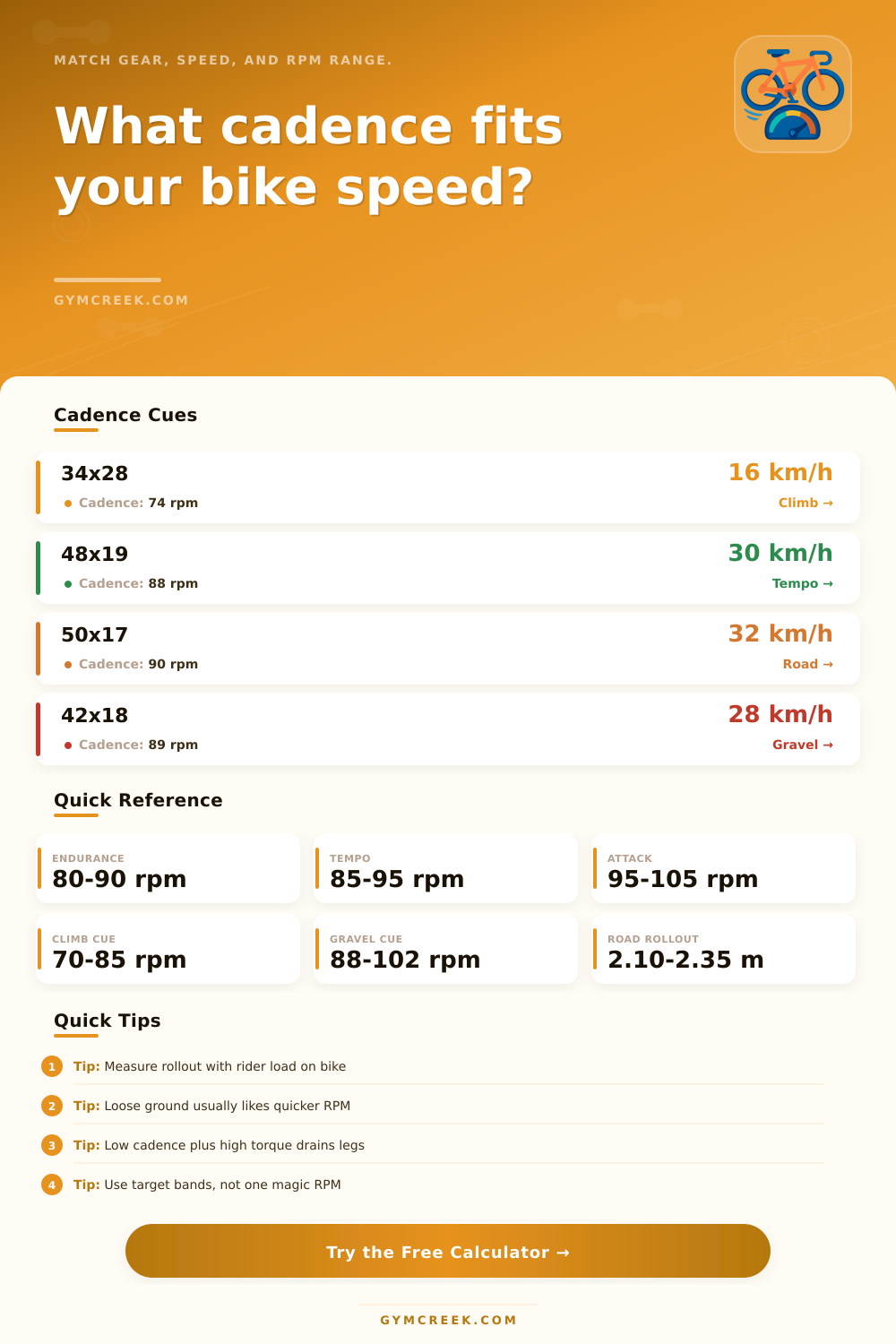
Translate target speed into real pedal RPM using your selected gear, measured wheel rollout, terrain load, and work-zone bias so your pacing plan feels realistic before the ride starts.
📌Ride Presets
Each preset drops in a believable speed, gear, wheel size, terrain, zone, and cadence band so you can compare a climbing cadence, gravel rhythm, or fast-road target in seconds.
⚙Cadence Inputs
Speed-to-RPM match
Enter ride details to compare required cadence with a usable target window.
📊Ride Metrics
📑Reference Tables
| Cadence | Km/h | Mph | Fit |
|---|---|---|---|
| 70 rpm | --- | --- | Check |
| 80 rpm | --- | --- | Check |
| 90 rpm | --- | --- | Check |
| 100 rpm | --- | --- | Check |
| 110 rpm | --- | --- | Check |
| Terrain | Bias | Why | Use |
|---|---|---|---|
| Smooth flat | 0 rpm | Neutral load | Base line |
| Rolling road | +1 rpm | Faster resets | Rhythm |
| Steady climb | -4 rpm | More torque | Seat push |
| Long headwind | +3 rpm | Save joints | Spin up |
| Loose gravel | +5 rpm | Traction help | Stay light |
| Technical trail | +7 rpm | Quick control | Keep moving |
| Zone | Bias | Typical feel | Prompt |
|---|---|---|---|
| Z1 recovery | +4 rpm | Easy legs | Flush fatigue |
| Z2 endurance | +2 rpm | Steady aerobic | Stay smooth |
| Z3 tempo | 0 rpm | Neutral load | Hold line |
| Z4 threshold | +3 rpm | Heavy but clean | Protect knees |
| Z5 VO2 | +6 rpm | Fast turnover | Lift cadence |
| Z6 sprint | +9 rpm | Explosive acceleration | Explode fast |
| Band | Range | Bias | Best fit |
|---|---|---|---|
| Torque saver | 70-80 | Lower spin | Climbing |
| All-day | 80-90 | Balanced | Long rides |
| Tempo | 85-95 | Steady work | Road pace |
| Fast spin | 90-100 | Quick legs | Headwind |
| Attack | 95-105 | Higher snap | Bridges |
| Overspeed | 105-115 | Max spin | Sprint drills |
💡Cadence Tips
Cadence is the measurement of the numbers of revolutions of the pedals in a minute. The cadence of a cyclist is often referred to as the RPM of that cyclist. Cadence is one of the most critical measurement in cycling as it determine how a cyclist utilizes energy and muscle groups when cycling.
Cycling at the wrong cadence for the terrain or the gear a cyclist is utilizing will lead to fatigue more quickly than if cycling at the correct cadence. Cadence and physical fatigue are link in how much force a cyclist apply to the pedals. When a cyclist utilize a low cadence, the cyclist must apply more torque to the pedals.
What is cadence and why it matters in cycling
More torque means that the cyclist utilizes more strength in the leg muscles. Cycling at a low cadence will fatigue the cyclists leg muscles quickly. Conversely, cycling at a high cadence requires less of force application to each pedal stroke.
However, cycling at a high cadence requires more aerobic capacity from the cyclists legs to cycle at such a high rate. Terrain has an impact on the ideal cadence and the ideal gear selection for a cyclist. For cyclists on smooth asphalt, a cyclist can maintained a steady cadence.
For cyclists on gravel, a higher cadence will help keep the tires in traction with the ground. If a cyclist slowly pedal on gravel, the tires may lose traction from the ground. For cyclists who are climbing hills, a cyclist can utilize a lower cadence as it takes more force to climb a hill.
Many cyclists, however, prefer to utilize a higher cadence when they are climbing to minimize the strain on there leg muscles. The gear a cyclist utilize and the size of the wheels will impact the cadence a cyclist must utilize. The gear selection will determine the number of revolutions of the pedals that a cyclist will need to make in order to maintain a certain speed.
The size of the wheel will impact the distance that a cyclist will travel with one revolution of the wheel. Factors such as the tire pressure and the weight of the cyclist will impact the rollout of the wheel. The cyclist can measure the rollout of the wheel while sitting on the bicycle.
Cadence can be varied for cycling in different effort. For endurance cycling, steady pedals is used. For threshold cycling, a neutral cadence is utilized.
For sprint cycling or VO2 max cycling, a high cadence is required for the cyclist to move at a high rate with their legs. Cadence drills can be used to improve a cyclists cycling efficiency. High cadence cycling drills can strengthen a cyclists ability to move there legs at a high rate.
Low cadence drills can improve the strength in a cyclists legs. Using a cadence sensor for cycling will allow a cyclist to track their cadence while cycling. If a cyclist notices that their cadence begins to drop while cycling, that cyclist is likely experiencing fatigue.
The cyclist will need to adjust there gear or there cadence to match there terrain or its bodys need.