Yoga Calorie Burn Calculator
Estimate yoga calories from class style, body weight, session length, average effort, pose-hold share, resets, and movement rhythm so yin, steady hatha, and stronger flow work stop landing on the same number.
📌Class Presets
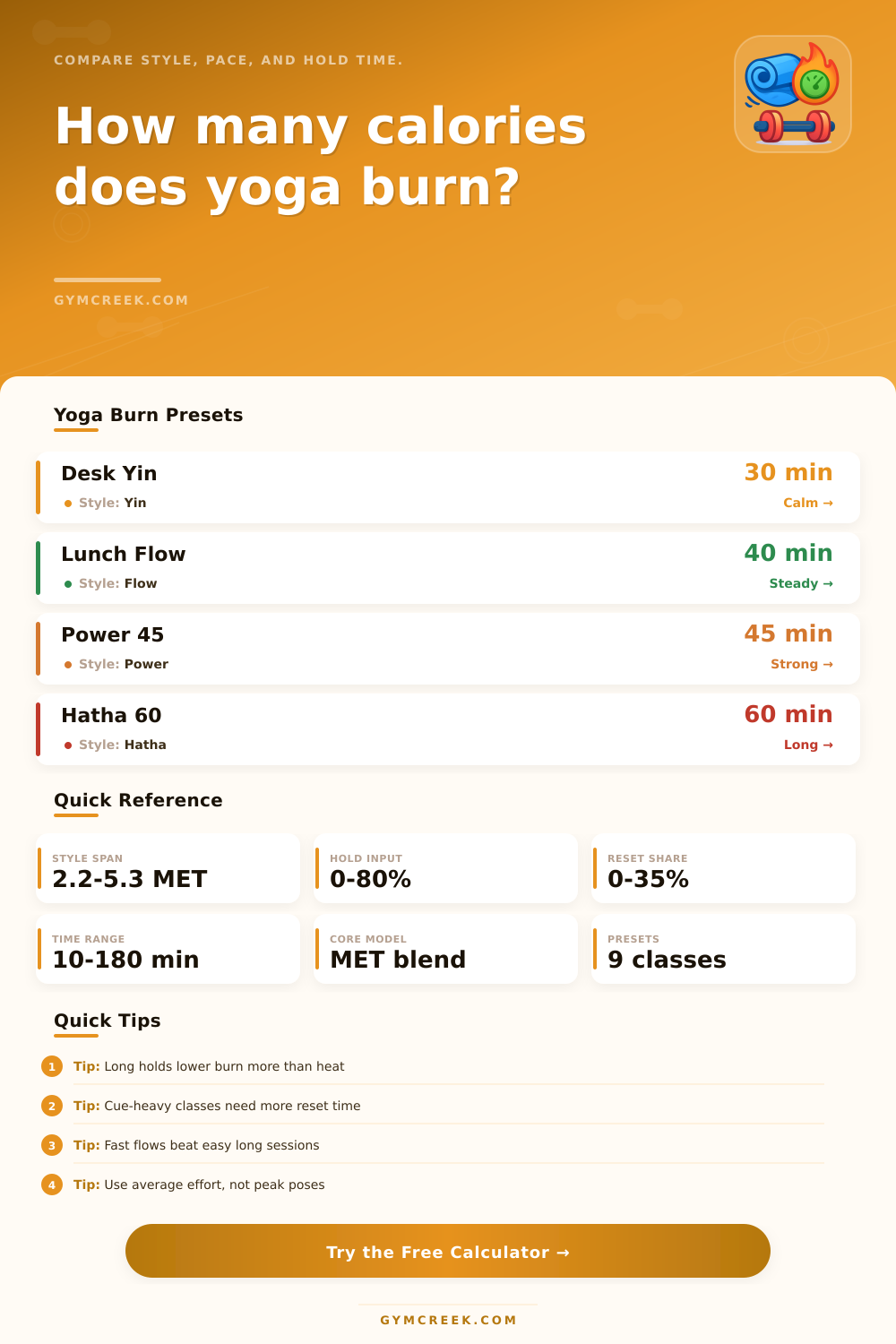
These nine presets range from quiet floor-heavy sessions to denser power flows, so hold time, transition rhythm, and real reset minutes all change the estimate for sensible yoga-specific reasons.
⚙Yoga Inputs
Yoga calorie snapshot
Enter your class details to estimate movement calories and how much your style differs from a hatha-style baseline.
📊Yoga Metrics
📑Reference Tables
| Duration | Total kcal | Moving kcal | Read |
|---|---|---|---|
| 30 min | --- | --- | Quick |
| 45 min | --- | --- | Base |
| 60 min | --- | --- | Long |
| 75 min | --- | --- | Studio |
| Style | Base MET | Focus | Typical feel |
|---|---|---|---|
| Restorative | 2.2 | Support and stillness | Very calm |
| Yin | 2.5 | Long tissue holds | Slow and deep |
| Hatha | 3.0 | Classic pose practice | Measured pace |
| Slow flow | 3.5 | Linked but unhurried | Warm steady pace |
| Vinyasa | 4.1 | Breath-linked transitions | Fluid movement |
| Ashtanga | 4.8 | Set sequence intensity | Strong repeat work |
| Power yoga | 5.3 | Strength-biased flow | Higher output |
| Pattern | Factor | What changes | Best fit |
|---|---|---|---|
| Long holds | 0.91x | More time under stillness | Yin or slower hatha |
| Balanced flow | 1.00x | Normal pose-to-pose rhythm | Most group classes |
| Continuous flow | 1.08x | Fewer full stops | Vinyasa sessions |
| Repeat ladder | 1.14x | Extra rounds and repeats | Power and ashtanga |
| Lever | Band | Model effect | Good fit |
|---|---|---|---|
| Hold share | 0-20% | Raises dynamic styles most | Flow-heavy practice |
| Hold share | 21-40% | Stays near class baseline | Balanced classes |
| Hold share | 41-60% | Trims moving MET modestly | Hatha and yin mixes |
| Hold share | 61-80% | Pulls active burn down | Long-hold sessions |
| Reset share | 0-5% | Nearly all minutes active | Dense led flow |
| Reset share | 6-12% | Normal cueing allowance | Most studio classes |
| Reset share | 13-20% | More demos and recovery | Learning phases |
| Reset share | 21-35% | Cuts active time sharply | Workshops or gentle classes |
💡Yoga Tips
Calculating the number of calories burn during a yoga class is a complex calculation due to the fact that a yoga class are not the same for every individual. While many may use general estimates to calculate the number of calories that an individual will burn during a yoga class, those estimates is often inaccurately in reflecting the calories that an individual burns due to the fact that the estimates dont account for an individual’s weight, movement style, and effort level during the class. To understand the number of calories burned during a yoga class, it is first important to gain an understanding of the concept of metabolic equivalent (METs).
METs is a measurement of the amount of energy that an individual burns during a particular activity in comparison to the amount of energy that an individual burns while sitting still. Different styles of yoga has different MET values, as a result of the different amount of physical exertion that each of those styles requires of an individual. For instance, restorative yoga classes has low MET values of around 2.2, as they involve gentle movement or no movement at all for long periods of time.
What Affects How Many Calories You Burn in Yoga
In contrast, power yoga classes have more higher MET values of around 5.3, as they involve more physical exertion and movement than other forms of yoga. The number of calories burned during yoga is also affect by the number of pose-holds included during the class. Yoga classes that include poses that is held for long periods of time, such as Yin yoga poses, will burn fewer calories than classes that include poses that require more movement, such as Vinyasa poses.
Furthermore, the amount of time that the yoga instructor is spending providing instructions or performing the poses itself will affect the number of calories that are burned during the class. When the instructor is demonstrating poses or providing instructions for the poses, the student often take breaks from performing the poses required of them during the class; the more breaks from performing poses, the fewer calories will be burned during the class as a result. Thus, it is important to account for the number of “resets” that occur during the class of yoga instructor; resets are periods during which the body is not performing any active work.
Another factor that can impact the number of calories burned during a yoga class is the weight of an individual; the greater the body mass of an individual, the more calories that will be burned during the class as a result of the body mass that must be moved. For instance, an individual that weighs 170 pounds will burn more calories during a yoga class than an individual that weighs 120 pounds; the individual of 170 pounds has more body mass to move during the class. Thus, body weight is another critical factor in calculating the calories burned during a yoga class.
Additionally, the level of experience with yoga can impact the number of calories burned during a yoga class. An experienced yoga instructor may be able to move through the poses more quick than an individual that is beginning to learn yoga poses; thus, the more experienced individual will burn more calories than the beginner. In order to calculate the calories burned during a yoga class for an individual, it is recommended to use the individual’s average level of effort rather than the individual’s peak level of effort during the class.
The effort level should not be based off the number of poses that is the most difficult to perform during the class; additionally, the location of the yoga class may factor into the number of calories burned by an individual during the class. For instance, individuals may burn more calories during a hot yoga class than during a yoga class that does not heat the room to such high temperatures; however, the increased sweating that occur during a hot yoga class is not directly related to the burning of more calories by the individual. Thus, in calculating the number of calories burned by an individual during a yoga class, it is important for the individual to provide honest and accurately inputs into the calculation.
Furthermore, the individual should use its actual body weight and actual level of effort during the class to ensure that the calculation of the number of calories burned will be useful. By understanding these various factors that impact the number of calories that are burned during a yoga class, it is possible to determine an accurate number of calories that an individual burned during there specific yoga class.