🏋 Bench Press Bar Weight Calculator
Calculate total bar weight or find which plates to load — supports all bar types
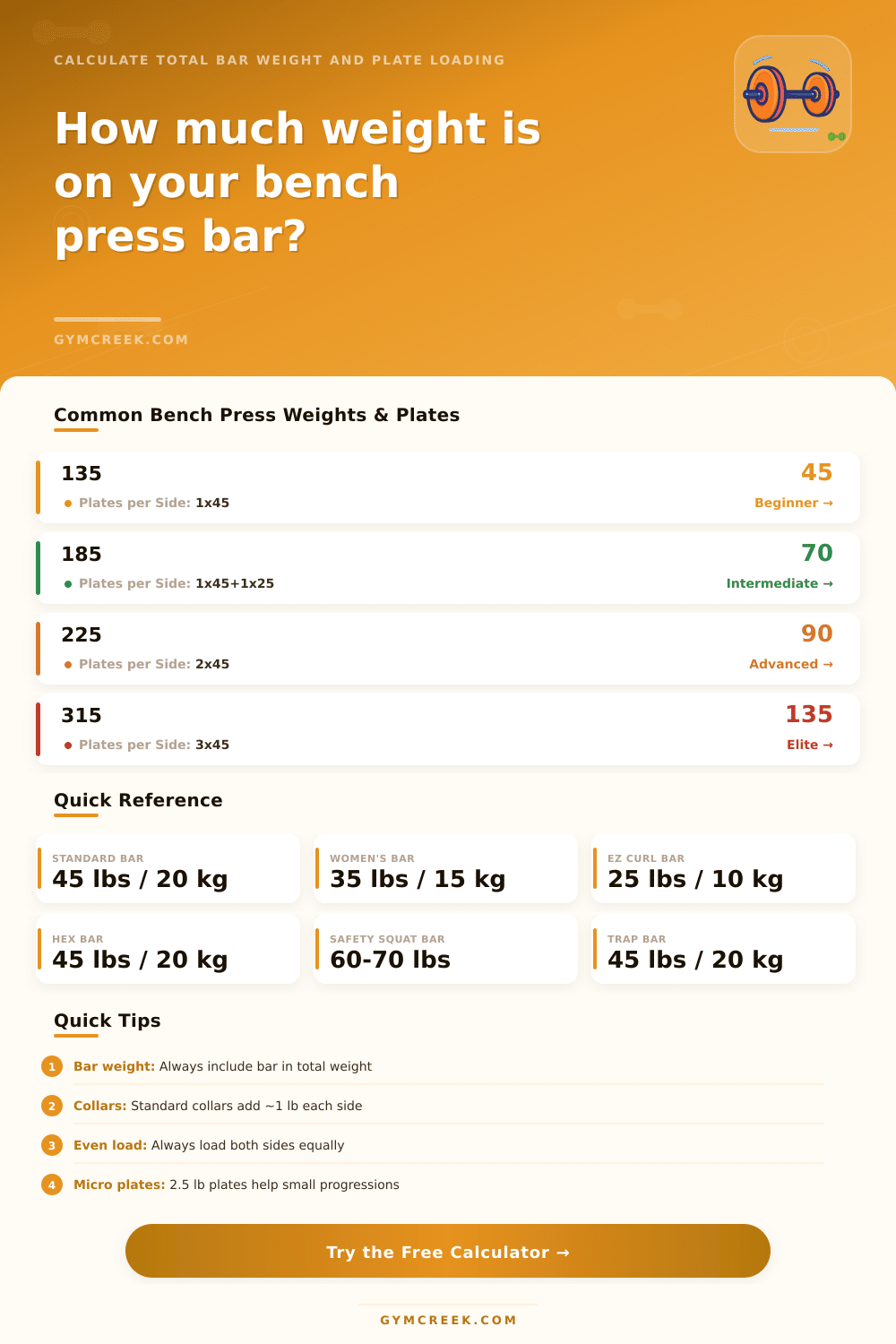
| Total (lbs) | Total (kg) | Per Side (lbs) | Plates per Side |
|---|---|---|---|
| 95 | 43.1 | 25 | 1×25 |
| 115 | 52.2 | 35 | 1×25 + 1×10 |
| 135 | 61.2 | 45 | 1×45 |
| 155 | 70.3 | 55 | 1×45 + 1×10 |
| 185 | 83.9 | 70 | 1×45 + 1×25 |
| 205 | 93.0 | 80 | 1×45 + 1×35 |
| 225 | 102.1 | 90 | 2×45 |
| 245 | 111.1 | 100 | 2×45 + 1×10 |
| 275 | 124.7 | 115 | 2×45 + 1×25 |
| 315 | 142.9 | 135 | 3×45 |
| Bar Type | Weight (lbs) | Weight (kg) | Notes |
|---|---|---|---|
| Standard Olympic Bar (Men's) | 45 lbs | 20 kg | Most common for bench press |
| Women's Olympic Bar | 35 lbs | 15 kg | Shorter, thinner, lighter |
| EZ Curl Bar | 25 lbs | 10–11 kg | Angled grips, used for curls |
| Safety Squat Bar | 60–70 lbs | 27–32 kg | Cambered bar, specialty use |
| Hex / Trap Bar | 45–60 lbs | 20–27 kg | Hexagonal frame, deadlifts |
| Plate (lbs) | Plate (kg) | Color (standard) | Use |
|---|---|---|---|
| 55 lbs | 25 kg | Red | Heavy loading |
| 45 lbs | 20 kg | Black / Blue | Standard heavy |
| 35 lbs | 15 kg | Yellow | Medium loading |
| 25 lbs | 10 kg | Green | Medium loading |
| 10 lbs | 5 kg | White / Gray | Fine adjustment |
| 5 lbs | 2.5 kg | White | Fine adjustment |
| 2.5 lbs | 1.25 kg | Silver | Micro-loading |
The Bench Press is an exercise with weights, where one pushes the Weight upward, while lying on a bench for training weights. One lowers the Weight until the level of the chest then pushes it upward while stretching the arms. For this move, one can use a Bar or two dumbbells.
That exercise works several muscles at once. It mainly works the big chest muscles the front shoulder muscles and the triceps. Also the core gets work.
How to Do the Bench Press
Because it uses so many muscle groups, it ranks between the most useful for building the force of the upper body and the muscular size. Here the upper body exercise, by means of that one can raise the biggest Weight.
Good technique is important. Before removing the Bar, the position already should be ready. The back stays pressed against the bench, the shoulders drawn together and the feet push against the bench for help the move upward.
While lowering the Bar, the feet stay flat on the floor and do not move. One takes deep breath before lowering the Weight, and use it for tightening the abs for beter stability. Imagine, that one bends the Bar in U-form, help the elbows move naturally, what works the back muscles and protect the shoulders.
The breath one keeps until passing the most difficult part of the press, then breathe out while push upward.
About the position of the feet, narrower stance with the legs pressed against the bench can strengthen the stability, especially if the feet are turned a bit below. Straighten the toes outside help for better side balance.
If one fails in the middle of the press, commonly that shows weak front shoulder muscles. Failure at the chest usually points too weak chest muscles or back muscles. The press with dumbbells and heavier exercises can help beat those limits.
Moves as the JM-press and skullcrushers affect more well the Bench Press then the tricep pushes down.
Train the Bench Press three times weekly, with various sets and enough amount, is good method. Use both ranges for muscular growth, of eight until twelve reps, and for endurance, of fifteen until thirty; during four until six weeks, help for lasting progress. More important is control the reps well than raise Weight with bad form.
Lifting for show force with mistakes in the technique commonly stops the progress.
Dumbbells work well as replacement for the Bar, although the lifted Weight probably will be less because of the less stable move. Stronger chest and triceps from the Bench Press can ease the performance of push-ups, handstand push-ups and muscle-ups. Combine the flat Bench Press with Bar by means of inclined and declined versions reach the chest from various directions and work the upper, middle and bottom parts of the chest.
Some folks find, that the Bench Press works more in their triceps than in the chest, especially at first. That is entirely normal. The Bench Press does give strong tension to the chest, but does not reach full squeeze, because the elbow does not go before the chest.
Actually, the pressure on the chest drops, when the Weightraised goes more high.