🏋 Sinclair Calculator
Compare your Olympic weightlifting total across all body weight categories using the official IWF Sinclair formula
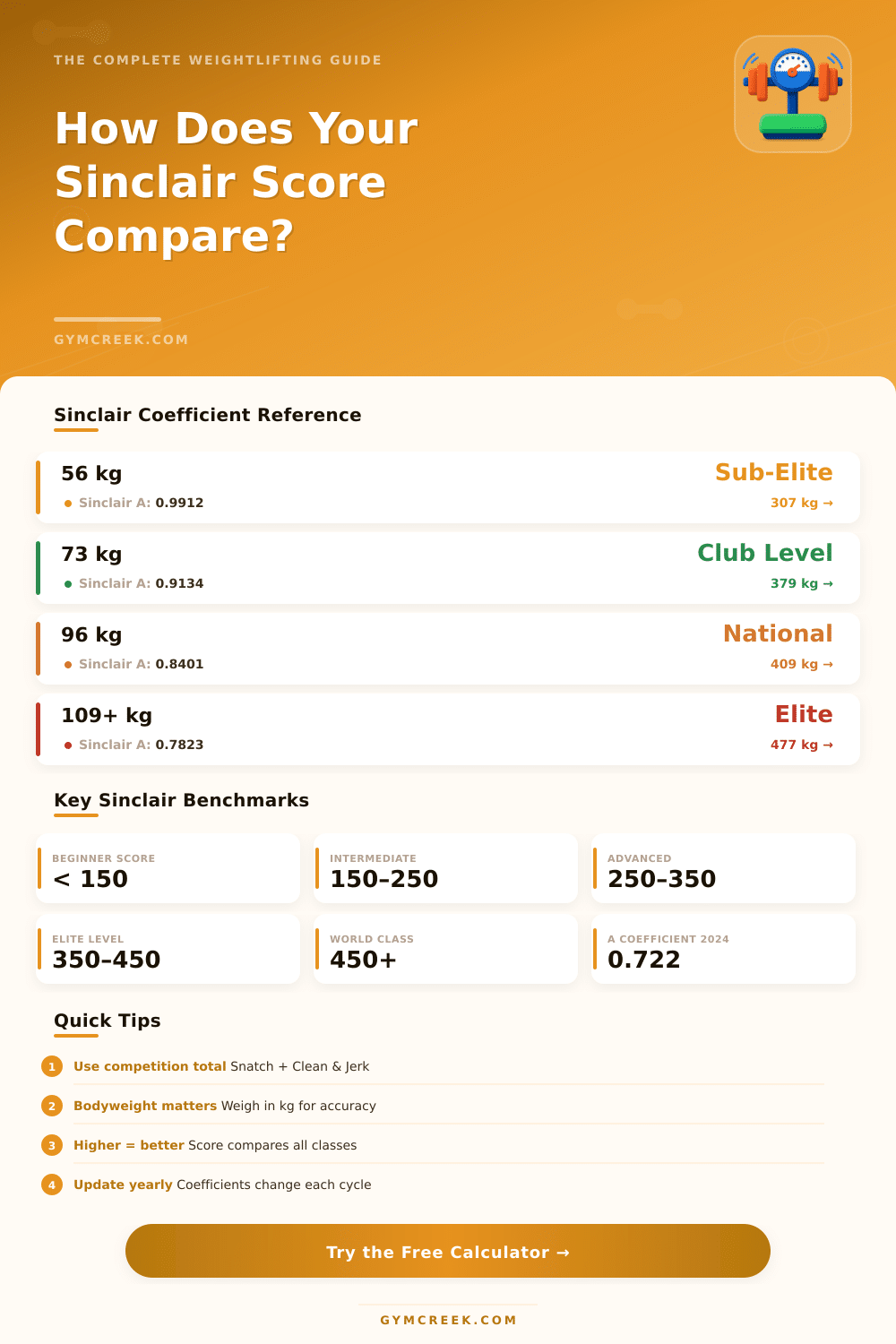
| Gender | A Coefficient | b (kg) | Cycle |
|---|---|---|---|
| Male | 0.722762521 | 175.508 | 2024–2028 |
| Female | 0.787004341 | 153.655 | 2024–2028 |
| Level | Male Score | Female Score | Description |
|---|---|---|---|
| Beginner | < 100 | < 80 | First year of training |
| Novice | 100–180 | 80–140 | 1–2 years consistent training |
| Intermediate | 180–260 | 140–200 | Club competitor, 2–4 years |
| Advanced | 260–340 | 200–270 | Regional / national qualifier |
| Elite | 340–420 | 270–340 | National / international level |
| World Class | 420+ | 340+ | Olympic / World Championship podium |
| Weight Class | Qualifying Total | World Record Total | Sinclair WR |
|---|---|---|---|
| 55 kg | 215 kg | 294 kg | ~399 |
| 61 kg | 240 kg | 318 kg | ~412 |
| 67 kg | 265 kg | 344 kg | ~424 |
| 73 kg | 288 kg | 379 kg | ~443 |
| 81 kg | 318 kg | 393 kg | ~437 |
| 89 kg | 340 kg | 412 kg | ~437 |
| 96 kg | 362 kg | 433 kg | ~440 |
| 102 kg | 376 kg | 442 kg | ~438 |
| 109 kg | 390 kg | 477 kg | ~458 |
| +109 kg | 410 kg | 484 kg | ~437 |
| Weight Class | Qualifying Total | World Record Total | Sinclair WR |
|---|---|---|---|
| 45 kg | 148 kg | 198 kg | ~367 |
| 49 kg | 163 kg | 213 kg | ~371 |
| 55 kg | 185 kg | 240 kg | ~383 |
| 59 kg | 198 kg | 255 kg | ~385 |
| 64 kg | 214 kg | 272 kg | ~388 |
| 71 kg | 236 kg | 294 kg | ~393 |
| 76 kg | 250 kg | 307 kg | ~394 |
| 81 kg | 263 kg | 319 kg | ~396 |
| 87 kg | 275 kg | 335 kg | ~399 |
| +87 kg | 287 kg | 348 kg | ~385 |
| Ratio (Sn/C&J) | Interpretation | Common Cause |
|---|---|---|
| < 76% | Snatch lagging behind | Technique or mobility issue |
| 76–79% | Slightly low | Snatch needs more volume |
| 80–83% | Optimal range | Balanced program |
| 84–87% | Slightly high | C&J needs more volume |
| > 87% | C&J lagging behind | Technique or strength issue |
• Use your official competition body weight (weighed in at the official weigh-in).
• Enter your best successful lifts from official competition, not training maxes.
• Imperial inputs are converted to kg before applying the Sinclair formula as the IWF uses metric.
• The Sinclair score is only meaningful for the current 4-year Olympic cycle coefficients.
The Sinclair calculator helps in olympic weightlifting to compare lifters from various weight classes. It takes the total of the athlete which is the amount of the maximum press and pull, and multiplies that by the Sinclair coefficient. Like this one gets the Sinclair total.
The bigger this total the better the result according to the standard scale.
How the Sinclair calculator works for weightlifting
The main idea behind it matches a basic question. What total would an athlete have, if they competed in the heaviest category with same skill? The core of the method is simple: one multiplies the real total by the Sinclair coefficient, which gives the Sinclair total.
Thanks to that one can compare the totals of lifters from different weight classes, for men and for women.
The Sinclair coefficient itself needs more complex math. It divides the total raised weight by 10 raised to a certain power. This power comes form the difference between a coefficient tied to the world record total in the heaviest class and another pattern, that ties to the spread of world records from the most lightweight to the heaviest categories, combined with the base 10 logarithm of the body weight of the athlete.
The IWF uses this measure to compare lifters from various wait classes.
Online Sinclair calculators simplify everything. You just give the sex, the body weight and the raised weight, and the device itself computes the points or the total. Some versions add age correction for masters lifters.
The coefficients get updated for every olympic cycle. For instance, there are versions for the period 2013, 2017 and for the season 2021, 2024. Different values for A and B count for every phase, and they show the Sinclair coefficients for every Olympics sinceatleast 2009.
Some programs let you also experiment with guesses, for instance see, what total would result with a bit less body weight or better press.
Now, the name Sinclair relates also to something entirely different… To Sinclair calculators as those electronic devices. Clive Sinclair was an electronic genius known for small devices.
In United Kingdom one knew him chiefly as the inventor of the pocket calculator. The first Sinclair calculators used the chip TMS1802 from Texas Instruments. Since 1971, Texas Instruments offered single chip building blocks, and the chip set TMS0803 appeared in several Sinclair calculators.
Clive Sinclair wanted to create a calculator that competed with the HP-35 using this series of chips. One later model from Sinclair Radionics had a plastic case with eighteen rectangular buttons, including figures, math operations, decimal spot and memory key. The Sinclair science calculator appeared in 1974.