🔥 Weekly Calorie Deficit Calculator
Calculate your ideal daily & weekly calorie deficit for safe, effective weight loss
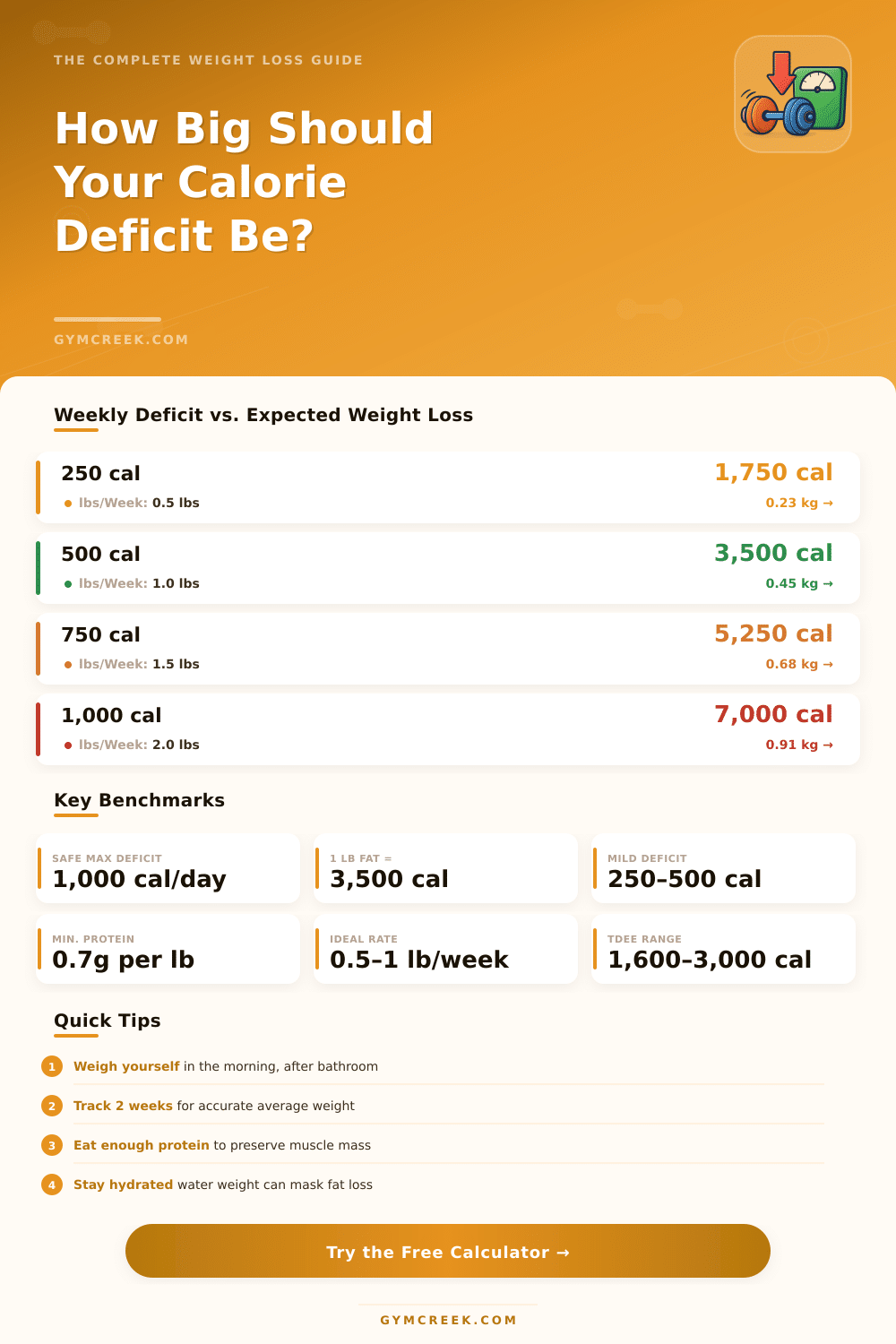
| Daily Deficit | Weekly Deficit | Loss / Week (lbs) | Loss / Week (kg) | Rate |
|---|---|---|---|---|
| 250 cal | 1,750 cal | 0.5 lbs | 0.23 kg | Mild |
| 500 cal | 3,500 cal | 1.0 lb | 0.45 kg | Standard |
| 750 cal | 5,250 cal | 1.5 lbs | 0.68 kg | Moderate |
| 1,000 cal | 7,000 cal | 2.0 lbs | 0.91 kg | Aggressive |
| Activity Level | Multiplier | Exercise Frequency | Examples |
|---|---|---|---|
| Sedentary | × 1.2 | None | Desk job, no exercise |
| Lightly Active | × 1.375 | 1–3 days/wk | Walking, light gym |
| Moderately Active | × 1.55 | 3–5 days/wk | Regular gym, cycling |
| Very Active | × 1.725 | 6–7 days/wk | Heavy training |
| Extremely Active | × 1.9 | 2x daily | Athletes, labor jobs |
| Goal | Protein (g/lb BW) | Protein (g/kg BW) | Why It Matters |
|---|---|---|---|
| Minimum | 0.54 g/lb | 1.2 g/kg | Prevent muscle loss |
| Recommended | 0.7–0.8 g/lb | 1.6–1.8 g/kg | Preserve lean mass |
| High Deficit | 0.9–1.1 g/lb | 2.0–2.4 g/kg | Active individuals |
| Athlete | 1.0–1.2 g/lb | 2.2–2.6 g/kg | Maximize muscle retention |
| Category | Safe Rate / Week | Max Deficit | Notes |
|---|---|---|---|
| General Adult | 0.5–1 lb (0.23–0.45 kg) | 500–750 cal | Sustainable long-term |
| Obese (BMI >30) | 1–2 lbs (0.45–0.9 kg) | 750–1,000 cal | Monitor micronutrients |
| Athletes | 0.5 lb (0.23 kg) | 300–500 cal | Preserve performance |
| Seniors (60+) | 0.25–0.5 lb | 250–400 cal | Higher protein needs |
| Postpartum | 0.5 lb (0.23 kg) | 300–500 cal | Consult OB-GYN |
| Approach | Protein | Carbs | Fat |
|---|---|---|---|
| Standard Deficit | 30% | 40% | 30% |
| High-Protein Deficit | 40% | 30% | 30% |
| Low-Carb Deficit | 35% | 20% | 45% |
| Athletic Deficit | 35% | 45% | 20% |
Weekly Calorie Deficit depends on the amount of calories that you eat less than the needs of your body during seven days. The main idea stays very simple. If you eat around 500 calories less daily, that adds up to 3500 calories less for the whole week.
One sometimes calls that the rule of 3500 kcal. That Calorie Deficit of 3500 calories normally should help lose around one pound during a week.
How Weekly Calorie Deficit Works
Here is a simple example. Assume some person needs 2500 calories daily to keep his weight but eats only 2000 calories during the whole week, like this creating a Calorie Deficit of 3500 calories. That normally should lead to loss of around one pound in that time.
The advantage of weekly planning is the freedom that it offers. It is not needed that the Calorie Deficit be the same every day. If you eat 200 calories more one day, you can make up for that by eating 200 calories less the next day.
What matters is the average during a week or even month. Look at it as an account in a bank. Taking from savings one week, while you overall grow your savings, is perfectly fine.
Eat more than needed one day, while you stay in a Calorie Deficit for the whole week, wroks just as well.
One way is to keep a 700-calorie deficit from Monday until Friday, later eat normally on Saturday and on Sunday. That however still forms a weekly Calorie Deficit of 3500 calories and should help lose one pound. It is helpful to count weekly, to leave space for social times or days, when the meal a bit goes passed the plan.
One Calorie Deficit of around 500 calories daily is usually suggested for healthy weight loss. For people with bigger needs, a Calorie Deficit of around 1000 calories a day also can be fine, which helps to lose around two pounds weekly. Losing more than two pounds of fat during a week is widely not advised.
A daily Calorie Deficit of 1000 calories matches that upper limit. The more body fat someone has, the stronger the deficit can be.
That Calorie Deficit can happen by eating less, moving more, or combining both. If you eat 250 calories less and burn 250 more through exercise, that forms a daily gap of 500 calories. Combining 7000 calories of total weekly Calorie Deficit through cutting food and exercise matches thatexpected loss.
Both daily and weekly tracking works. As long as the daily targets are less than the calories that the body burns, weight loss will happen. Keeping a Calorie Deficit over time is the main secret.
The general advice of 3500 fewer calories weekly, that leads to one pound of loss, is not always exact however. The needed deficit can change based on your progress, so regular changes based on results are a wise step.