🥩 Protein Intake Calculator for Athletes
Calculate your precise daily protein target based on sport, training intensity, and goals
| Athlete Type | g/kg body wt | g/lb body wt | Notes |
|---|---|---|---|
| Sedentary (RDA baseline) | 0.8 | 0.36 | Minimum to prevent deficiency |
| Recreational Athlete | 1.0–1.4 | 0.45–0.64 | Light training 2–3x/week |
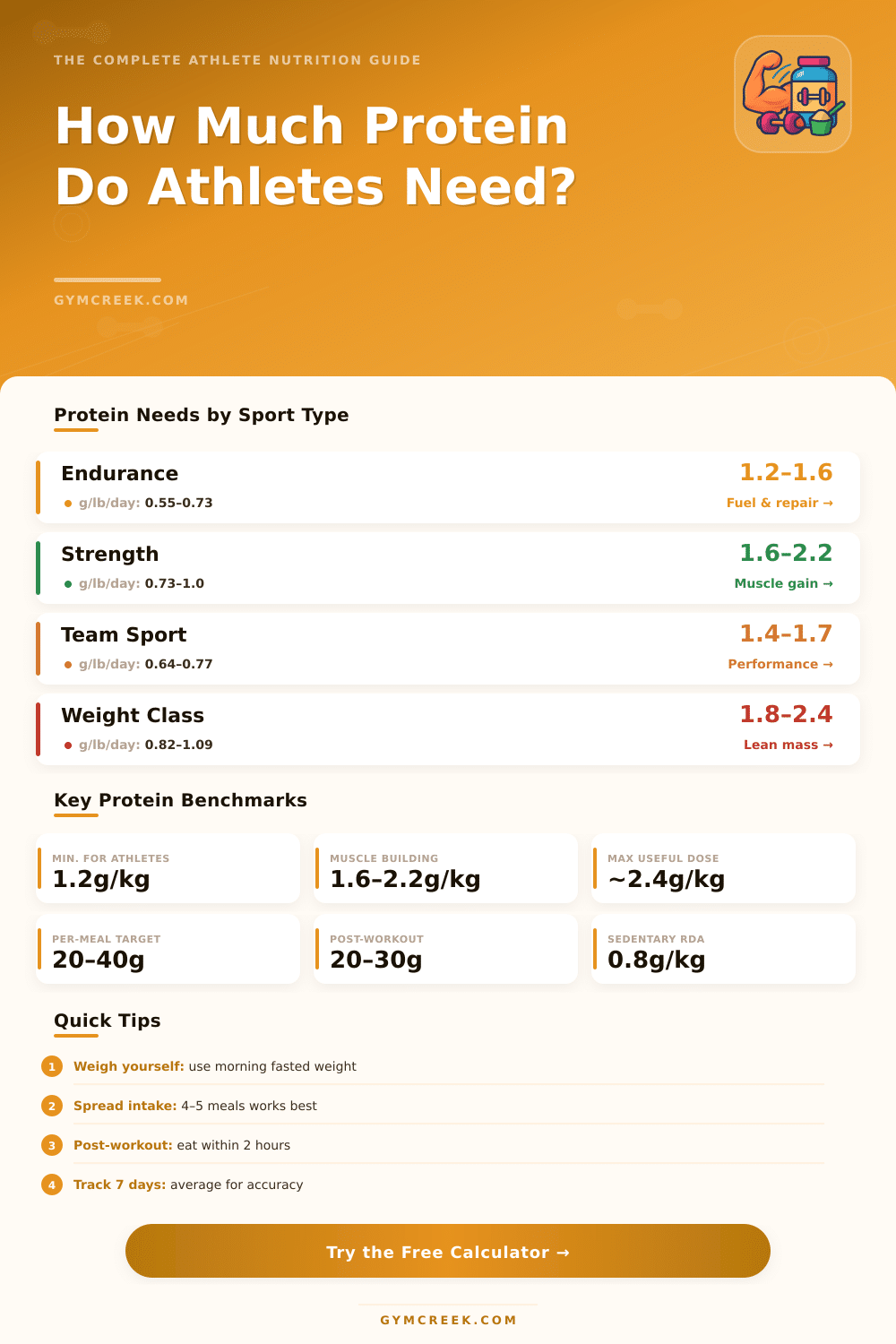
| Endurance Athlete | 1.2–1.6 | 0.55–0.73 | Repair, glycogen support |
| Team Sport Athlete | 1.4–1.7 | 0.64–0.77 | Mixed aerobic/anaerobic |
| Strength / Power Athlete | 1.6–2.2 | 0.73–1.0 | Hypertrophy & strength gains |
| Combat Sports Athlete | 1.8–2.4 | 0.82–1.09 | Weight cutting, lean mass |
| Elite / Multi-session | 2.0–2.5 | 0.91–1.14 | 2+ sessions/day |
| Masters Athlete (50+) | 1.6–2.2 | 0.73–1.0 | Counters anabolic resistance |
| Meals Per Day | Body Wt 60kg / 132lb | Body Wt 80kg / 176lb | Body Wt 100kg / 220lb |
|---|---|---|---|
| 3 meals | ∼40g/meal | ∼53g/meal | ∼67g/meal |
| 4 meals | ∼30g/meal | ∼40g/meal | ∼50g/meal |
| 5 meals | ∼24g/meal | ∼32g/meal | ∼40g/meal |
| 6 meals | ∼20g/meal | ∼27g/meal | ∼33g/meal |
| Food Source | Protein (g) | Calories | Quality Score |
|---|---|---|---|
| Chicken Breast (cooked) | 31g | 165 kcal | Complete (DIAAS 1.08) |
| Canned Tuna | 29g | 130 kcal | Complete (DIAAS 1.0) |
| Whole Eggs | 13g | 155 kcal | Complete (DIAAS 1.13) |
| Greek Yogurt (0% fat) | 10g | 59 kcal | Complete — high in leucine |
| Cottage Cheese | 11g | 98 kcal | Complete (casein, slow release) |
| Salmon (cooked) | 25g | 208 kcal | Complete + omega-3s |
| Tempeh | 19g | 195 kcal | Near-complete plant protein |
| Lentils (cooked) | 9g | 116 kcal | Incomplete (pair with grain) |
| Edamame | 11g | 122 kcal | Near-complete soy protein |
| Lean Beef (90% lean) | 26g | 176 kcal | Complete + creatine, iron |
| Window | Recommendation | Amount | Why It Matters |
|---|---|---|---|
| Pre-workout (1–2 hr) | Mixed meal with protein | 20–40g | Fuels session, primes MPS |
| Post-workout (0–2 hr) | Fast-digesting protein | 20–40g | Maximizes muscle repair |
| Before Sleep | Casein / slow protein | 30–40g | Overnight MPS support |
| Between Meals | Distribute evenly | 20–40g | Sustains leucine threshold |
| Category | Men (%) | Women (%) | Protein Priority |
|---|---|---|---|
| Essential Fat | 2–5% | 10–13% | Very high (protect LBM) |
| Athletic | 6–13% | 14–20% | High (2.0–2.4g/kg) |
| Fitness | 14–17% | 21–24% | Moderate-high (1.6–2.0g/kg) |
| Average | 18–24% | 25–31% | Moderate (1.2–1.6g/kg) |
| Obese | 25%+ | 32%+ | Use lean mass for calculation |
• Weigh yourself: first thing in the morning, after using the bathroom, before eating.
• Body fat %: Use DEXA scan or 7-site skinfold for best accuracy. BIA scales can vary by କ%.
• Track your intake: Log protein for 7 days and use your average — single-day tracking is unreliable.
• Reassess every 8–12 weeks as your weight, composition, and training load change.
Protein is commonly mentioned in talks about nutrition, and honestly, counting exactly how much one truly needs can seem too hard. The standard advice for most adults is 0.8 grams per kilo of body weight, everything needed to escape shortage. Consider a typical everyday person at around 75 kilos (that is about 165 pounds).
That gives around 50 to 60 grams daily. For adult men especially, 56 grams mark the basic standard.
How Much Protein Do You Need?
Here it becomes more interesting. Children that are growing, and pregnant or nursing women need much more because their bodies indeed work extra tasks. The point is that needs about protein do not apply for all equally.
Your goals, your activity, general health and the strength of your exercise all affect what well works for you.
The official guides offer to aim between 10 and 35 percent of the daily calories from protein. Interesting is, that the average American already reaches around 16 percent of calories from protein; so many folks get quite a lot without too much effort. Meat delivers around two thirds of that daily intake for most people.
For many, a range of 50 to 125 grams daily hits the right level, based on their situation.
When one talks about sporty folks or those that want to build muscle, the number changes. With regular training, 1.6 grams per kilo of body weight per day is enough for good increase of muscles and better output. Bodybuilders usually aim higher; at least 2.2 grams per kilo…
To maximize the gain of lean mass. One commonly hears the rule “1 gram per pound of body weight” for muscle building, although some reckon that it is too much. Research shows that 0.82 grams per pound is nearer to the limit, wear protein truly stops having big impact.
At the level of meals, getting around 15 to 30 grams of protein works well. Having more than 40 grams in one meal does not seem to give big benefit compared to staying in that range. Spreading protein through most of your meals?
It is a good habit to build. Meat, fish and eggs cover the whole range; they are complete proteins with all nine key amino acids.
Loss of weight changes the situation. Research on 65 overweight women showed that those on a high-protein diet; where protein made up more than 25 percent of total calories. Lost more weight after six months than the groups with high carbs or the control group.
If you eat fewer calories daily, a bigger part of them should be from protein to protect the muscles. For most folks, supplements are not needed unless food alone does not suffice. Whatseriously matters is your whole protein intake from everything, all foods and drinks together, not only from powders.