❤️ Zone 3 Heart Rate Calculator
Find your aerobic training zone using age, resting heart rate & preferred method
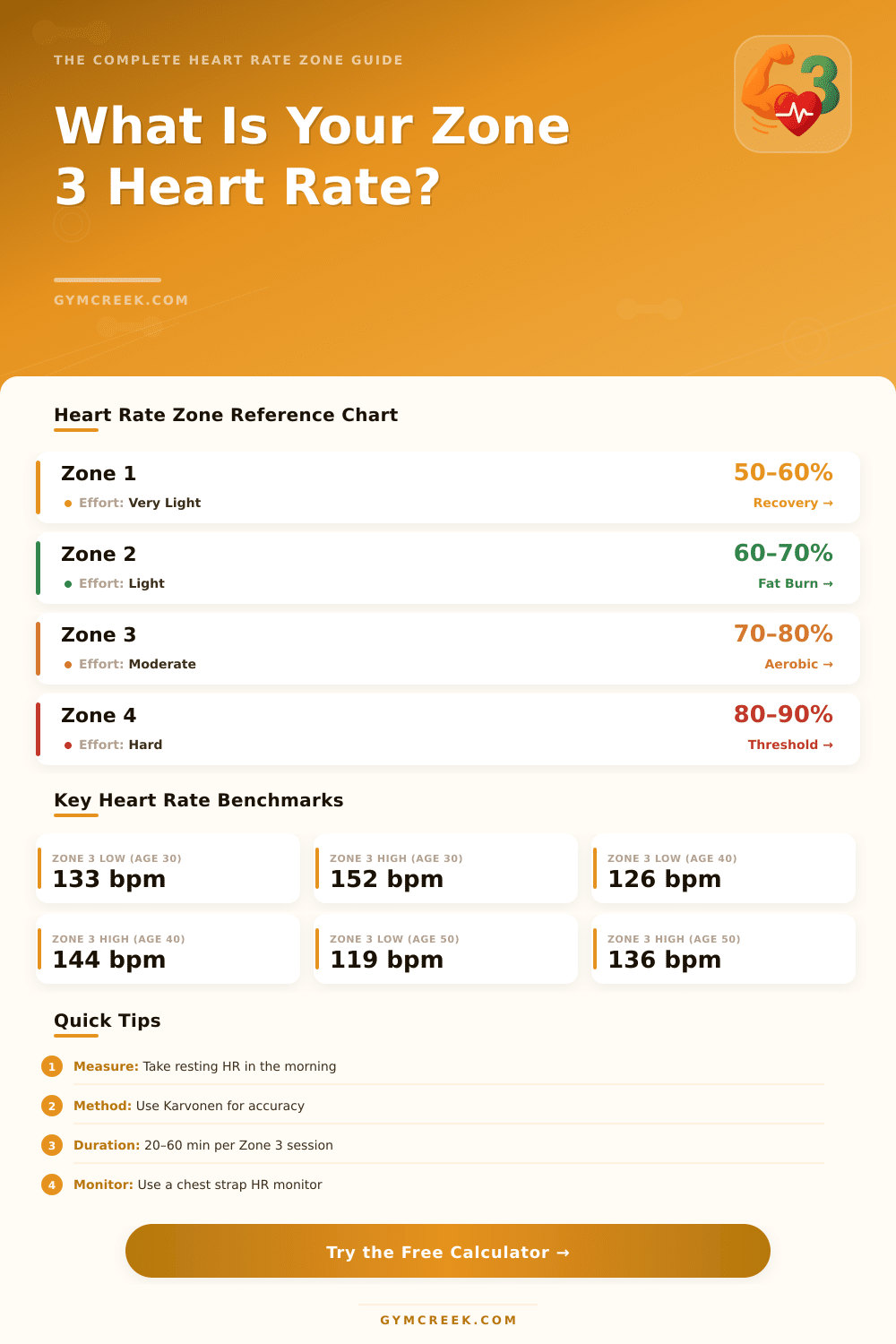
| Zone | % Max HR | Effort Level | Primary Benefit | Typical Duration |
|---|---|---|---|---|
| Zone 1 | 50–60% | Very Light | Active Recovery | 20–40 min |
| Zone 2 | 60–70% | Light / Conversational | Fat Oxidation, Base Fitness | 45–90 min |
| Zone 3 ⭐ | 70–80% | Moderate / Aerobic | Cardiovascular Fitness, Endurance | 20–60 min |
| Zone 4 | 80–90% | Hard / Threshold | Lactate Threshold, Speed | 10–30 min |
| Zone 5 | 90–100% | Maximum | Peak Power, VO2 Max | 3–8 min |
✱ Zone 3 highlighted. Percentages based on maximum heart rate (HRmax).
| Age | Est. Max HR | Zone 3 Low (70%) | Zone 3 High (80%) |
|---|---|---|---|
| 20 | 200 bpm | 140 bpm | 160 bpm |
| 25 | 195 bpm | 137 bpm | 156 bpm |
| 30 | 190 bpm | 133 bpm | 152 bpm |
| 35 | 185 bpm | 130 bpm | 148 bpm |
| 40 | 180 bpm | 126 bpm | 144 bpm |
| 45 | 175 bpm | 123 bpm | 140 bpm |
| 50 | 170 bpm | 119 bpm | 136 bpm |
| 55 | 165 bpm | 116 bpm | 132 bpm |
| 60 | 160 bpm | 112 bpm | 128 bpm |
| 65 | 155 bpm | 109 bpm | 124 bpm |
| 70 | 150 bpm | 105 bpm | 120 bpm |
✱ Values calculated using the standard 220 — Age formula. Individual max HR may vary ±10–12 bpm.
| Category | RHR Range (bpm) | Fitness Interpretation |
|---|---|---|
| Athlete / Elite | 40–50 | Excellent cardiovascular fitness |
| Excellent | 51–58 | Above average fitness level |
| Good | 59–65 | Healthy, active individual |
| Average | 66–72 | Moderate fitness / sedentary lifestyle |
| Below Average | 73–80 | Low activity, improve with cardio |
| Poor | 81+ | Consult physician, begin light activity |
DISCLOSURE: This post may contain affiliate links, meaning when you click the links and make a purchase, I receive a commission. As an Amazon Associate I earn from qualifying purchases.

✱ Source: American Heart Association guidelines. Resting HR measured in a calm, seated position after 5 minutes of rest.
| Age | 220 — Age | Tanaka (208 — 0.7×Age) | Difference |
|---|---|---|---|
| 20 | 200 bpm | 194 bpm | -6 bpm |
| 30 | 190 bpm | 187 bpm | -3 bpm |
| 40 | 180 bpm | 180 bpm | 0 bpm |
| 50 | 170 bpm | 173 bpm | +3 bpm |
| 60 | 160 bpm | 166 bpm | +6 bpm |
| 70 | 150 bpm | 159 bpm | +9 bpm |
✱ Tanaka formula (2001, JACC) is considered more accurate for adults over 40. The 220—Age formula tends to underestimate HRmax in older adults.
- Maintain Zone 3 HR for 20–60 minutes per session for aerobic benefit
- Use the talk test: you should be able to speak in short sentences but not hold a full conversation
- A chest strap monitor gives more accurate readings than wrist-based optical sensors during movement
- The Karvonen method accounts for your individual resting HR, making it more personalized than simple % max HR formulas
Training in the third Heart Rate zone happens at 70 to 80 percent of the maximum Heart Rate. One commonly calls it the steady or mid-intensity area. It helps a lot for building the aerobic fitness and growing the endurance.
Thanks to it the blood flows more well through the heart and the muscles of the body.
Training in the Third Heart Rate Zone
If you exercise in that zone during 10 to 40 minutes, you will burn fat well, while building the muscles and growing their endurance. In this area, the workouts usually are made up of activities as run, swim or cycle at same speed. Based on your fitness level, one can keep this effort from 20 to 60 minutes, or even mroe long.
For guessing the upper limit of the third zone without machines, simply take 180 minus your age. The Heart Rate starts to pass that value, when one enters harder areas. For instance, at maximum rate of 185 bpm, the third zone almost matches to 130 to 150 bpm.
Test of the body function can help find exact zones for the Heart Rate and count the calories burned in each of them. Such testing truly is useful four the long run.
The third zone has also the name of aerobic endurance area. It sits between easy endurance and strong intensive work. In that middle part, sometimes one reaches a wall, because bigger effort not always gives better results.
When one enters the third zone, the body starts to depend more on harder processes, what makes it hard to keep the effort during truly long time.
In good training program, one should give only 10 to 15 percent of the whole time to the third zone. The biggest part goes to the first and second zones, that together covers around 70 to 90 percent. Do not always run in the third zone.
More well is to run most of the time in the second zone and plan one or two faster sessions weekly with efforts in the third.
Different methods split the zones a bit differently, so there are many differences. Some put the third zone at 70 to 80 percent, while others lay it at 80 to 87 percent. That does talks about zones a bit hard.
The real maximum Heart Rate can differ from age-based math. Some can believe, that they are in low third zone, while they indeed are in high second.
When exercise, that usually stays in the second zone, sharply brings breathing into the fourth zone, that shows, that the body needs more rest. On the other hand, if prior efforts in the third zone feel easier and the resting Heart Rate drops, the fitness clearly improved. For folks, that train less thansix hours weekly, do not bother to care about staying out of the third zone.
Every zone has its role.