Zig Zag Diet Calculator
Build a weekly calorie-cycling plan from your estimated TDEE, goal phase, high-day count, low-day spread, and steady protein target.
📌Zig Zag Diet Presets
Presets change demographics, activity, goal phase, day distribution, calorie swing, and macro factors so the weekly average stays controlled.
⚙Calculator
Zig zag calorie cycle
Enter body stats and weekly calorie-cycle settings to calculate.
📊Fitness Metrics
📑Reference Tables
| Day type | Days/week | Calories | Protein | Fat | Carbs |
|---|---|---|---|---|---|
| High calorie | --- | --- | --- | --- | --- |
| Medium calorie | --- | --- | --- | --- | --- |
| Low calorie | --- | --- | --- | --- | --- |
| Weekly total | 7 | --- | --- | --- | --- |
| Goal phase | Weekly average | High day swing | Low day role |
|---|---|---|---|
| Fat loss | 10-20% below TDEE | 10-25% above average | Create the deficit |
| Recomp | 0-10% below TDEE | 5-20% above average | Moderate intake |
| Maintenance | Near TDEE | 5-15% above average | Balance high days |
| Lean gain | 5-10% above TDEE | 5-15% above average | Limit surplus size |
| Formula | Variables | Used for | Note |
|---|---|---|---|
| Mifflin-St Jeor | Weight, height, age, gender | BMR estimate | Common adult equation |
| TDEE multiplier | BMR x activity factor | Maintenance calories | Best adjusted by trend |
| Weekly energy | Daily average x 7 | Cycle control | Keeps zig zag honest |
| Macro calories | Protein 4, carbs 4, fat 9 | Day macros | Carbs flex most |
| Layout | High | Medium | Low | Best fit |
|---|---|---|---|---|
| Classic cut | 2 | 2 | 3 | Most lifters |
| Training heavy | 3 | 1 | 3 | Hard sessions |
| Social high | 2 | 1 | 4 | Weekend meals |
| Maintenance | 2 | 3 | 2 | Stable weight |
💡Tips
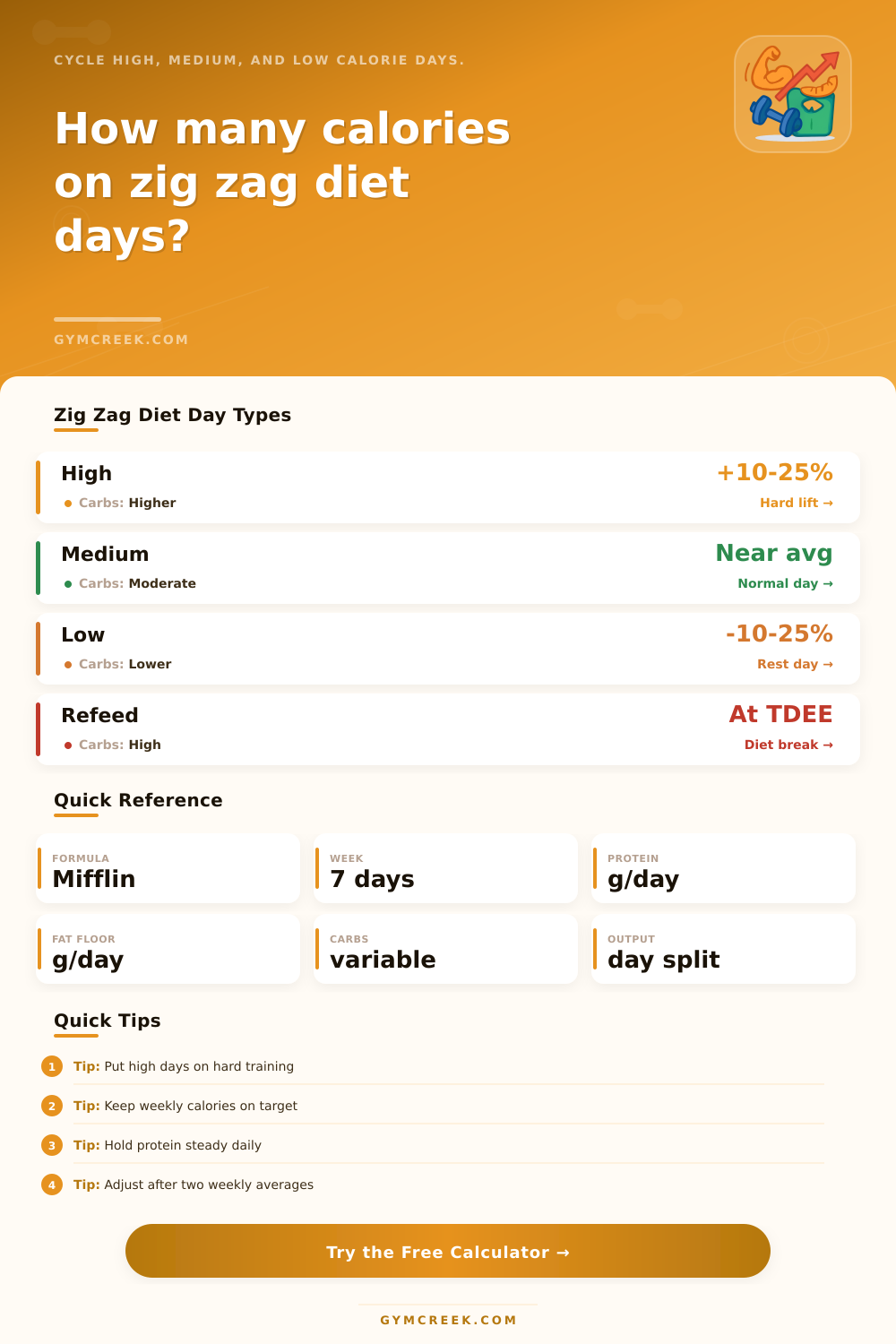
Calorie cycling is a process where an individual consumes a different amount of calories each day within a 7-day period. During calorie cycling, an individual can consume more calories on certain days than others, but the average amount of calories consumed each week has to remain the same. This form of calorie cycling provide benefits to individuals due to the fact that high calorie days can provide the energy required to perform hard training days, and the low calorie days allow the individual to experience a calorie deficit for fat loss.
The calorie calculator included on this page can help an individual determine how to best distribute their calories throughout the weeks. The calculator use the Mifflin-St Jeor equation to calculate an individual’s Basal Metabolic Rate (BMR), and then multiplies that figure by an activity factor chosen by the individual. After determining the BMR and activity factor of an individual, the calculator allows for an individual to choose a goal phase for their body composition, either a cut, maintenance, or surplus.
How to Use the Calorie Cycling Calculator
The result of this calculation is an average amount of calories that an individual should consume each week. The individual must consume around this target for the week, but may vary the calories consumed each day as long as the weekly target isnt changed. An individual should distribute the high, medium, and low days that are to be consumed according to their training schedule.
High calorie days should occur on days that include hard training sessions for the individual. Medium calorie days should be distributed around the average calorie target for the individual, as they are meant to act as a buffer to the high and low calorie days. Low calorie days should occur on days off from training for the individual.
The calculator can help an individual to determine how many high and low calorie days they would like to have each week, as well as how large of a swing in calories should exist between those days. The amount of protein and fat that is consumed each day should remain constant. An individual must consume protein each day to aid in the retention of their muscles, regardless of the number of calories consumed.
Additionally, the body requires fat each day to aid in the production of hormone. As a result, the only variable macronutrient is carbohydrates, which the calorie calculator can calculate for each day. There are reference tables included on this page that may help to provide examples of various calorie cycling patterns.
One table displays the different amount of calories that would be deficit or surplus according to the goal phase that is selected. Another table displays common weekly layouts for the various goal phases. These tables can help an individual to understand the different patterns of calorie cycling, but should not be relied upon instead of the data about an individuals body and performance.
The calorie cycling plan may need to be adjusted according to the individuals schedule. For instance, an individual may be required to change their training schedule or may have social meals during the week. Therefore, an individual should adjust their calorie cycling plan after collecting data for two weeks, and again after collecting data for four weeks.
The body does not adapt to new caloric targets instantly, so the individual should not make to many changes to the calorie cycling plan to quick. An individual may experience changes to their hunger during the calorie cycling plan. For instance, some individuals feel less hungry on low calorie days, but other individuals feel more irritable on those days.
Because the protein and fat intake is held constant each day, any changes in hunger are likely due to the change in carbohydrate intake. An individual can adjust their carbohydrate intake, especially around their training days, to help manage their hunger. An individual may want to review the high calorie days to ensure that they match the individuals training schedule.
For instance, if there are more high calorie days than hard training days, then those surplus calories will not benefit the individuals training schedule. In another situation, if there are hard training days that do not have high calorie days allotted to them, those training sessions will not have the fuel that their body require to perform at its best. These warnings are provided to the individual to help them decide how to adjust the high calorie days according to their training schedule.
The calculator also includes an estimate of lean mass for each individual, based off their body fat percentage. This value is not used to calculate the calories for each day, but may help an individual to understand whether or not their target of protein intake is appropriate for their body. Individuals with higher lean mass have higher protein requirements, and this estimate can help an individual understand whether their protein target is set appropriately.
An individual can determine whether or not the calorie cycling plan is working by monitoring their weight and training performance. If their strength level remain the same or increase, and if their weight is moving in the direction of their goal, then their calorie cycling plan is working. If an individual feels that their energy levels have dropped or that their training performance has declined, their calorie swings may be to large.
Therefore, the individual should use the first few weeks of implementing the calorie cycling plan to collect data about their body and performance, after which they can make adjustments to the plan.