Zercher Squat Load Calculator
Estimate a practical Zercher squat working load from your set, RPE, torso angle, elbow comfort, and front or back squat carryover.
📌Presets
Presets load realistic Zercher scenarios, including comfort-limited loading, torso-angle constraints, and squat carryover estimates.
⚙Calculator
Zercher load snapshot
Enter your recent set and calculate the suggested load.
📊Mechanics Metrics
📑Reference Tables
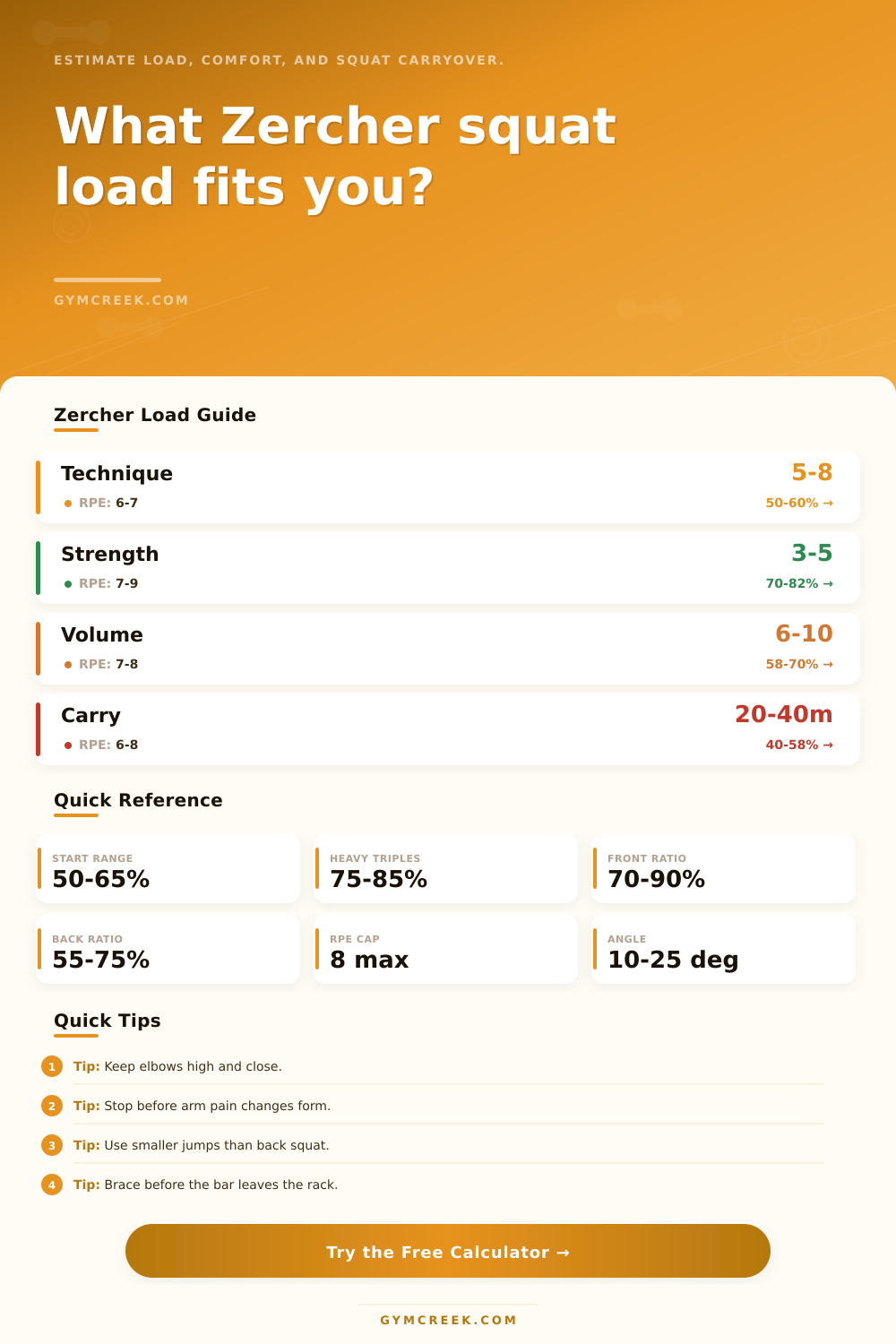
| Goal | Typical Sets | Target RPE | Load Zone |
|---|---|---|---|
| Technique practice | 3-5 x 5-8 | 6-7 | 50-60% e1RM |
| Strength work | 4-6 x 2-5 | 7-9 | 70-82% e1RM |
| Hypertrophy volume | 3-5 x 6-10 | 7-8 | 58-70% e1RM |
| Loaded carry transfer | 3-6 carries | 6-8 | 40-58% e1RM |
| Heavy triple peak | 3-5 x 1-3 | 8-9 | 80-88% e1RM |
| Carryover Source | Zercher Range | Use | Caution |
|---|---|---|---|
| Back squat 1RM | 55-75% | Lower-body anchor | Torso may limit |
| Front squat 1RM | 70-90% | Closest squat cousin | Arm cradle differs |
| Deadlift to lap | 40-60% | Strongman starts | Setup costs energy |
| Paused Zercher | 60-75% | Brace and position | Use lower RPE |
| Torso Angle | Signal | Load Choice | Adjustment |
|---|---|---|---|
| 0-12 deg | Very upright | Load normally | 0% change |
| 13-25 deg | Good control | Use planned load | 0-4% cut |
| 26-38 deg | Forward lean | Trim working load | 5-10% cut |
| 39+ deg | Position limit | Technique priority | 10-18% cut |
| Comfort Rating | Interpretation | Loading Rule | Next Step |
|---|---|---|---|
| 9-10 | No distraction | Use calculation | Progress normally |
| 7-8 | Tolerable pressure | Keep RPE honest | Small jumps |
| 5-6 | Pressure limits form | Reduce 5-12% | Try sleeves or pad |
| 1-4 | Pain or grip issue | Cap load low | Change setup |
💡Tips
With the Zercher squat, you grab bar with your hands held in the crook of your elbows. This puts weight in front of your body and feels awkward. When the bar is across your arms, there’s no way to conceal weakness in either your midsection or your upper back. Torso posture has to be exact for entire set. Also, your arms will realy get hammered before you begin feeling any sort of weight on your legs. To say this workout require careful balance is an understatement.
You’re looking for a weight that builds strength without beating up your form or your comfort level. People make one mistake with this: They do this move with the same numbers as their heavy back squat. That’s wrong.
Why You Should Lift Lighter for Zercher Squats
Because this exercise is front-loaded, physics are completely different than before. The bar being in front of your center of gravity create a lever arm that forces your torso to battle weight. The bar is positioned ahead of your center of gravity; the heavier the weight, the harder your body must work to prevent it from slipping forward. This is why torso angle becomes so important. How upright you can remain tells the calculator about your safety zone. By knowing how much weight you’ve been lifting and what feels comfortable, the calculator predicts working weight you should of try without exceeding these physical limits.
Many times, it’s your elbow that limit how much you can do, not your glutes or quadriceps. When you hold bar, it digs into soft tissue, nerves and skin. Pain is not something to push through; it’s not a badge of honor. If you find yourself rounding your shoulders or flaring out your elbows to relieve the pressure, you have used to much weight for the exercise to be effective. So the tool lets you rate how comfortable you are with the load. Then, when it sees that rating go down, it will cap it so you don’t push through unsafe levels of discomfort.
That’s a good thing because most training apps expects linear progress. But the Zercher squat doesn’t progress linearly. It progresses in tiny little baby steps. Some weeks, you’ll add five pounds. Other weeks, you’ll have to get used to that added weight over the course of several week.
And finally consider its relationship to rest of your lifts. For example, the Zercher is a great builder for front squat. You are in the same upright torso position as when you front squat, but you don’t have to keep your shoulders in a strict overhead rack hold. But don’t expect it to transfer directly into your back squats. Having a solid back squat doesn’t mean you’ll be able to handle a Zercher with equal weight. While there’s some carryover from the front-loaded pattern, it won’t be quite as much. That’s reflected in the table on the page, where you see that your Zercher max will probably sit closer to your front squat max then your back squat max. This is to help manage realistic expectations.
If you’re doing this for strongman carryover, then it’s less about raw power and more about stability and endurance. You want to learn to hold it while fatigued rather than just lift a heavy barbell once. That’s not muscle failure. That’s your bracing slipping and it’s burning because you know the trick, you’re measuring something else entireley.
This exercise rewards patience. It is ego-punishing. It won’t make you look good in the gym. In fact, you’ll look hunched and uncomfortabley. That is good. The discomfort forces you to engage your entire posterior chain to stay upright. It develops a strong functional core that carries over into nearly any other lift.
Start with a reasonable zone using the calculator and tweak from there depending off the feeling in your elbows and the degree to which your torso remains vertical. Let your pride take a backseat and listen to your arms instead. Brace your core and go by the numbers. The weight remains in your arms. And you continue forward, carefully rep by carefuly rep.