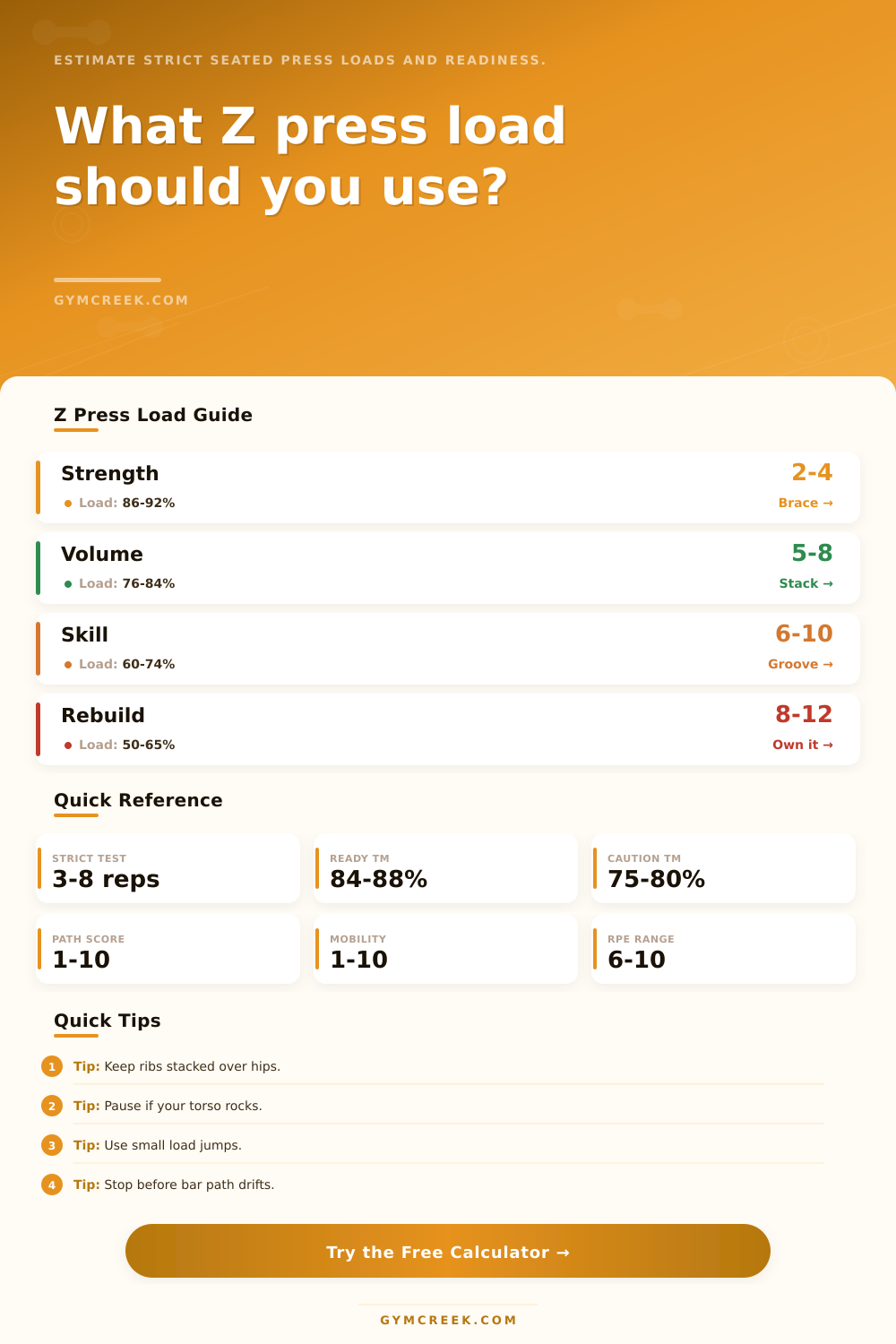
Z Press Load Calculator
Estimate your strict seated press 1RM, Z press training max, target set load, and technique readiness from load, reps, posture, mobility, bar path, body weight, and RPE.
📌Presets
Each preset fills a realistic Z press scenario and recalculates the strict-load recommendation.
⚙Calculator
Z press load snapshot
Enter your strict set details to estimate a useful training load.
📊Metrics Grid
🧮Formula Cards
RPE-Corrected Epley
Estimated 1RM starts with load multiplied by 1 plus adjusted reps divided by 30. Adjusted reps add estimated reps in reserve from RPE.
Z Press Skill Factor
The raw estimate is scaled by torso position, mobility score, and bar path score so technique limits reduce the usable strict max.
Readiness Training Max
Readiness selects a conservative training-max percentage: 75, 80, 84, or 88 percent before a small RPE fatigue adjustment.
Target Load Reverse
The selected target rep range is converted back from the training max with reverse Epley math and rounded to your plate increment.
📑Reference Tables
| Training Goal | Target Reps | Suggested % TM | Use Case |
|---|---|---|---|
| Max strength | 2-4 | 86-92% | Heavy strict practice |
| Strength volume | 4-6 | 80-87% | Primary work sets |
| Hypertrophy | 6-10 | 68-80% | Controlled shoulder volume |
| Technique rebuild | 8-12 | 50-68% | Groove the stacked position |
| Torso Position | Score | Load Effect | Meaning |
|---|---|---|---|
| Vertical and stacked | 100 | Full credit | Best strict transfer |
| Slight forward lean | 88 | Small reduction | Often manageable |
| Back lean appears | 72 | Moderate cut | Brace or reduce load |
| Rounded or rocking | 58 | Large cut | Technique is limiting |
| Readiness Band | Score | TM Percent | Recommendation |
|---|---|---|---|
| Green | 88-100 | 88% | Load can progress |
| Steady | 75-87 | 84% | Normal training work |
| Caution | 62-74 | 80% | Keep reps crisp |
| Rebuild | Below 62 | 75% | Prioritize position |
| BW Ratio | Novice | Intermediate | Advanced |
|---|---|---|---|
| Men | 0.30-0.45x | 0.46-0.65x | 0.66x plus |
| Women | 0.18-0.30x | 0.31-0.45x | 0.46x plus |
| Mixed use | Technique first | Compare trends | Retest often |
| Programming | Light practice | Main accessory | Strength focus |
💡Technique Tips
You can lie back on the floor with your legs out straight and a barbell across your chest. It looks easy enough. Except this movement expose weaknesses in both your shoulder and core.
Because there’s no hip drive in the Z press, you can’t use momentum to pull weight up. Instead your shoulders and thoracic spine has to do all of the work; your hips is locked down. It becomes a great diagnostic tool for this reason, but it’ll make your lifting numbers appear different when compared to a standing press.
How to Use the Z Press Calculator
How do you translate that strict effort into a number that guides your training while not damaging your shoulders? No need to fudge your actual one rep max, the calculator does all of calculations after you input your current set data. And unlike most formulas used by most lifters (which assume perfect form), posture actualy alters results.
Rocking your torso or leaning backward is not testing your pressing strength; it’s testing your ability to drive with hips. To compensate for this, the tool asks you to rate your torso position. Full credit will be given for a stacked and vertical torso position, while rocking or rounded torso positions results in a lower estimated max. That way you can’t build a program based off a number that forces you to sacrifice your spine. You should of own the strict press.
The calculator also factors in mobility, which is weighted heavily since it requests a self-assessed mobility score between one and 10. That’s a composite of your thoracic extension, hip range of motion and hamstring flexibility. If your hamstrings is tight, you have to sit back farther when getting the bar overhead, and that lean add extra demands to your shoulders. Having higher mobility keeps your center of gravity above your hips, so it move more of the load to the strength of your deltoids. Your readiness score reflect that blend.
Higher readiness percentages mean you can train with estimated max as a ceiling. Lower numbers indicate you should go lighter and focus on position before anything else. But that means you have to change your idea of progression when using these estimates; you’re pursuing superior mechanics under load instead of simply bigger numbers.
The tool has reference tables that present clear goal-specific targets. For maximum strength, it suggests low-rep sets loaded with approximately eighty-six to ninety-two percent of your training max. For technique restoration, its recommended range plummets, frequently below seventy percent.
That’s why so many folks stall out here… They look down at a smaller percentage and assume they’ve backslid. They haven’t backslid; they’re stabilizing. By practicing the movement at a lighter load, they establish neural patterns that carry over to their heavier work in the future.
Also worth noting is that this calculator does take into account the ratio of your lift to your bodyweight. Two-hundred pounds is very different for a 140-pound person then it is for a 230-pounder. The ratio shows that strength is relative and gives you a way to measure your own progress against general standards. You may be able to lift a ton of weight but still have mobility issues. Or you might not be able to lift all that much but when you tighten up your position, you unlock gains while livig with good form. The ratio provides some context to your absolute number.
Training the Z press require a lot of patience because the lift reveals weaknesses that is usually hidden by momentum. If you’re at the end of a set and find yourself thinking that your torso wants to rock forward, it’s time to stop lifting. That sensation is the cue that you can no longer strictly control the weight. Your best bet isn’t to force it through bad mechanics; instead, back off a bit, keep those ribs stacked atop your hips and get greater longterm rewards.
The numbers come from the tool; the accuracy comes from your own honesty regarding your form. Pressing overhead is a challenging lift that at the same time demands force, stability and coordination. The Z press does just that. It isolates the pressing muscles, while at the same time asking for engagement from the core.
With a systematic approach to loading management, what was a hard exercise becomes a fine-tuned tool for developing shoulder health. No more guesswork, it’s time to engineer your gains with bar moving up and down, not your shoulders.