Yoke Walk Weight Calculator
Plan loaded yoke weight, bodyweight multiple, plate load per side, carry pace, and crossbar setup before a strongman yoke run.
📌Presets
Each preset fills a realistic yoke setup and recalculates the loading recipe, pace, bodyweight multiple, and pick-height demand.
⚙Calculator
Yoke carry snapshot
Enter your yoke frame, loading, and lane target to calculate the carry.
📊Carry Metrics Snapshot
📈Fitness Metrics Comparison
📑Reference Tables
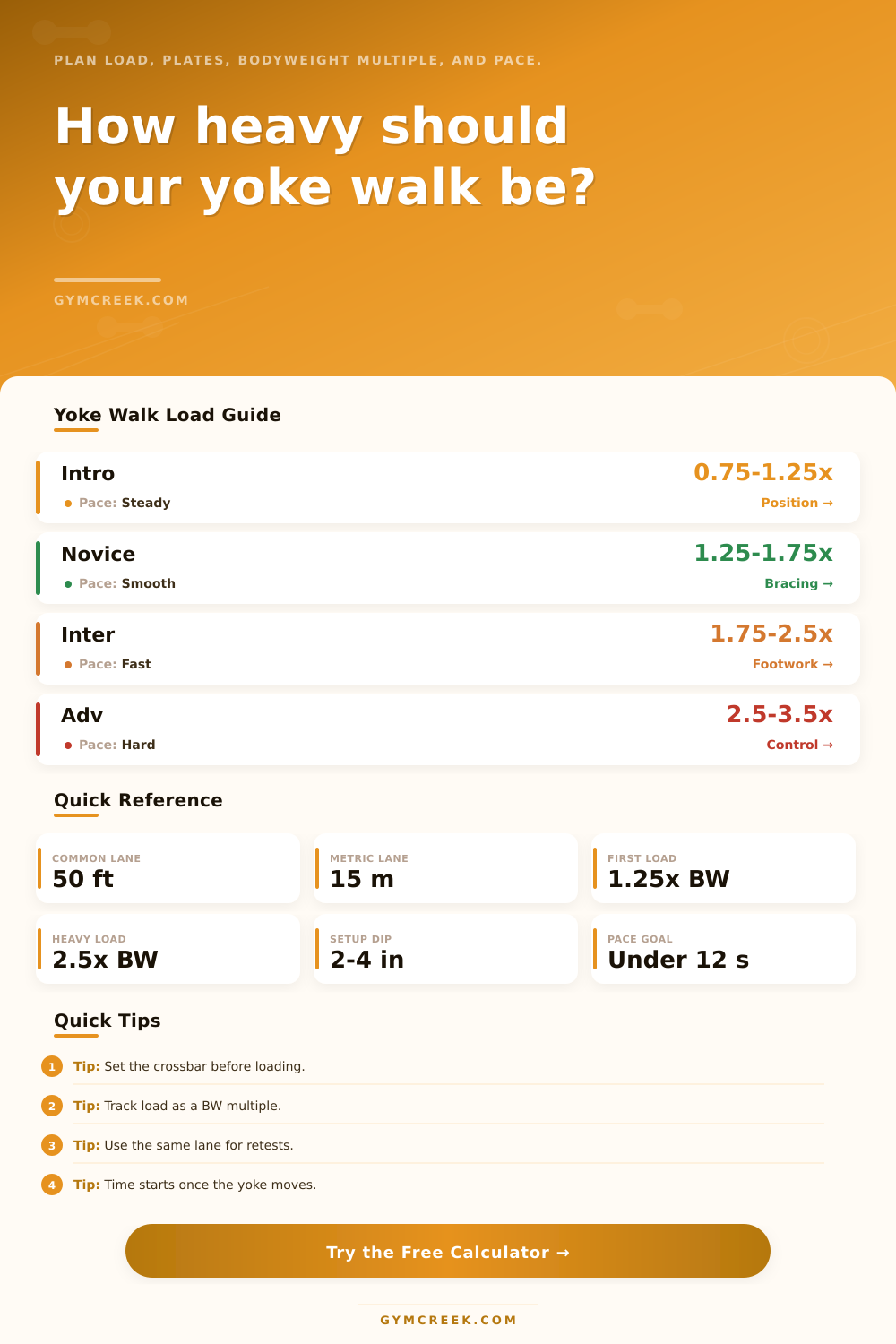
| Load Level | BW Multiple | Carry Goal | Training Use |
|---|---|---|---|
| Technique | 0.75-1.25x | Quiet steps | Position practice |
| Novice | 1.25-1.75x | No drops | Base building |
| Intermediate | 1.75-2.5x | Fast finish | Contest prep |
| Advanced | 2.5-3.5x | Stable speed | Heavy events |
| Carry Distance | Imperial | Metric | Use Case |
|---|---|---|---|
| Short drill | 30 ft | 9.1 m | Acceleration |
| Common lane | 50 ft | 15.2 m | Strongman tests |
| Long lane | 60 ft | 18.3 m | Conditioning |
| Metric event | 65.6 ft | 20 m | Outdoor lanes |
| Crossbar Setup | Pickup Dip | Feel | Adjustment |
|---|---|---|---|
| High | 0-1 in | Easy pick | May sway more |
| Moderate | 2-4 in | Strong start | Common setting |
| Low | 5-7 in | Hard pick | Use for practice |
| Too low | 8+ in | Slow break | Raise crossbar |
| Formula | Variables | Result | Use |
|---|---|---|---|
| Total yoke | Frame, collars, plates | Loaded weight | Load planning |
| BW multiple | Total / bodyweight | Relative load | Benchmarking |
| Per side | Plate load / 2 | Sleeve load | Loading checks |
| Standard time | Time x lane ratio | 50 ft or 15 m | Retesting pace |
💡Tips
The Yoke Walk as a Test of Structural Integrity While this test isn’t just raw strength, it is testing structural integrity under pressure. Sure you might be able to bench press 2x your bodyweight, but maybe you can’t hold it all together for more than ten steps in a loaded carry. Your technique falters. That weight doesn’t give a rip about how much you can lift. What it does care about? Your bracing, your stability, and your ability to carry a structure that’s pressing into your back as you move forward.
So yes, we plan out our load. We know exactly what it is we’re asking our bodies to do before stepping underneath the crossbar. This calculator will do all the math for you on this page, while letting you concentrate on the game plan. You enter weight of the yoke frame, the collars, and the plates you want to add and it spits out a total load. Then it determines a bodyweight multiple based off that load.
Why Use a Yoke Walk Calculator
Why does it matter? Because you might be able to handle a five-hundred-pound yoke if you weigh three-hundred pounds but not if you only weigh two-hundred. A relative load is an indicator of how far down your development curve you are. With this tool, you won’t have to guess about this relationship anymore; it’ll show you instantly.
Most lifters ignore how important it is to evenly distribute plates when loading the yoke. To achieve this balance, the calculator will break it down by sides. This shows you exactly how many plate to put on each side so the implement does not tilt from being off-balance by only a few pounds. Your core would of been forced to do all the work simply to stabilize the implement rather than move you forward. It even factors in spacer and collar weights as they add up too. If you’re trying to hit a certain multiple of your bodyweight, forgetting about ten pounds worth of hardware can make the difference between hitting the mark or not. Using the tool to account for those details gives you an accurate picture of what’s on the bar.
Another differentiator between strongmen and the average person who works out is pace. You can put your desired pace for an average lane distance (typically fifty feet) into the calculator, and it will output your pace in seconds/foot or second/meter. If your pace with a decently heavy load are three seconds per foot, for instance, then you’re probably wasting some energy doing something wrong with your footwork or posture. Knowing your pace helps you see how efficient you are.
Another crucial factor in performance is setup height. You enter your shoulder height into the tool and height of the crossbar above that. The tool will then calculate how much of an angle or “dip” off your shoulders the bar must be lifted to fit over your back. A more difficult angle requires harder work lifting the weight initially, tiring out your legs before they’ve taken one single step. On the other hand, a higher setup means you have an easier time getting the yoke onto your back, but the load may sits too high on your traps and feel insecurely balanced. There’s a sweet spot here, one that also factors into preparing for contests.
The tool includes reference tables with benchmark lifts ranging from beginner-level drills to advanced competition loads. They give meaning to your numbers by comparing them to existing standards. The point isn’t simply adding mass. It is learning how to keep a good posture and use the right muscles. Newbies sometimes forget breathing and bracing mechanics as they get weighted down. Maintain a straight body; use core muscles during the carry. Don’t let any pressure escape: If you do, the weight will transfer uncomfortably to your back/spine.
The calculator aids this development through its ability to model different scenarios. Try a lighter load so you can work on form, or create a max effort contest prep day where you push yourself with full weight. Versatility enables periodization of training to develop strength and avoid overworking the central nervous system.
The takeaway: the yoke walk teaches us how to manage discomfort. The weight will always feel heavier than your max lift because it is distributed across a wide area and demands constant tension. The weight will never feel like your maximum lift. There is never a rep where you aren’t pulling the weight, and there is never a time when you get a break while waiting for the next repetition.
When you plan out these workouts with a calculator, each one becomes purposeful. What was once a haphazard thing to do at the gym becomes a series of steps towards progress. You begin creating your strength with tangible measurements rather than wondering how much is too much. Your body doesn’t just respond to effort; it responds to planning.