
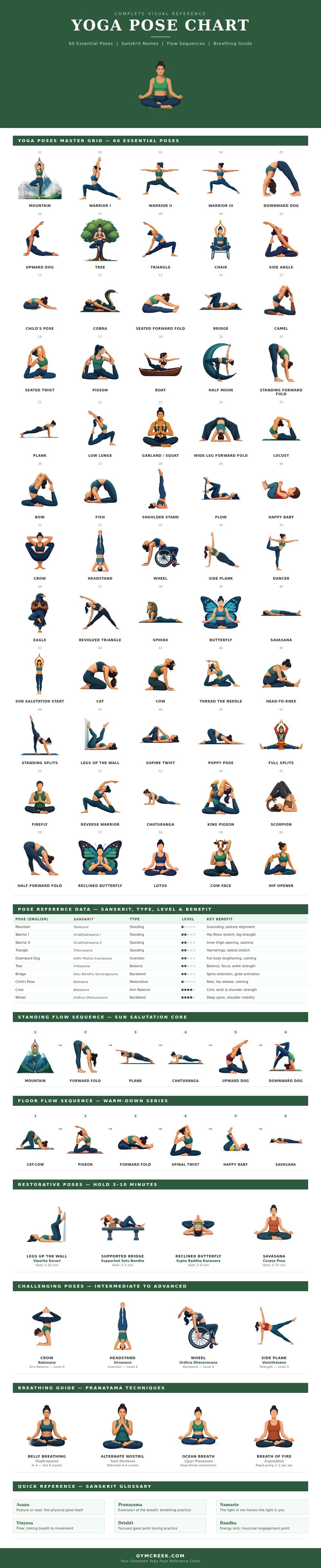
A yoga pose chart can provide a visual representation of many yoga pose, and it can help you to understanding the correct alignment for each of those yoga poses. When you are performing yoga poses, you may find it difficult to understand whether you are performing them correct. However, a yoga pose chart can help you to understand the poses that is required of you in yoga.
A yoga pose chart displays sixty different foundation yoga poses, and each pose include the Sanskrit name for that pose, the category of that pose, and the benefit that the pose provides to the body. This information is all contained in one location so that you dont have to search for this information elsewhere. The poses is arranged into specific categories within the pose chart.
How a Yoga Pose Chart Helps You Learn Yoga
Categories of poses may target specific benefits for the body. For instance, standing poses provides benefits for the legs, while inversions can help to quiet the nervous system. Categories of poses may also target specific effort for the body.
For instance, restorative poses require the body to hold certain position for long periods of time, while poses like forward bend may require the body to use muscular effort to maintain those poses. Flow sequences is included on the pose chart to demonstrate how the poses are to be sequenced for the body. Flow sequence are designed to show how one pose can lead to another pose, and to demonstrate how the breath and the movement of the body can be linked to one another.
These flow sequences can help you to learn about the movement of the body, and you can use those sequences to make substitution for other poses within your practice. The pose chart displays which poses are for movement and which poses are for holding pose; however, it does not display for how long each pose should of be held. Breathing technique are also included in the pose chart, as they can alter the way that your body feel as it performs those poses.
For instance, breathing techniques like belly breathing can help to calm the body prior to performance of the poses. Alternate nostril breathing can help the body to feel balance, and poses like ocean breath can help to focus the mind during long yoga poses. The pose chart also uses Sanskrit term to describe the poses and categories.
For instance, asanas can refer to the poses that is required of the body during yoga practice. Pranayama poses can refer to techniques that extend or control the breath of the body. Drishti poses require the body to focus on a specific target in order to maintain balance during that pose.
These term become more meaningful for the practice of yoga when you learn them. Overall, a pose chart lowers the barrier between the intentioning of a pose and the actualy performance of the pose. Not all poses has to be learned perfectly, but the intentioning of each pose can be understood through the pose chart.
The pose chart can be used to understand the purpose of each pose, and to use breathing techniques to remain present during the practice of yoga poses. If you ever become unfamiliar with a pose, you can always return to the pose chart. You may use the pose chart to build a sequence of poses for performance.
The poses are arranged in a way that make it easy to understand the relationship between poses, which can be used to adjust the practice based off the bodys response to those poses.
