VO2 Max Calculator for Yo-Yo Test
Estimate VO2 max from Yo-Yo Intermittent Recovery Test distance, compare IR1 and IR2 scores, and review heart-rate recovery from one field-test entry.
📌Presets
Presets load realistic Yo-Yo test profiles, including distance, shuttles, heart-rate response, surface quality, and altitude.
⚙Calculator
Yo-Yo VO2 max estimate
Enter a valid Yo-Yo distance score to estimate aerobic capacity.
📊Fitness Metrics Grid
📑Reference Tables
| Variant | Best use | VO2 max equation | Distance style |
|---|---|---|---|
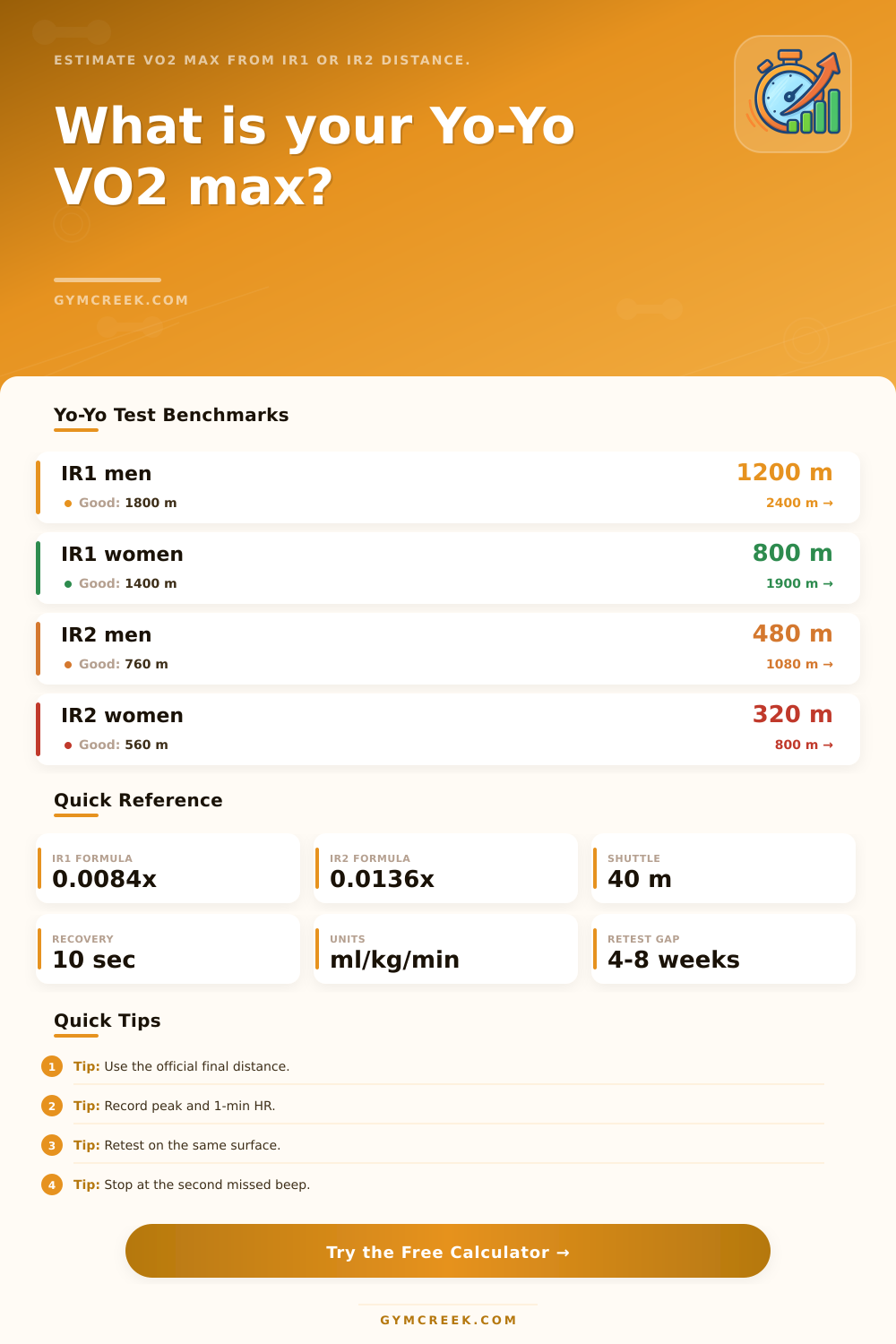
| Yo-Yo IR1 | Team-sport aerobic repeatability | 36.4 + 0.0084 × distance | 40 m shuttles |
| Yo-Yo IR2 | Higher-intensity repeat-sprint endurance | 45.3 + 0.0136 × distance | 40 m shuttles |
| Score entry | Official test sheets | Use accepted final meters | Round to protocol |
| Shuttle entry | Manual field notes | Shuttles × 40 m + partial | Approximation |
| Group | Developing | Good | Elite field score |
|---|---|---|---|
| IR1 men | Under 1200 m | 1600-2200 m | 2400 m+ |
| IR1 women | Under 800 m | 1200-1700 m | 1900 m+ |
| IR2 men | Under 480 m | 720-1000 m | 1080 m+ |
| IR2 women | Under 320 m | 520-720 m | 800 m+ |
| Final speed | Typical IR1 distance | Typical IR2 distance | Interpretation |
|---|---|---|---|
| 15.0 km/h | 800-1200 m | 240-400 m | Base fitness |
| 17.0 km/h | 1400-1800 m | 520-680 m | Competitive |
| 18.5 km/h | 1800-2200 m | 760-920 m | High level |
| 20.0 km/h | 2300 m+ | 1000 m+ | Elite repeatability |
| Metric | What it means | Useful range | Watch for |
|---|---|---|---|
| VO2 max | Relative aerobic capacity | 45-65+ | Protocol changes |
| HR drop | 1-minute recovery response | 25-45 bpm | Low recovery |
| Peak HR | Effort at test stop | 90-100% | Under-paced test |
| Surface factor | Context for slower fields | 0.94-1.00 | Compare like with like |
💡Tips
The Yo-Yo test measure an athletes aerobic capacity and there ability to recover from that intense exercise. The test consists of intervals of sprinting, pivoting, and jogging, but also include periods of recovery between each of those intervals. Beyond measuring how far an individual can run during the Yo-Yo test, the test also measurement how quickly an individual can recover between intervals of sprinting.
One of the physical attribute that can be measured by performing the Yo-Yo test is a persons VO2 max rating. VO2 max is a measurement of the amount of oxygen that an individual can utilize during periods of intense physical exercises. Inputting a persons total distance into a calculator provide an estimate of their VO2 max. The coefficient that the test applies to the distance ran by an individual change based off whether they performed the IR1 or the IR2 version of the Yo-Yo test.
The Yo-Yo Test Measures Fitness and Recovery
Many team sports use the IR1 version of the test to measure the aerobic capacities of their athletes, but professional athletes perform the IR2 version to measure their ability to perform sprints repeatedly. The surface upon which an individual perform the test can impact the total distance that they can run. For instance, running on a slippery pitch of grass require the use of more energy than running on an indoor court.
This effect on the performance of the test can be accounted for by the calculator that estimate an individual’s VO2 max.
Heart rate data can also be used to calculate an individual’s VO2 max. An individuals peak heart rate can indicate whether or not they push their body to its physical limit during the Yo-Yo test. Additionally, an individuals heart rate after one minute of the test indicate how efficient their heart can clear metabolic waste from their body. If an individuals heart rate drops significant within the first minute after the test, this indicates that their body is efficient at performing high levels of exercise repeatedly.
However, if their heart rate remain high during the recovery period after the Yo-Yo test, this indicates that an individuals recovery engine is not functioning at an efficient rate. The rating system for the test can help to provide an individual with context for their VO2 max score. A VO2 max score by itself can be difficult for an individual to understand and compare to others.
The rating system compare an individuals VO2 max score to their age and sex. For instance, the elite VO2 max score for a twenty year old athlete will be higher than the elite score for a thirty five year old athlete. This rating system allow an individual to understand whether their score is high in comparison to other athletes or if it remain average compared to others with the same age group.
It is common for individuals to make the mistake of attempting to pace themselves during the Yo-Yo test. However, an individual should not pace themselves during the test because the test is designed to find an individuals physical breaking point. During the test, an individual should operate as close to their physical limit as possible in order to reach their breaking point when they miss the last beep on the test.
If an individual does not push themself to their limit during the Yo-Yo test, their VO2 max will be artificially low and not reflective of their true aerobic capacity. Individuals should not perform the Yo-Yo test every week. The Yo-Yo test is an intense physical event that tax the central nervous system.
An individuals aerobic capacity does not change overnight. Therefore, individuals should allow time for their body to adapt to change in physical capacity. Many athletes allow four to eight weeks between Yo-Yo test.
This four to eight week period allow athletes to perform a training block that increase their aerobic capacity prior to performing the Yo-Yo test again. Though the Yo-Yo test can provide an individual with a measurement of their VO2 max, the test does not provide any measurement of mental or tactical skill. However, knowing an individuals VO2 max does allow them to stop guessing at their physical capability.
Knowing an individuals aerobic capacity allow them to train their body with intent in order to increase their aerobic capacity.