Y Balance Test Score Calculator
Normalize anterior, posteromedial, and posterolateral reach distances by limb length, then compare side-to-side asymmetry for a cleaner movement screen.
📌Presets
Each preset loads a full bilateral Y-Balance profile with limb length, three reach directions, test quality, pain status, and sport context.
⚙Calculator
Y-Balance score snapshot
Enter bilateral reach values to calculate composite and asymmetry scores.
📊Metrics Grid
📑Reference Tables
| Composite | Band | Meaning | Next step |
|---|---|---|---|
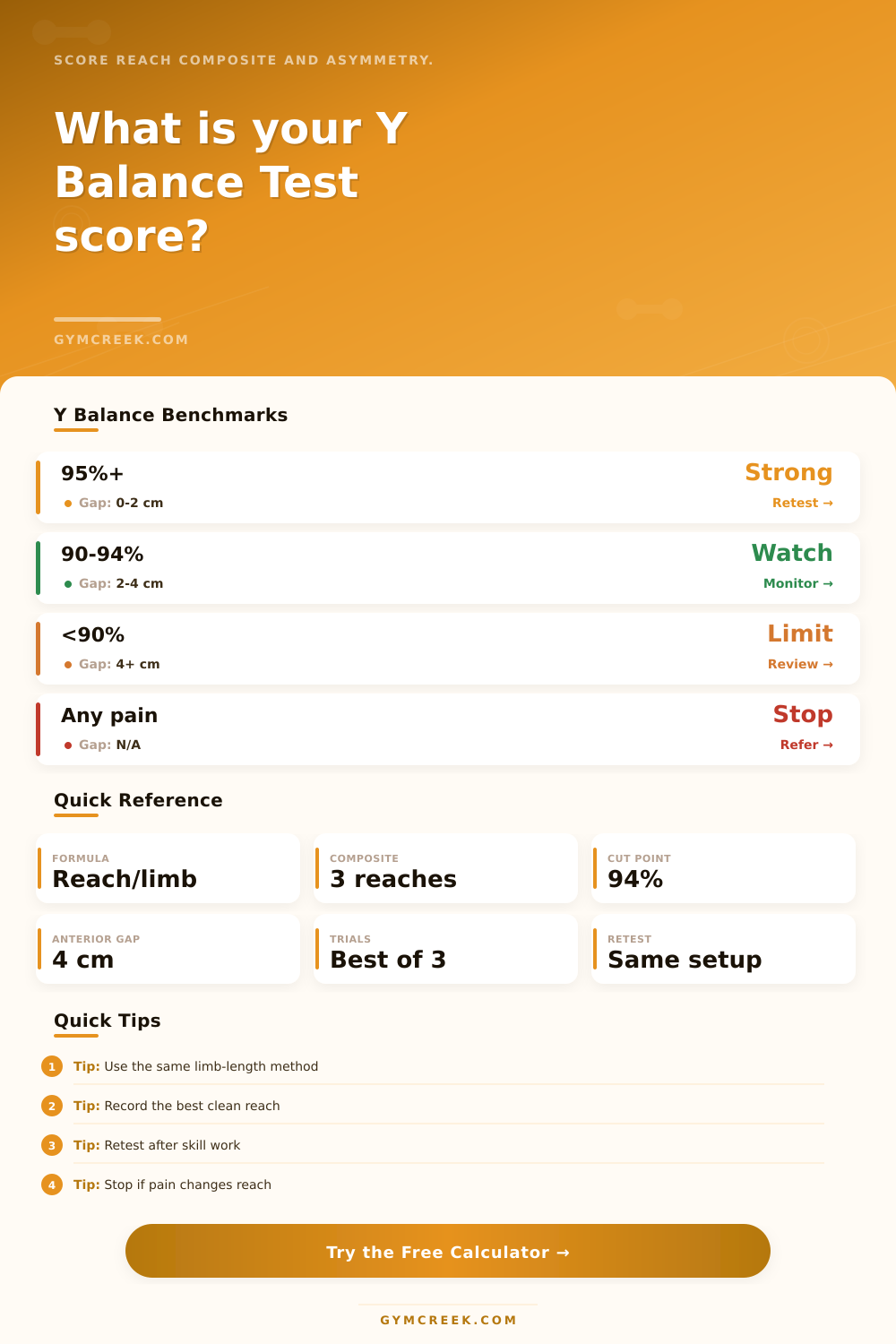
| 95%+ | Strong | High reach total | Track baseline |
| 90-94.9% | Watch | Borderline screen | Retest soon |
| <90% | Limited | Low reach total | Review quality |
| Any pain | Stop | Pain affected test | Refer out |
| Asymmetry | Green | Caution | Why it matters |
|---|---|---|---|
| Anterior | 0-3.9 cm | 4+ cm | Linked to control |
| Composite | 0-2.9 pts | 3+ pts | Side difference |
| PM or PL | 0-5.9 cm | 6+ cm | Posterior reach gap |
| Limb length | Matched | Recheck | Normalizes score |
| Scenario | Right | Left | Flag |
|---|---|---|---|
| Soccer RTP | 95% | 93% | Watch |
| Runner base | 96% | 96% | Strong |
| Ankle rehab | 88% | 95% | Review |
| Court sport | 92% | 91% | Watch |
| Formula | Inputs | Output | Use |
|---|---|---|---|
| Composite | ANT+PM+PL | % limb | Main score |
| Reach norm | Reach/limb | % | Direction score |
| Asymmetry | Side diff | cm or pts | Compare limbs |
| Readiness | Score+pain | Band | Screen flag |
💡Tips
Stand on one foot, root into that stance leg and with the other foot, reach forward. Simple enough right? Well, here is what it says about your athletic integrity that no gym machine can match.
The Y balance test isn’t simply to see if you’re flexible. It also measure how well your body maintains stability across different directions of movement. It also measures neuromuscular control. Most people use this as a stretch drill. But again, the true value is in the data you capture and standardize.
Why the Y Balance Test Is Important for Your Body
To measure reach, go from the medial malleolus to the ASIS. Why? Because it’s all relative, which means raw numbers don’t tell us much. Even with identical control, someone with longer legs reaches farther then someone with short ones. Normalizing reach by limb length provide an apples-to-apples comparison between athletes of various sports/body types. Simply input both sides in the calculator and let it do the math (no need to divide lengths yourself).
After you reach as far as possible to the sides, front, and back on both your right and left side, the system will tally a composite “dynamic balance” score for each leg. The higher it is (above 95%), the greater your ability to control yourself. A lower score (typically below 90%) suggests that stabilizer muscles can’t handle how far through space you’re going. That’s typically a sign of an ACL problem or sprained ankle. Why? Because your body is mobile but hasn’t yet caught up in terms of coordination. It is not because you lack strength.
Danger hides in asymmetry. Your total score looks fine but one limb is way off, limb length difference of four centimeters or greater (anterior reach) can be a red flag when deciding return-to-play status. Such a difference is typical following injury to the lower extremity (e.g., ankle sprain). Greater asymmetries is associated with increased risk of re-injury, according to research. That doesn’t necessarily indicate current injury. Rather, it suggests an imbalance in movement patterns. This could leave the weaker limb vulnerable during fatigue or impact.
How do you know if you should of continue practicing fully, or work on the weaker side? The reference table guides your decision. That’s where context comes into play with these tests. Comparing an elite sprinter versus someone recovering from a lateral ankle sprain on a soccer field require different standards. They do have presets for common scenarios. A weekend warrior playing basketball has different demands than a tactical athlete preparing for deployment.
The final warning is that if you are experiencing any sort of pain throughout the test it makes the data worthless. Pain changes your motor output. So what does it matter? Refer to a clinician then.
Consistency is key to retesting. Test on the same surface with the same footwear and warm up routine. That way, any changes in scores is due to improved balance rather than a change in the environment. Your warmup routine also counts, as warm muscles work better then cold ones. Don’t sacrifice your form for a really long reach just because it’s “the best”. It’s better to have clean trials in which you maintain control over the test even if they weren’t as long.
It’s a trust thing. Trust your joints. Trust your landing mechanics. And trust your data. If there isn’t much asymmetry, if the numbers add up, then you’re good to go. If not, you have an early warning system and you know when to pull it back so you can correct course before an injury takes you out of the game.