Wrist Roller Load Calculator
Estimate hanging load, per-hand wrist torque, vertical lifting work, and the next load jump for wrist roller training.
📌Presets
Each preset loads a realistic wrist roller setup and recalculates the recommended hanging weight.
⚙Calculator
Wrist roller load snapshot
Enter a current load and trips to calculate your next working weight.
📊Fitness Metrics
📑Reference Tables
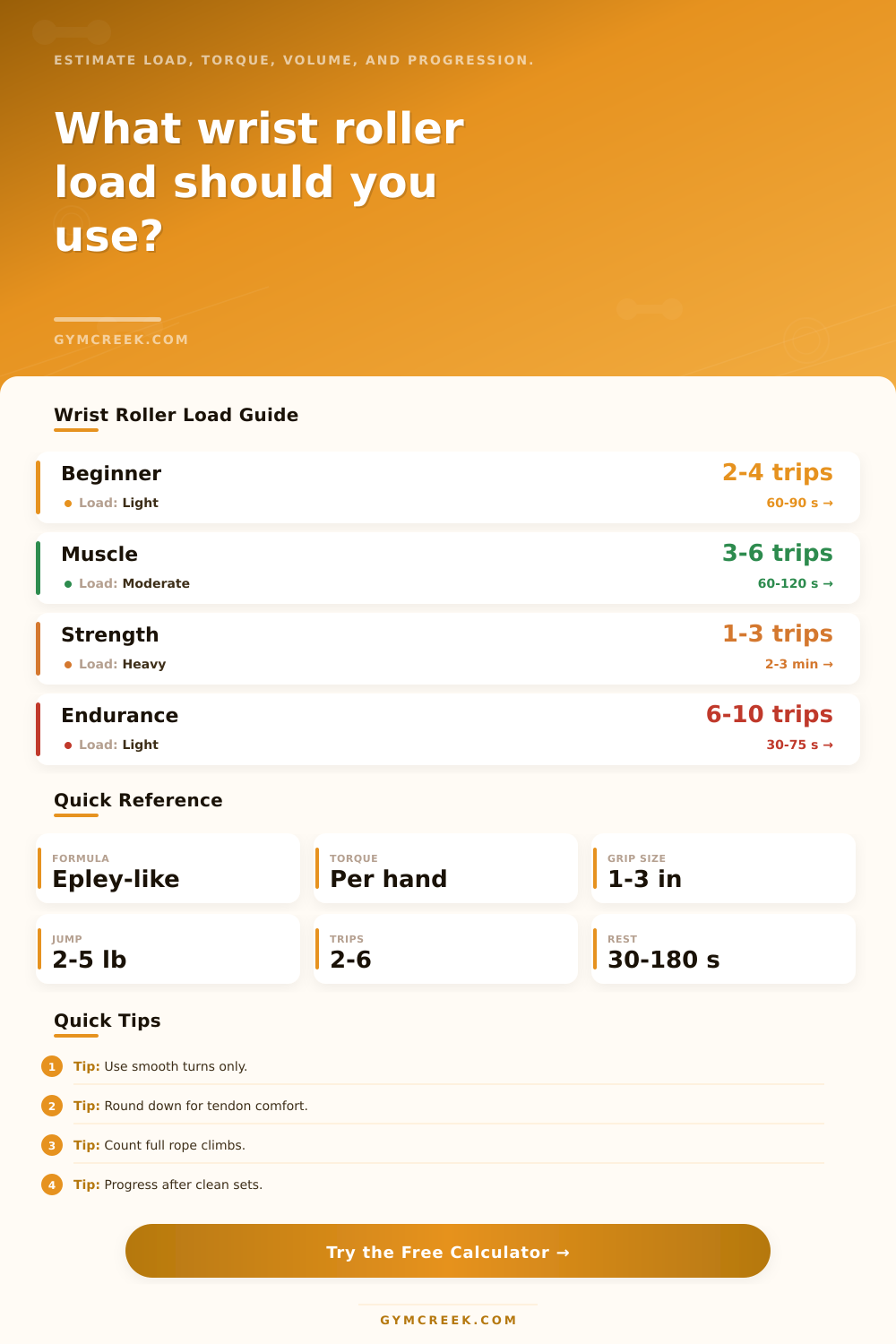
| Goal | Trips Per Set | Relative Load | Rest |
|---|---|---|---|
| Skill base | 2-4 full climbs | 4-8% body weight | 60-90 sec |
| Forearm muscle | 3-6 full climbs | 6-12% body weight | 60-120 sec |
| Heavy torque | 1-3 full climbs | 10-18% body weight | 2-3 min |
| Grip endurance | 6-10 full climbs | 3-7% body weight | 30-75 sec |
| Roller Diameter | Torque Effect | Best Use | Load Note |
|---|---|---|---|
| 1.0 in / 2.5 cm | Lower torque | Higher trips | Can load more |
| 1.5 in / 3.8 cm | Baseline | General work | Balanced |
| 2.0 in / 5.1 cm | Higher torque | Strength sets | Reduce load |
| 3.0 in / 7.6 cm | Very high | Advanced grip | Start light |
| Setup | Load Effect | Limiting Factor | Use Case |
|---|---|---|---|
| Elbows supported | Highest load | Forearms | Strict torque |
| Near torso | Baseline | Grip and wrists | Most sessions |
| Arms extended | Lower load | Shoulders | Challenge sets |
| Cable roller | Drag adjusted | Pulley friction | Stack match |
| Formula | Variables | Output | When Used |
|---|---|---|---|
| Trip capacity | Load, clean trips | Load ceiling | 1-12 trips |
| Torque | Load x radius | Per-hand torque | All rollers |
| Lift work | Load x length | Session volume | Full climbs |
| Progression | Load + jump | Next target | Clean sets |
💡Tips
People often think wrist rollers are just an accessory exercise to use for warming up, but that misses point entirely. When using wrist rollers, you’re training eccentric strength to maintain a solid grip while gripping under prolonged tension. It’s like conditioning the connective tissue that forms your grip. Depending on the load, you can train for either tendon adaptation through stress or for endurance. This is easy enough physics, but few folks follow it properly. They guess what they weigh and go from there.
That’s why I built the calculator: You input your roller diameter and your rope length and it does the math. It matters because torque isn’t a static thing. A 15 pound plate will feel different on a two inch handle compared to a one inch handle. And when you have a bigger radius, you’re creating more leverage against the flexors and extensors in your wrist. So you can create more stress on your joint with the same amount of weight because of the tool you chose to use. When you understand this, you learn how to adjust your intensity without having to add big plates that crush your grip so fast.
How to Use the Wrist Roller Calculator
The question then becomes: How much stress are your tendons capable of handling? Newbies frequently overload and go heavy right away; they believe that heavy means better. Unfortunatley, tendon adaptation lag behind muscle growth. High-rep, moderate-load exercises promote muscle growth, whereas low-rep, heavy-weight workouts require greater recovery time (longer rest periods). You’ll notice the differences in this reference table. Short breaks and light loads promotes endurance training; long rests and heavy torque support strength work. Overuse injuries typically occur when you mix protocols.
Results vary depending on how you set yourself up as well. With your arms at your sides, your forearms is isolated. When extending your arms at shoulder height with a wrist roller, your traps and shoulders will typically give out long before your wrists ever start to fail. This is why the calculator requests that you specify your setup style, it accounts for the leverage of that position. For example, if you train for combat sports or climbing, then set yourself up like you would during competition so that the angle of stress is replicated. Tuck your elbows to increase the load placed on your wrists outright (which may help thicken your forearms).
Another factor overlooked by people is tempo. If you roll it up fast, there’s momentum which makes the eccentric phase easier. Tendon conditioning happen during the control of how fast it comes back down. Slowing the movement so you have steady tension keeps the weight from banging around and bouncing when it hits bottom. That steady motion is safer on your joints and each turn will be counted as a repetition.
Drag and other factors like rope or pulley type makes a difference too. More friction means it takes more force to get it going so it can increase the intensity without having to add any weight. The tool figures this into the equation. Don’t judge your progress in terms of pure poundage. Use consistent effort as your measure. Add more weight after achieving full form for all scheduled outings. Failure to do so indicates breakdown and you’re ready to move to a heavier load. Conversely, finishing strong with gas left in the tank suggest you haven’t been pushing it hard enough.
And that’s where the calculator comes into play: It recommends your next jump in load size, typically one small increment such as five or two pounds. Going easy on yourself helps avoid plateaus and keep joint stress at a reasonable level. The wrist roller teaches balance between control and force. Think of it like stabilizing your hand through a long hold or when lifting something heavy. Respect your torque limits. Track your volume. Use this as a strength builder with a simple rope roll. Focus on smooth motion, start light, and let the numbers tell you how far you should of pushed yourself. This isn’t about winning a contest. It’s about building a grip that refuses to quit.