Wrist Curl Load Calculator
Estimate a strict wrist curl working load from your current reps, grip setup, range of motion, tempo, rest, effort, and forearm training goal.
📌Presets
Each preset fills a realistic wrist curl scenario and recalculates the suggested load.
⚙Calculator
Wrist curl load snapshot
Enter a current strict load and calculate your next forearm working weight.
📊Fitness Metrics
📑Reference Tables
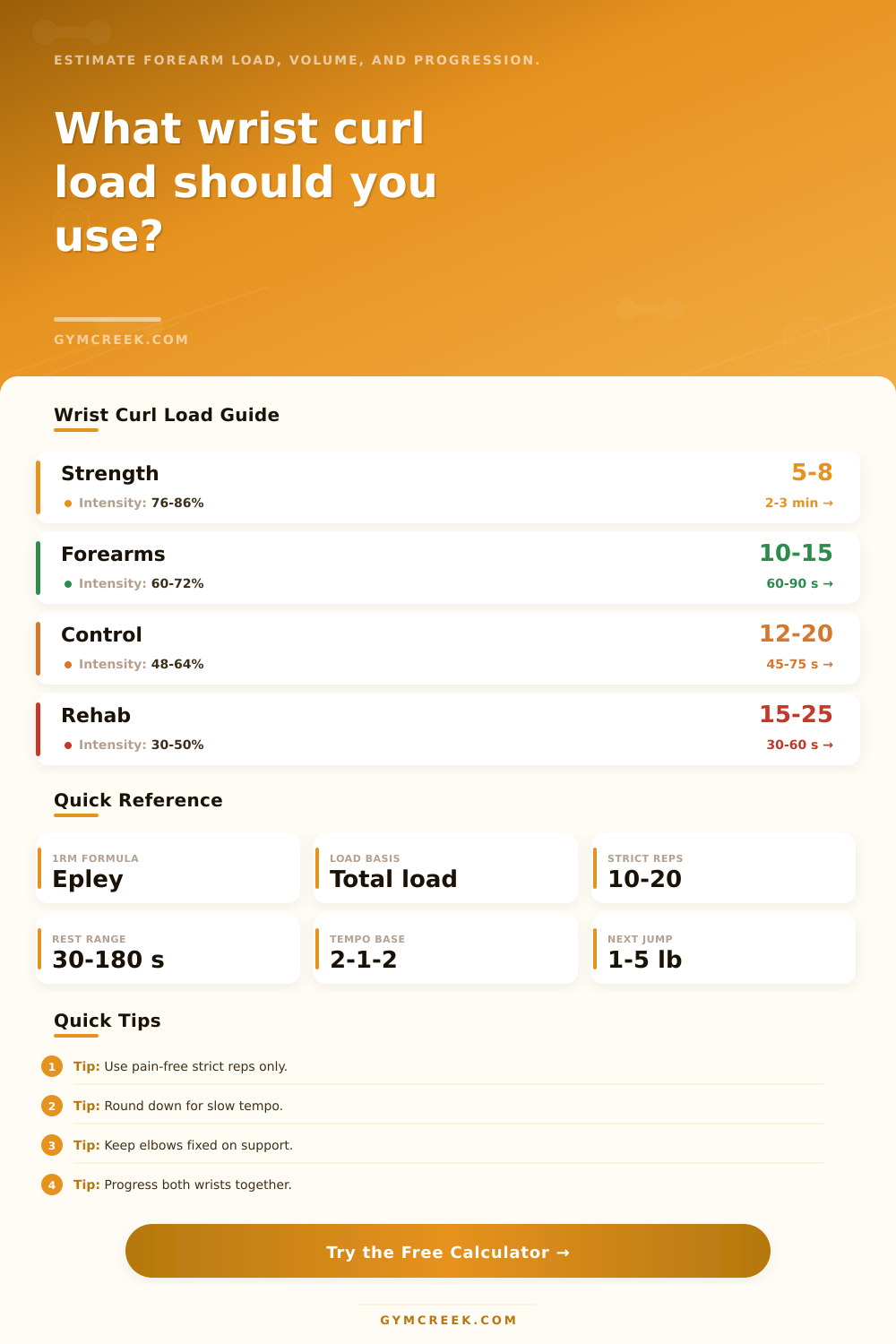
| Goal | Rep Range | 1RM Range | Rest |
|---|---|---|---|
| Forearm strength | 5-8 | 76-86% | 2-3 min |
| Hypertrophy | 10-15 | 60-72% | 60-90 sec |
| Pump endurance | 15-25 | 40-60% | 30-60 sec |
| Return week | 15-25 | 30-50% | 30-90 sec |
| Variation | Load Effect | Best Target | Form Cue |
|---|---|---|---|
| Seated palms up | Base | Flexors | Elbows fixed |
| Behind-back | +8% | Heavy flexion | Soft knees |
| Single dumbbell | -8% | Side balance | Match wrists |
| Reverse wrist curl | -25% | Extensors | No shrug |
| Cable curl | -3% | Even tension | Brace forearms |
| Relative Level | 1RM to BW | Example | Use |
|---|---|---|---|
| Novice | Under 18% | 20-35 lb | Skill base |
| Intermediate | 18-30% | 35-60 lb | Forearm work |
| Advanced | 31-45% | 60-90 lb | Heavy sets |
| High specialist | 46%+ | 90 lb+ | Grip sport |
| Formula | Variables | Output | When Used |
|---|---|---|---|
| Epley 1RM | Load, reps | Max estimate | 2-20 reps |
| Rep intensity | Target reps | Base load | Work sets |
| Volume | Load x reps x sets | Total work | Direct sets |
| Progression | Load + jump | Next target | Clean reps |
💡Tips
Forearms get little love from most lifter, until they can’t hang onto a pull-up or feel forearm cramps in the middle of a deadlift. The wrist curl corrects this oversight, but its tricky to load appropriately. There isn’t a “go heavy with a big bar” approach like you’d have for bench presses or squats. The small muscle tire fast and don’t take weight well when your form falters.
How much do you load? That’s the question that dictate whether the workout will build muscle or wreck a tendon. Now that you have enter your goal (and your starting strict reps), the calculator do all the work for you. It eliminates need for making guesses about volumes and intensity percentages.
How To Use The Calculator
It begins with this question: How much do you clean, and how many reps? You’ll notice it wants you to enter a specific number of reps. Why? Because that’s the anchor point for this calculation.
If you cheat on a rep. I.e., lift your forearm off the bench, then this estimate won’t apply. The reason is simple: wrist curls has a very small range of motion. When you’re at the bottom of movement, it’s nearly impossible to distinguish between a partial rep and a full rep unless someone’s looking closely. For this reason, the program presume that you’re sticking to wrist movements alone while keeping your elbow fixed. If you start rocking your arm, you’re transforming the exercise into a bicep curl. That completely undermines what we’re trying to achieve.
After setting the baseline, the calculator tweak itself according to your training goal. Going for pure strength? Rep range goes down; intensity percentage goes up. Hypertrophy? Typically, the sweet spot fall somewhere between 10-15 reps. That’s when your forearms will flourish… They’re particularly receptive to metabolic stressors.
Tempo enters the equation as well. Lowering the bar over a period of two-to-four seconds (the slow lowering phase) extends the amount of time the forearm stay under tension without having to add any additional weight. Again: We don’t need to wrap extra-heavy plates around our wrists; it’s much safer to manipulate the muscles involved rather than a heavy dumbbell hell-bent on smashing into your palm.
The second part of the equation is the support method. Because your biceps aren’t working when your forearms rest on bench, you can use more weight. When doing the move while standing up, your whole body are involved, so you won’t be able to lift as much weight. This is why the tool factors in what part of your wrist is free-floating or braced when recommending how much weight you should of load.
A lighter load is needed for reverse wrist curls too. The flexors (on the underside) is bigger and stronger than the extensors (on the top). Attempting to use the same amount of weight for the reverse exercise as you do for palms-up curls will result in overtraining.
The other thing it measures is volume. High-frequency exercises includes wrist curls. These are exercises where you can recover quickly between reps. Higher rep sets with short rest periods tend to produce better results then heavy low-reps sets. Those distinctions are spelled out in the reference tables on the page. And they illustrate the change in rest intervals from two minutes for strength work to forty-five seconds for endurance work.
Match your stimulus to your goal. Use higher volume for bigger forearms. Use more control and intensity for stronger grips in martial arts or rock climbing. Don’t rush it. Forearm muscles don’t adjust to additional weight like your back or quads. Often, simply adding a pound or two each couple of weeks will be sufficient. Rushing too much too quick will cause sloppy form and decreased range of motion. While the calculator tell you what the next progression target should be based off your starting workout, you’ll want to heed the advice of your joints first. Don’t confuse pain with pushing through pain. That’s a sign to stop.
The benefit of wrist curls is precision. It’s not about how much weight can be moved. It’s about applying just enough tension to stimulate an area consistantely. The feel of the burn is the guide. Use the suggested load as a starting point and focus on the squeeze at the top of the motion. Allow the weight to lower slowly. Treat your forearm like your other larger muscle group and they’ll grow.
Good training versus great training comes down to that careful attention to detail. It begins with the right load and it ends with strict form.