Wrestling Hydration Test Calculator
Estimate hydration-test readiness from urine specific gravity, body composition, target class, descent-rate limits, and certification timing.
📌Presets
Presets load realistic certification scenarios and recalculate hydration status, minimum wrestling weight, and descent schedule.
⚙Calculator
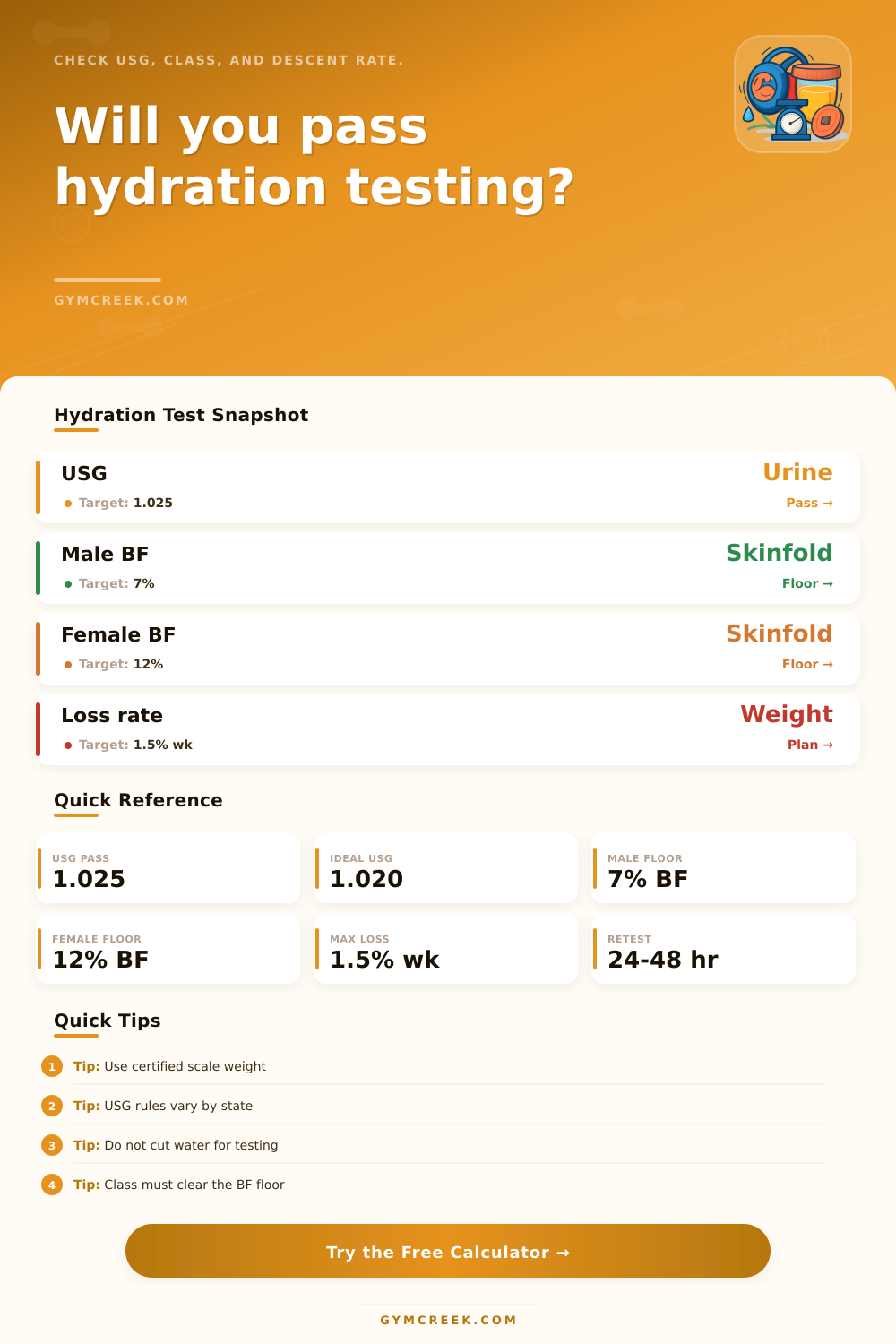
Hydration test snapshot
Enter USG, body composition, and target class to calculate readiness.
📊Fitness Metrics
📑Reference Tables
| USG range | Common read | Testing note | Action |
|---|---|---|---|
| 1.000-1.019 | Hydrated | Usually passes | Test normally |
| 1.020-1.025 | Watch line | Can pass common rule | Confirm rule |
| 1.026-1.030 | Borderline | Often retest | Delay cut |
| 1.031+ | High USG | Likely fails | Rehydrate |
| Rule item | Common value | Formula | Purpose |
|---|---|---|---|
| Male BF floor | 7% | LBM / 0.93 | Min weight |
| Female BF floor | 12% | LBM / 0.88 | Min weight |
| Descent rate | 1.5% weekly | Weight x .015 | Timeline |
| USG pass | 1.025 | USG <= line | Hydration |
| Status | Signal | Class note | Meaning |
|---|---|---|---|
| Green | USG pass | Class legal | Ready |
| Yellow | Near line | Time tight | Monitor |
| Orange | USG high | Class okay | Retest |
| Red | Class below | BF floor | Not legal |
| Formula | Inputs | Output | Use |
|---|---|---|---|
| Lean mass | Wt, BF% | LBM | Floor |
| Min weight | LBM, floor | Weight | Class |
| Max loss | Weight | 1.5% wk | Plan |
| Mifflin | Wt, ht, age | BMR | Context |
💡Tips
Wrestling weight certification involve several different variable. To complete the certification process, you must manage your hydration, your body fat percentage, and follow the rules establish by your state wrestling association. Knowing these different variables allow wrestlers to adjust for whether they pass the certification or have to take a retest.
The certification process can be challenging because there is many rules and measurements to manage for each wrestler. One of the most important variable is the urine specific gravity reading. This reading measure the concentration of the urine sample that the wrestling officials submit for examination.
How to Pass Wrestling Weight Certification
Based off the reading, the officials can determine if the wrestler have limited fluids in the body. If the wrestler do have limited fluids, then the wrestler will need to take a retest to submit another urine sample. Another important variable is the body fat percentage that each wrestling program require wrestlers to maintain.
There is a minimum body fat percentage that each wrestler must maintain to protect their body from losing too much weight too quicky. The body fat percentage also limit the wrestler from competing in a weight class that is too low for that wrestler; if the wrestler weighs too much less than the minimum weight based on lean body mass, then they will not be eligible for competition in that weight class. The descent rate rule limit how much weight a wrestler can lose in a single week.
Many wrestling associations limits the descent rate to a percentage of the wrestlers current body weight. This rule is created to avoid rapid weight loss of fluids and stored glycogen instead of body fat since this can negatively impact an athlete’s performance and the accuracy of body fat percentage measurements. Many wrestlers makes the mistake of showing up for certification dehydrated.
Showing up dehydrated is a mistake because a retest will be required after a period of hours or days to allow the wrestler’s body to rehydrate. The tool will show an estimated window for when a retest can be conduct based on the dehydration of the wrestler. The reference tables contains information about specific gravity and the mathematical formula that calculate the wrestler’s weight and the amount of weight that they can lose each week.
These tables contains the formulas for minimum wrestling weight and weekly weight loss and explain the variables that can change the wrestler’s certification results. Wrestlers’ weights can change frequent. The activity level that is selected in the tool can account for changes in the wrestler’s activity level.
However, the activity level cannot account for all changes to the wrestlers schedule or their health. It is best to enter the wrestler’s weight and training load for many weeks into the program to determine if the weekly weight loss goal is sustainable. The age and sex of the wrestler are another important variable.
The body fat percentage floor for male wrestlers is more different than female wrestlers. The wrestling certification tool will account for this automatically when the wrestler’s sex and age are enter in the form. The goal that is selected at the bottom of the form change the way the application displays the results.
If the wrestler wants to pass certification, the form will show different results than if they are simply determining if their weight class is legal. The math is the same for both selection, but the form allows them to select which one they want to focus on. Wrestlers should use this form during the wrestling season to manage their certifications.
The wrestler should update their weight, their training load, and their target weight every two week. Using this form will allow the wrestler to avoid emergencies and certification retakes.