Wind Chill Running Calculator
Estimate running wind chill from air temperature, wind speed, pace, clothing, duration, exposure, wetness, and route shelter, then translate it into frostbite risk, pace adjustment, and layering guidance.
❄Cold-Run Presets
Presets are planning examples. Replace them with the current forecast, your real route exposure, and the clothes you will actually wear.
⚙Calculator Inputs
Running cold-stress snapshot
Wind chill, frostbite risk, pace drag, and clothing guidance update as inputs change.
📊Metrics Grid
📑Reference Tables
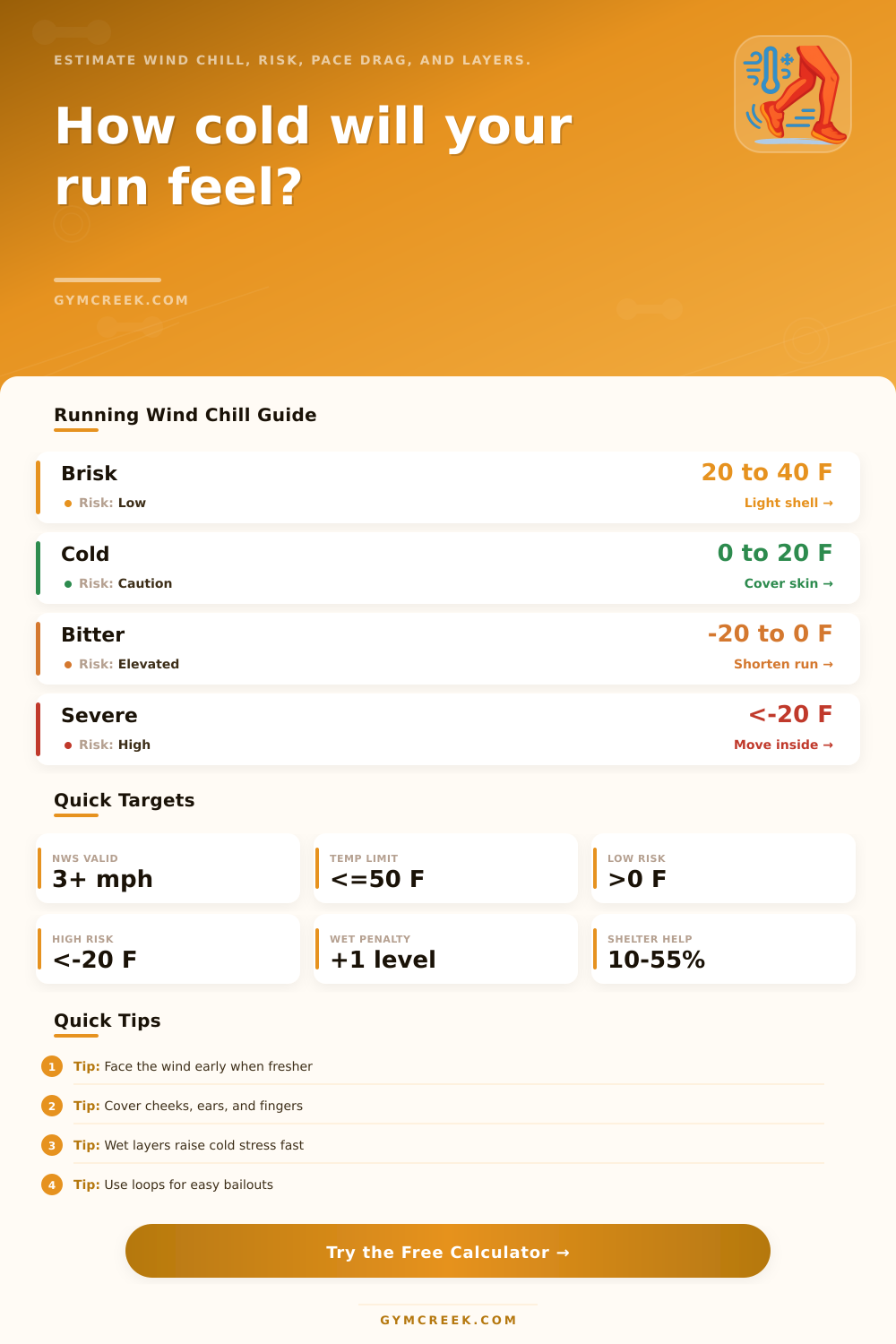
| Running wind chill | Risk band | Exposed-skin window | Running response |
|---|---|---|---|
| Above 20 F / -7 C | Low | Usually low for short runs | Dress for sweat control and cover ears if windy |
| 0 to 20 F / -18 to -7 C | Caution | Long exposure can irritate skin | Cover cheeks and fingers, use a route with bailout points |
| -20 to 0 F / -29 to -18 C | Elevated | Frostbite possible with long exposure | Shorten the run, avoid wet gloves, and check skin often |
| -35 to -20 F / -37 to -29 C | High | Often 10 to 30 minutes | Choose short loops, full coverage, or move indoors |
| Below -35 F / -37 C | Extreme | Can be under 10 minutes | Avoid outdoor training unless expertly prepared |
| Cold band | Base and mid layer | Shell and accessories | Key warning |
|---|---|---|---|
| Brisk | Light base or thin long sleeve | Optional vest, gloves if windy | Do not overdress and soak the base layer |
| Cold | Thermal base and light mid layer | Hat, gloves, wind vest or shell | Hands and ears cool before legs feel cold |
| Bitter | Thermal base plus insulating mid layer | Wind shell, mitts, face cover, warm socks | Manage sweat before turning into the wind |
| Severe | Heavy base and warm mid layer | Full wind shell, balaclava, mitts, eye cover | Outdoor quality depends on staying dry and sheltered |
| Route choice | Wind reaching runner | Best use | Watch point |
|---|---|---|---|
| Open waterfront or bridge | 90 to 100 percent | Only when conditions are moderate | Gusts can dominate the final risk |
| Mixed streets | 65 to 80 percent | Normal winter run planning | Open gaps can be colder than the average |
| Neighborhood blocks | 50 to 65 percent | Cold easy runs and short workouts | Intersections still create wind tunnels |
| Wooded trail | 35 to 50 percent | Very cold days when footing is safe | Snow and ice may slow pace and increase exposure time |
| Indoor access | 10 to 25 percent | Warm-up, cooldown, or bailout option | Do not count indoor warmth for exposed miles |
| Step | Rule | Inputs used | Output |
|---|---|---|---|
| Unit base | Metric entries convert to Fahrenheit and mph internally | Unit toggle | NWS-compatible calculation |
| Runner airflow | Pace converts to running speed, then contributes partial apparent wind | Pace, exposure pattern | Movement wind component |
| Effective wind | Measured wind is reduced by route shelter and adjusted by exposure | Wind, shelter, exposure | Wind used for wind chill |
| NWS wind chill | 35.74 + 0.6215T - 35.75V^0.16 + 0.4275TV^0.16 | Temperature, effective wind | Apparent temperature |
| Risk score | Wind chill band plus duration, wetness, skin, clothing, and intensity | All cold-stress inputs | Practical frostbite risk |
| Pace adjustment | Cold load adds conservative seconds per mile or kilometer | Wind chill, wetness, exposure | Training pace modifier |
| Layer guidance | Cold band is raised by wetness, exposed skin, and weak clothing coverage | Clothing, wetness, skin | Layer recommendation |
💡Cold-Weather Running Tips
Running in cold weather involve many different factors related to both running in cold weather. One of the factors that relates to the body is an effect of wind. The wind can remove heat from the body at a much more faster rate than the still air around the person when he or she is running.
The body also creates some of that airflow, which add to the effect of the wind on the body. Thus, the combination of the wind and the movement of the body creates both the feeling of cold for the runner, as well as contributes to the development of numbness in the finger of the runner. One of the ways to calculate these factors is with the calculator provided for such determinations.
How to Stay Safe When Running in Cold Weather
You can enter factors like air temperature, running pace, clothing coverage, and route into the calculator to determine the effect of each of these variable on the body of the runner. Air temperature is one of the starting points for calculating the effects of the cold weather on the body, but the running variable have much more impact on the body. For instance, running pace will impact the amount of airflow against the body, sheltered routes will provide a differenter calculation then exposed routes with the same air and wind temperature.
Duration and wetness are two additional factor that contribute to the stress caused by the cold weather. Stress is cumulative in relation to the cold weather; ninety minute of running in the cold is more stressful for the body than twenty minutes of running at the same rate. Additionally, wet clothing will lose it’s ability to provide insulation for the body; wet clothing will cause the body to lose heat at a faster rate.
Thus, the body will experience more stress if the clothing become wet. Finally, the route that is taken can impact the amount of wind that hits the body; routes that has many trees or buildings may provide shelter for the body from the wind. Frostbite is one of the most important condition to avoid while running in the cold weather.
Factors that contribute to frostbite include the amount of skin that is exposed to the air, the amount of clothing that covers the body, and the number of break in movement. Areas of the body that lose heat rapidly include the cheeks, ears, nose, and fingers. These areas is provide for in the skin exposure setting of the calculator.
Additionally, the calculator displays a risk band and suggested adjustment in running pace to help avoid frostbite. These effect can be understood through both physics and physiology. Physically, headwinds and wet clothing create physical resistance against movement.
Additionally, the body work to move blood to the extremities to retain heat from those extremities, which use energy that could potentialy be used for running. The conservative estimate of adjustment in pace for cold weather account for these two different science. Before beginning to run, it is important to use the calculator to determine the impact of the cold weather.
If high level of exposure are determined by the calculator, decision can be made regarding the clothing or route to be used for the run. Thus, while not an alternative to personal judgment, this calculator can help runners understand the impact of cold weather on the body. Changes in the body of the runner or changes in the route can both have an impact based off the exposure score.
For instance, changes in route or the addition of a wind-shell will lower the exposure score. Additionally, starting the run with headwinds will also alter the determination of the exposure score. While perfect data cannot be obtained for any of these variable, it is important for the runners to provide honest response to the calculator for the best results of the calculation.
Thus, the calculator provide a means of comparing the various choice of route or clothing. The ultimate goal for runners is to use the calculator to understand when the cold weather may be too difficult for the body with the clothing and route that are to be used, thus allowing for runners to make decisions prior to shivering in the cold weather.