Wilks Powerlifting Calculator
Calculate classic Wilks and updated Wilks 2020 scores from bodyweight, sex, unit system, meet total, or individual squat, bench, and deadlift numbers.
📌Wilks Presets
Each preset loads a realistic bodyweight, sex, formula version, equipment context, and either a full total or the three competition lifts.
⚙Calculator
Wilks score snapshot
Enter bodyweight, sex, and total or lifts to compare classic and updated Wilks points.
📊Powerlifting Metrics
📑Reference Tables
| Version | Scale | Uses | Context |
|---|---|---|---|
| Classic Wilks | 500 / polynomial | Older best-lifter comparisons | Common in historical meet talk |
| Updated Wilks 2020 | 600 / polynomial | Modern Wilks-style comparisons | Rebalanced coefficients |
| Bodyweight input | Always kg internally | Coefficient calculation | Pounds convert to kilograms |
| Total input | Always kg internally | Score = total x coefficient | Use meet-legal total |
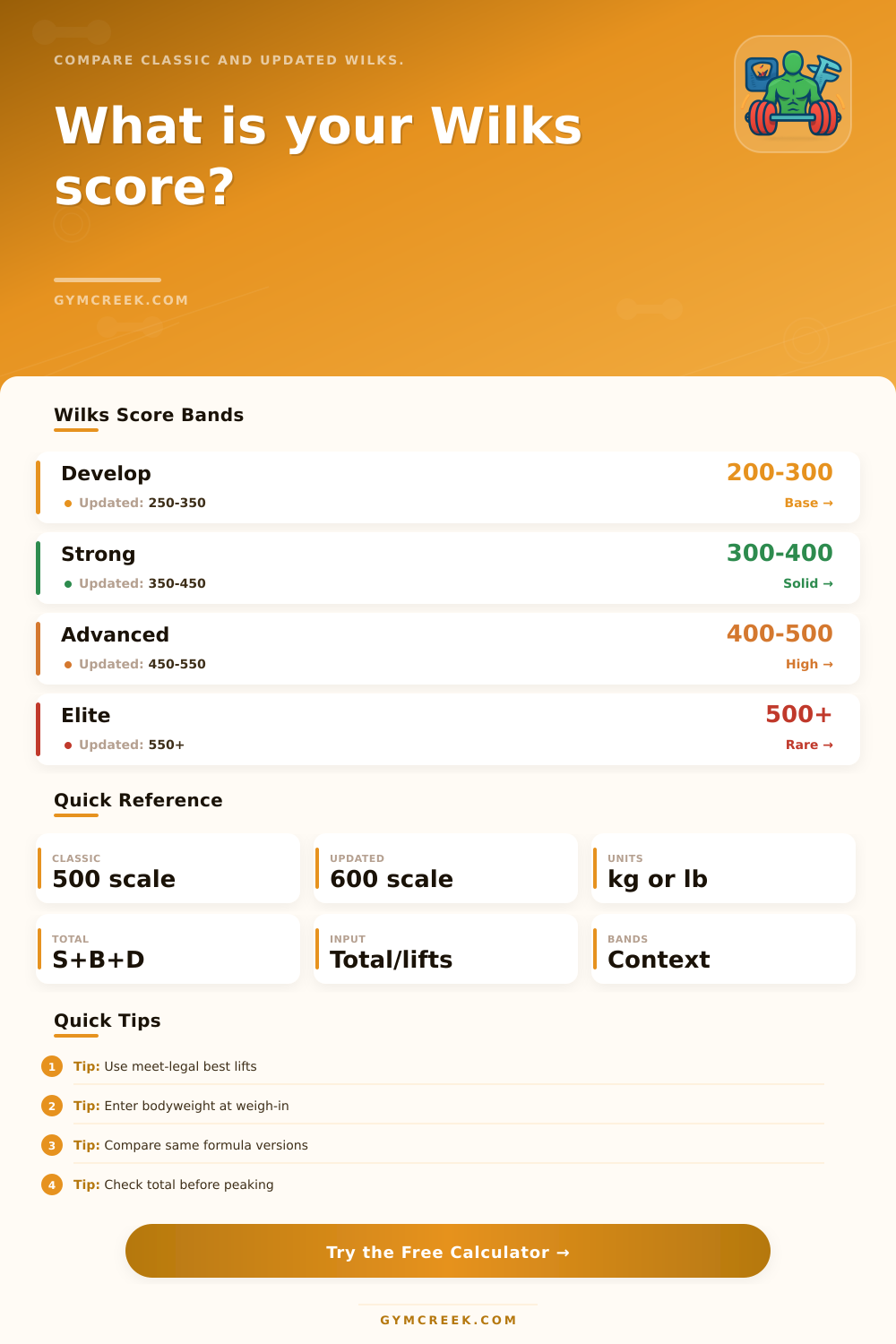
| Band | Classic Wilks | Updated Wilks | How to read it |
|---|---|---|---|
| Developing | Under 300 | Under 350 | Useful novice or early meet context |
| Strong | 300 to 399 | 350 to 449 | Competitive local strength |
| Advanced | 400 to 499 | 450 to 549 | High regional or serious standard |
| Elite | 500 plus | 550 plus | Rare total relative to bodyweight |
| Lift | Common share | Calculator metric | Watch point |
|---|---|---|---|
| Squat | 32% to 38% | Squat divided by total | Low share may signal technical gap |
| Bench | 20% to 28% | Bench divided by total | Often equipment and sex sensitive |
| Deadlift | 34% to 42% | Deadlift divided by total | High share can hide squat weakness |
| Total | All three lifts | Squat plus bench plus deadlift | Total-only mode skips lift balance |
| Item | Classic | Updated | Calculator note |
|---|---|---|---|
| Male coefficients | 1990s Wilks | 2020 Wilks | Separate polynomial from female |
| Female coefficients | 1990s Wilks | 2020 Wilks | Separate polynomial from male |
| Formula output | Total x coefficient | Total x coefficient | Score units are points |
| Best use | Same formula comparisons | Same formula comparisons | Do not mix score systems |
💡Tips
Powerlifting competitions involve comparing the strength of different lifter. Comparing lifters, however, is difficult due to the fact that lifters has different bodyweights. A lifter who can lift heavy weights may have a much larger body than another lifter who can lift slightly lighter weights.
The Wilks formula helps to solve this problem of comparing lifters because the Wilks formula transforms the raw weights that an lifter lifted into a single score that accounts for the bodyweight of that lifter. The Wilks formula do not consider the unit of weight for which the lift was performed… It does not matter if the weights were measured in kilogram or pounds.
How the Wilks Formula Helps Compare Lifters
The formula only considers the relationship between the weights that the lifter lifted and the bodyweight of the lifter. The calculator on this site will calculate the mathematical components of the Wilks formula for you. To use the calculator, you will need to enter your bodyweight at the time of your weigh-in, your sex, and either your total weight lift during competition or the individual weights of your three competition lifts.
The calculator will output both a classic Wilks score and an updated 2020 Wilks score. Both of these scores is provided to ensure that the results of your competition lifts can be compared to those recorded at older Powerlifting meets that used the classic formula as well as to those that use the more updated and revised coefficients in their rankings of powerlifters. The classic formula and the updated 2020 formula are slightly different than one another in their coefficients.
The classic formula used a 500 point scale with coefficients that provided a certain weight class with a higher value than others. The updated 2020 formula now uses a 600 point scale and coefficients that are rebalanced such that the updated formula provides a score to each powerlifter that reduce the bias that the classic formula provided to certain weight class. Thus, the scores for each powerlifter will be different depending upon the formula used and a powerlifter’s score may change enough with the update to place them into a different scoring band for powerlifting competition.
These two scores are displayed on the screen alongside one another so that the user does not have to guess which scoring band their score falls into. Bodyweight is the most important value that is required for the performance of the calculations for the Wilks formula. The coefficient for the Wilks formula is based entirely upon bodyweight.
The value that is entered for bodyweight should be the actual bodyweight of the powerlifter at the time of the competition weighs in. Using a rounded training weight instead of the actual weigh-in value will lead to inaccuracies in the calculated bodyweight. Additionally, because the coefficient is based upon bodyweight, changes to bodyweight will have an impact upon that calculated coefficient.
Thus, powerlifters may track their bodyweight at the same time of day each that they compete in powerlifting meets. The calculator allows for either the total weight lifted to be entered or the individual lift to be entered separately. Additionally, if the individual lifts are entered separately, the calculator will provide metric regarding the balance of those lifts.
Each of the three lifts does not have to be the same weight; differences in weights will be reflected in the calculations for those lifts, even if they are not considered “good” or “bad” by the calculator. The tables provided on this site provide a means of understanding the scores calculated by the calculator. These tables are not to be memorized, however.
These tables list the scoring bands associated with each value of Wilks score, which many people use when discussing the scores of powerlifters within powerlifting gym or online discussion forums. For instance, a classic Wilks score of 400 points is considered an advanced score for powerlifters yet the same score may provide an updated Wilks score of 450 points. While not exact, these scoring bands provide a general understanding of the score that a powerlifter achieve during there competition.
The Wilks formula is limited in that it can only compare the performance of a powerlifter during one specific meet to that of another powerlifter during that same meet. Thus, scores calculated with the formula are not indicators of a powerlifter’s skill in performing powerlifting competitions, that lifter’s ability to recover from competitions, or of the lifter’s potential to increase their strength over time. However, the limited nature of the Wilks formula is one of its strengths in that it can help an athlete to understand the trade-offs that may be present in dropping one’s bodyweight to compete in another weight class within powerlifting competitions.
While the calculator will not make a decision for the powerlifter as to whether they should drop their bodyweight or not, the calculator will help to reveal the numerical value of each of those choice. The inputs for age and activity level are provided even though they are not incorporated into the calculation of the Wilks score. Many powerlifters who compete in age groups within the Masters division will wish to compare themselves to other powerlifters within the same age groups.
Additionally, the activity level input allow for powerlifters to reflect their training levels and ensure that the result of the calculation is representative of their training program. Neither of these values will impact the calculation of the Wilks score yet they are provided as a means of context for the performance of the powerlifter. Many people will make mistakes with the Wilks formula if they are not careful to use the correct formula for the comparisons that they wish to make.
For instance, comparing a classic Wilks score to an updated 2020 Wilks score may result in incorrectly suggesting that one powerlifter is stronger than another when their scores are actualy comparable. Thus, the classic and 2020 updated scores are calculated separately to avoid this type of error. Another error that may be made with the calculator is when the scores from one type of total are compared to another; for instance, the total weight entered may be compared to the individual lift entered.
Additionally, different scores will be calculated for the same powerlifter if their bodyweight is altered or if they switch from entering the total weight lifted to entering each of the three individual weights. The field for equipment allows for the powerlifter to indicate whether the calculated score was for raw powerlifting competitions, powerlifting competitions with wraps, single ply lifting technique, or multi-ply lifting technique. The raw score for powerlifters will not be the same as the score for those who used multi-ply technique because the strength required of each type of competition is not the same.
Thus, although the Wilks formula does not change with the equipment entered, the field for equipment allows for powerlifters to record the type of lift that they performed to ensure that the score is associated with the correct context for that performance. Within the metrics for competition lifts, percentages can be provided for the portion of the total weight lifted by each of the three lift. Most powerlifters will have competition lifts that account for each of the three lift types within a specific range of percentages.
If a powerlifter has lift outside of that range, the metrics will reflect that to the powerlifter. However, the calculator does not make known the reason for that imbalance in strength between lift to the powerlifter. The primary value of the Wilks formula is that it can help to provide clarity in discussions between powerlifters.
For instance, if two powerlifters wish to discuss which of the two produced more strength in their competition, the Wilks formula can help to reveal that information. As long as the weights that are entered into the calculator are accurate (as compared to meet weights), the results of the calculator will be accurate in their discussion of the relative strength between those two powerlifters. Thus, while the Wilks formula will not eliminate the need for those lifters to understand the history of their training, it will help to eliminate any potential distortion of their discussed strength due to their bodyweight.
Additionally, the calculator can help the powerlifter to understand the potential impact of action like dropping bodyweight to compete against other lifters of similar bodyweights.