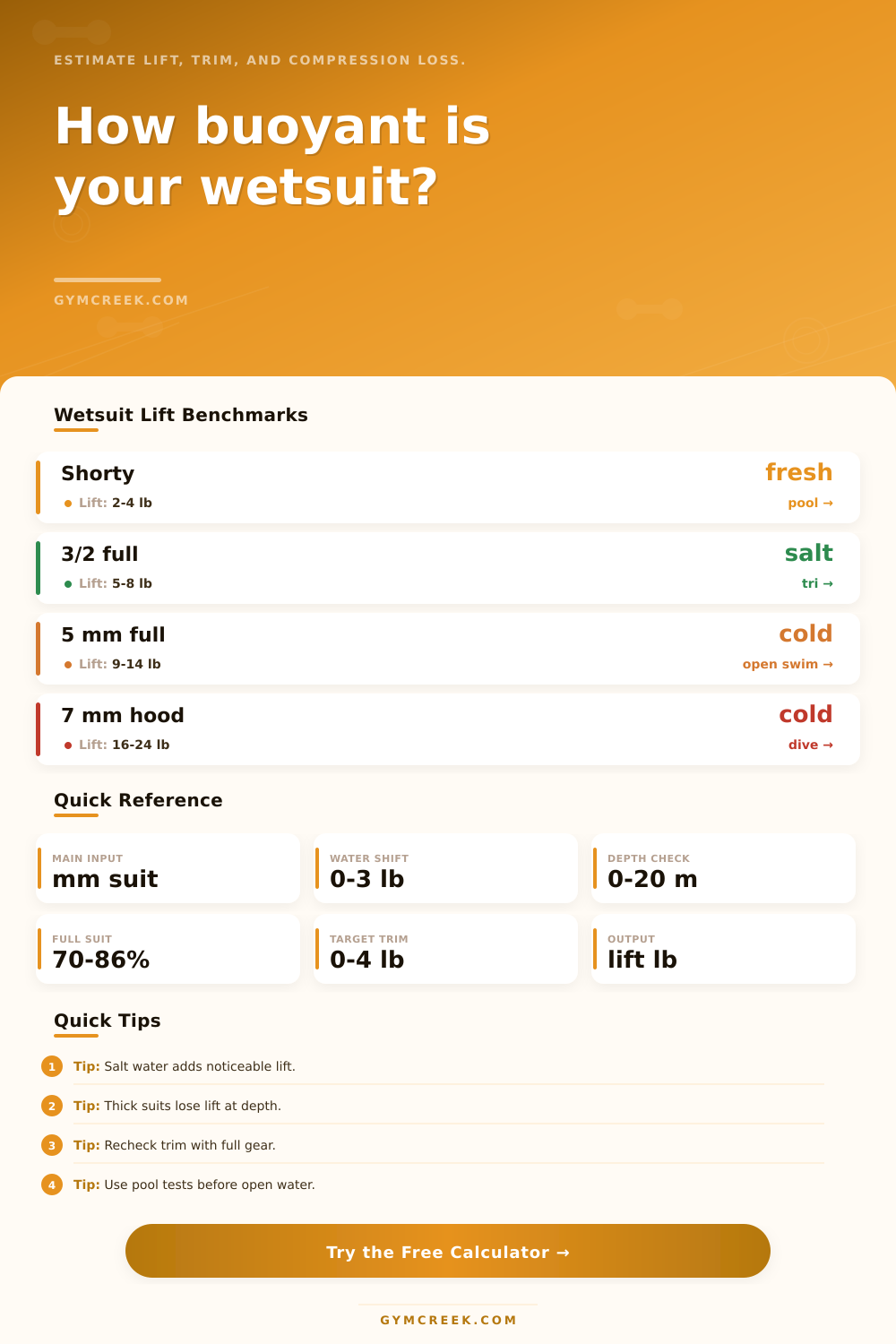
Wetsuit Buoyancy Calculator
Estimate neoprene lift, body float, gear trim, and depth compression before a pool check, open-water swim, surf session, or dive-weight adjustment.
📌Presets
Each preset loads a realistic suit thickness, body size, water type, and trim goal for a quick buoyancy comparison.
⚙Calculator
Wetsuit buoyancy snapshot
Enter your suit, body size, and water conditions to estimate trim.
📊Fitness Metrics
📑Reference Tables
| Suit Setup | Typical Thickness | Coverage Factor | Common Lift Signal |
|---|---|---|---|
| Shorty or spring suit | 1.5-2.5 mm | 0.42-0.55 BSA | Small surface assist |
| Sleeveless full suit | 2-4 mm | 0.62-0.72 BSA | Hips float higher |
| Triathlon full suit | 3-5 mm | 0.74-0.84 BSA | Strong swim support |
| Cold-water full suit | 5-7 mm | 0.78-0.88 BSA | Large trim change |
| Hooded or two-piece suit | 6-9 mm | 0.88-1.05 BSA | Major weighting change |
| Water Type | Density Used | Compared With Fresh | Practical Effect |
|---|---|---|---|
| Warm pool | 995 kg/m³ | Slightly less lift | Good baseline check |
| Fresh water | 997 kg/m³ | Reference point | Lake or quarry estimate |
| Salt water | 1025 kg/m³ | About 2.8% more | Needs more trim weight |
| Cold salt water | 1028 kg/m³ | About 3.1% more | Highest surface lift |
| Depth | Suit Lift Retained | What Changes | Use Case |
|---|---|---|---|
| Surface | 100% | Maximum lift | Open-water swim check |
| 5 m / 16 ft | About 86% | Noticeable loss | Snorkel or shallow dive |
| 10 m / 33 ft | About 72% | Trim shifts down | Freedive practice |
| 20 m / 66 ft | About 52% | Large lift drop | Dive weighting review |
| 30 m / 98 ft | About 42% | Heavy compression | Advanced dive planning |
| Metric | Low | Balanced | High |
|---|---|---|---|
| Suit lift ratio | Under 3% | 3-8% body mass | Over 8% |
| Surface reserve | Under 1 lb | 1-4 lb positive | Over 8 lb positive |
| Compression loss | Under 1 lb | 1-5 lb | Over 5 lb |
| Trim change | No added weight | Small adjustment | Pool verify first |
💡Tips
When you were kid, you tried swimming in a heavy wetsuit in cold water for the very first time, fifteen minutes of struggling with gravity just to hold your face out of the water. It was like trying to wrestle with a floating object that didn’t wish to be separated from you. That’s a brutal crash course on hydrodynamics.
Your body shape matter. If you’re not right, the water won’t give a damn how fast you’d love to swim. Buoyancy matters with every stroke. There’s more to understanding lift than the thickness of the neoprene. Many believe that if wetsuit is thicker it will float them better. That isn’t necessarily true. Neoprene does not act linearly because it will compress with pressure.
How to Swim Without Sinking or Floating Too High
Once you know your suit specs and your build, simply plug those numbers into this calculator and it will do all the math for you so you don’t have to guess on how much weight to cut out or put on. It also factors in something we all know… Neoprene takes up less space the deeper you go. You can get huge lift off the surface on a seven millimeter wet suit, but lose that lift by the time you reach 10m. And that’s what most folks forget when they trim in shallows only to sink like a stone while deep swimming or on their dive.
Your body composition is just as important. Muscle sinks and fat floats. This means a leaner body are denser in the water. You will have less naturaly buoyancy, so you will need extra help to stay horizontal. The tool uses this to approximate your surface area (based off your height and weight), which tells it how much of you to cover with neoprene. That in turn traps air pockets that add lift. So a full wetsuit envelops almost all of your limbs and torso, while a shorty expose your legs, shifting your center of buoyancy and making your hips sink lower without some adjustment or increase in core strength.
Everything else hinges on water density. Saltwater is denser than freshwater. So, wearing exactly the same wetsuit on the ocean will make you feel noticeably lighter than when swimming in the lake. A difference of approximately three percent doesn’t sound like much on paper, but that’s several pounds of additional lift in the sea. Trim your body for neutral buoyancy in the pool and jump in the ocean without readjustment and you’re probably going to find yourself floating uncomfortably high above the water. Not only does this prevent dropping down efficiently it also makes maintaining effective stroke mechanics more challenging. On top of that, cold saltwater is even denser than warm saltwater. This adds another layer of difficulty for swimmers who train in colder waters in northern climates during the winter months.
Then there’s the variable of gear: How does all that stuff you carry affect your lift? Does a heavy racing cap, a dive computer, or even a mask strap affects your overall weight distribution? The page includes a lift signal reference table that shows average lift figures per typical suit configuration so you can check to see where your particular combination sits in the normal range. Typically a cold water endurance suit will have more lift then a speed oriented triathlon sprint suit because flotation is sacrificed for more flexible fabrics. So knowing where you sit gives you the option to add trim weights to sink slightly or remove some to prevent rolling back.
It’s not enough to float; it’s about floating well. At depth, you need neutral buoyancy so that you remain stationary, hovering easily without struggling to maintain your position and disturbing all the surrounding silt. On the surface, use positive buoyancy so that you don’t need to worry about sinking and can rest comfortabley. The key is to get that tuning correct through trial-and-error in the water. That’s what you’re going to do when you dive or swim. You want to test your equipment in those conditions. Simulation is a good start. But numbers on a page aren’t like water in your face. The estimates help you refine your options for equipment, and then check them in the field.
That’s the battle I was referring to earlier, until I finally added a small weight belt that brought my hips in line with my shoulders. From there, the water became more of a support system than an enemy, and the drag dissapears. Because the friction between you and the fluid is gone, balance allows you to get out of your own way and start thinking about what really matters: going forward.