Wendler Training Max Calculator
Estimate a clean one-rep max, set a conservative Wendler training max, round your 5/3/1 work sets, and preview cycle progression for squat, bench, deadlift, or overhead press.
📌Presets
Each preset loads a realistic lift, rep max, training-max percentage, rounding rule, progression amount, and cycle plan.
⚙Calculator
Training max snapshot
Enter a rep max and lift context to build your Wendler 5/3/1 training max.
📊Training Metrics
📑Reference Tables
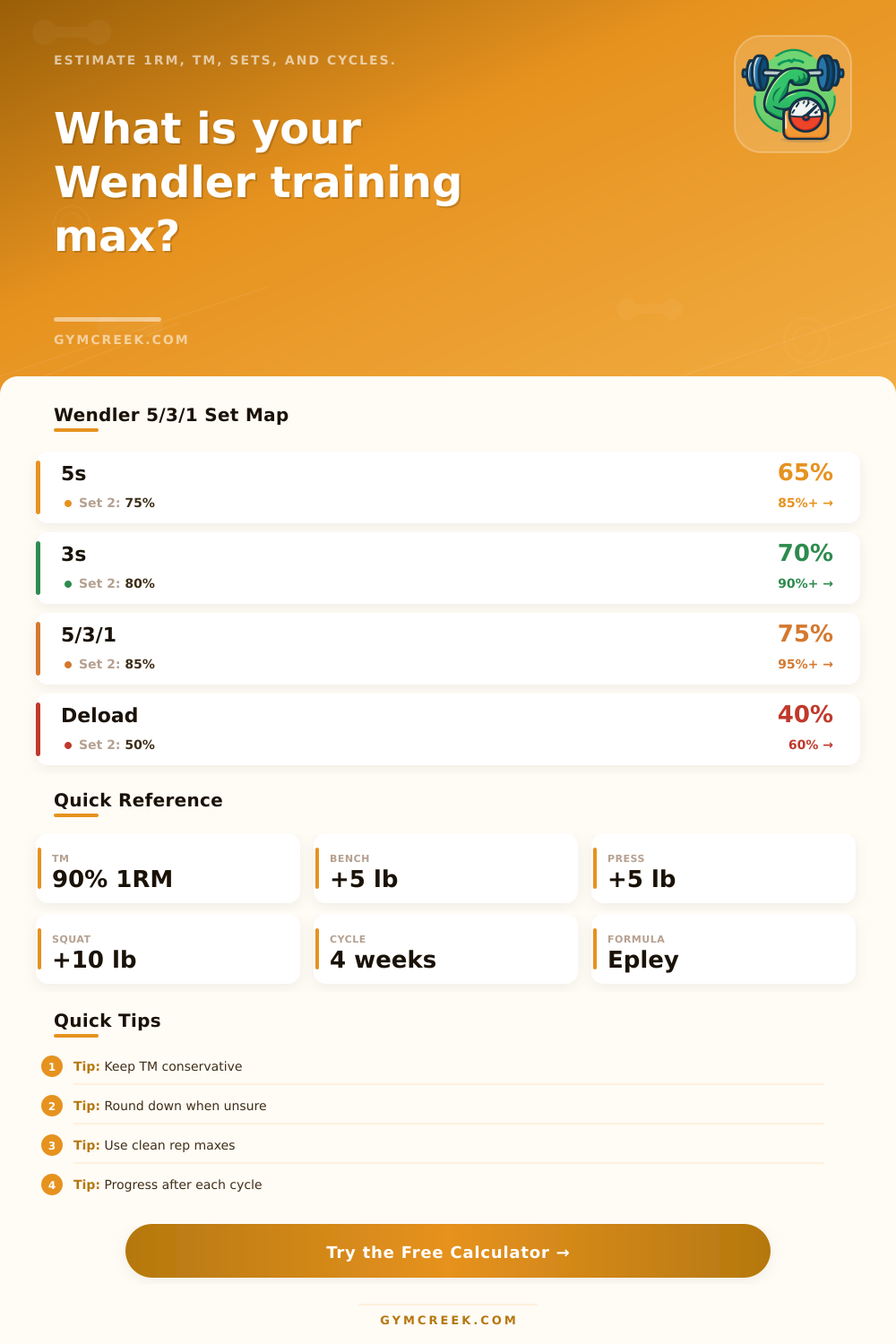
| Week | Set 1 | Set 2 | Top set |
|---|---|---|---|
| Week 1 - 5s | 65% x 5 | 75% x 5 | 85% x 5 plus |
| Week 2 - 3s | 70% x 3 | 80% x 3 | 90% x 3 plus |
| Week 3 - 5/3/1 | 75% x 5 | 85% x 3 | 95% x 1 plus |
| Week 4 - Deload | 40% x 5 | 50% x 5 | 60% x 5 |
| Situation | TM percent | Reason | Use when |
|---|---|---|---|
| Conservative reset | 85% | Build momentum | Returning after layoff |
| Classic start | 90% | Wendler default | Most lifters |
| Strong recent test | 92% | Slightly heavier | Clean, recent rep max |
| Aggressive anchor | 95% | Less buffer | Experienced lifters only |
| Lift | Imperial | Metric | Note |
|---|---|---|---|
| Overhead press | +5 lb | +2.5 kg | Smallest jump preferred |
| Bench press | +5 lb | +2.5 kg | Upper-body progression |
| Squat | +10 lb | +5 kg | Lower-body progression |
| Deadlift | +10 lb | +5 kg | Lower-body progression |
| Formula | Equation | Best range | Use |
|---|---|---|---|
| Epley | Weight x (1 + reps/30) | 1 to 10 reps | Common strength estimate |
| Brzycki | Weight x 36 / (37 - reps) | 1 to 10 reps | Conservative mid reps |
| Lander | 100 x weight / (101.3 - 2.67123 x reps) | 1 to 10 reps | Another comparison |
| Average | Mean of three formulas | 2 to 8 reps | Smooths formula noise |
| Lift | Novice TM ratio | Intermediate | Advanced |
|---|---|---|---|
| Squat | 0.75-1.10x BW | 1.10-1.60x BW | 1.60x BW plus |
| Bench press | 0.50-0.80x BW | 0.80-1.20x BW | 1.20x BW plus |
| Deadlift | 0.90-1.30x BW | 1.30-1.90x BW | 1.90x BW plus |
| Overhead press | 0.30-0.50x BW | 0.50-0.75x BW | 0.75x BW plus |
💡Tips
The Wendler training max calculator allow you to take your most recent rep max and transform that into a training weight. Using a training weight allows for the individual to incorporate additional benefits into their training program. Many training programs fail when the starting weight is too close to an individual capacity for that exercise.
Using a conservative training max will allow for each individual to see steady progress over several week without getting overwhelmed with the amount of weight they have to lift. The rep max that you enter into the calculator is important. However, the quality of the set of reps that you use to determine your rep max is just as important.
How to Use the Wendler Training Max Calculator
Five sets of reps performed sloppily are not the same than five sets of reps performed cleanly. The Wendler training max calculator use a specific formula to calculate the training weight that will be used in your training program. You can determine this training weight by lowering the training max percentage that is used in the program.
This is better than utilizing an optimistic rep max.
Body weight and training experience will be two of the inputs into the training program. These factor will help to determine the strength of the individual relative to their experience and their body weight. A squat that is 1.4 times an individuals body weight will have different results for an individual with three years of training experience relative to an individual who has taken a long break from strength training.
Using the strength ratio table will help to show where an individual strength fit into a general spectrum of strength. The rounding increment will impact each of the sets of weights that will be lifted during training. The example show that rounding to the nearest five pounds is the easiest increment for most individuals in commercial gyms.
However, an individuals access to weights may dictate a different increment for the training program. The Wendler training max calculator will apply the rounding of the training max to make it easier for an individual to incorporate these weights into their training program. Cycle progression is essential for providing an individual with a long-term strength training plan.
For example, an individual may add ten pounds of weight to each squat performed during each cycle. However, adding ten pounds to a bench press or an overhead press may be too aggressive relative to the squat or deadlift strength. The Wendler training max calculator will allow an individual to preview the weights that will be used after several training cycles.
This will allow the individual to avoid setting weights that may be too aggressive for their body. The reference tables will show the structure of each training week without the individual having to memorize the percentages. For example, week one will use five-pound sets, followed by three-pound sets during week two and a mix of five, three, and one-pound sets during week three.
A deload week will allow an individual to take a necessary break from their training program that will reset their training fatigue for the next cycle. For most lifters, their training max should not be a fixed number for their training program. An individual might start their training program at 90% of their training max because the plus sets will allow for the individual to break their personal record.
The decision of when to add weight to the training program should be based off how the top sets felt during the cycle. Although there is no specific training formula that is universally the best for all lifters, there are formulas that produce more results than others. For example, the Epley formula will produce higher estimates for an individuals training max than reps performed in the range of five to ten.
The Brzycki formula is more conservative for an individuals training experience in the middle of the rep range. An average of the three training formulas will eliminate the quirks of each formula. Using any will produce the same results for an individual over time if they stick to the training program.
The age and sex of an individual can be entered into the Wendler training max calculator as the inputs for their training program. While these values will not change the math for the training program, the age and sex can be used to dictate how aggressive or conservative an individual wants to be with their training max percentage. For example, a forty-year-old may have a more conservative training program relative to a twenty-five-year-old because of their age and recovery needs.
By using the same inputs over time, an individual will be able to see how their training program is developing. If their training max is moving forward or if an individual is feeling plateauing in their training program, the individual can adjust their training accordingly. Another benefit to the Wendler training max calculator is the estimation of the number of training plates that should be loaded onto each side of the bar for each exercise.
By entering the weight of the bar and the weight of each training plate, the calculator will provide an individual with the estimated number of training plates that should be loaded onto each side of the bar. This saves the individual from guesswork and mistake from rounding the numbers in there heads during training. An individual should only retest their training max after the completion of a training cycle and deload week.
The training program is designed to keep an individuals training max stable so that their plus sets provide the most benefits to their training program. By testing their training max too often, an individual might reset their training max downward with their training and prevent the building of strength. The Wendler training max calculator takes the place of the math that would be used to calculate training max inputs.
For example, if the training max that an individual sets for themselves is sustainable for four weeks of training, then the training max that is entered into the calculation will be used in each training session. If the top sets for week three are a grind for an individual, then their training max should be lower with a lower starting percentage to allow the 5/3/1 structure of the training program to work as effectively as it was designed to work. You should of used a lower percentage if the sets felt heavy.
It is much better to stay consistant with progress. Making sure you dont rush is key. Its better to be slow than too fast.
The modern lifter needs to be carefull. Youll see more results if you follow teh plan.