Weightlifting Score Calculator
Score an Olympic weightlifting meet from snatch attempts, clean and jerk attempts, weigh-in bodyweight, bodyweight category, target total, and Sinclair comparison.
📌Presets
Each preset loads a full six-attempt card with bodyweight, category set, target total, and realistic made or missed lifts.
⚙Calculator
Weightlifting score snapshot
Enter the six attempts to score snatch, clean and jerk, total, and bodyweight-adjusted comparison.
📊Score Metrics
📑Reference Tables
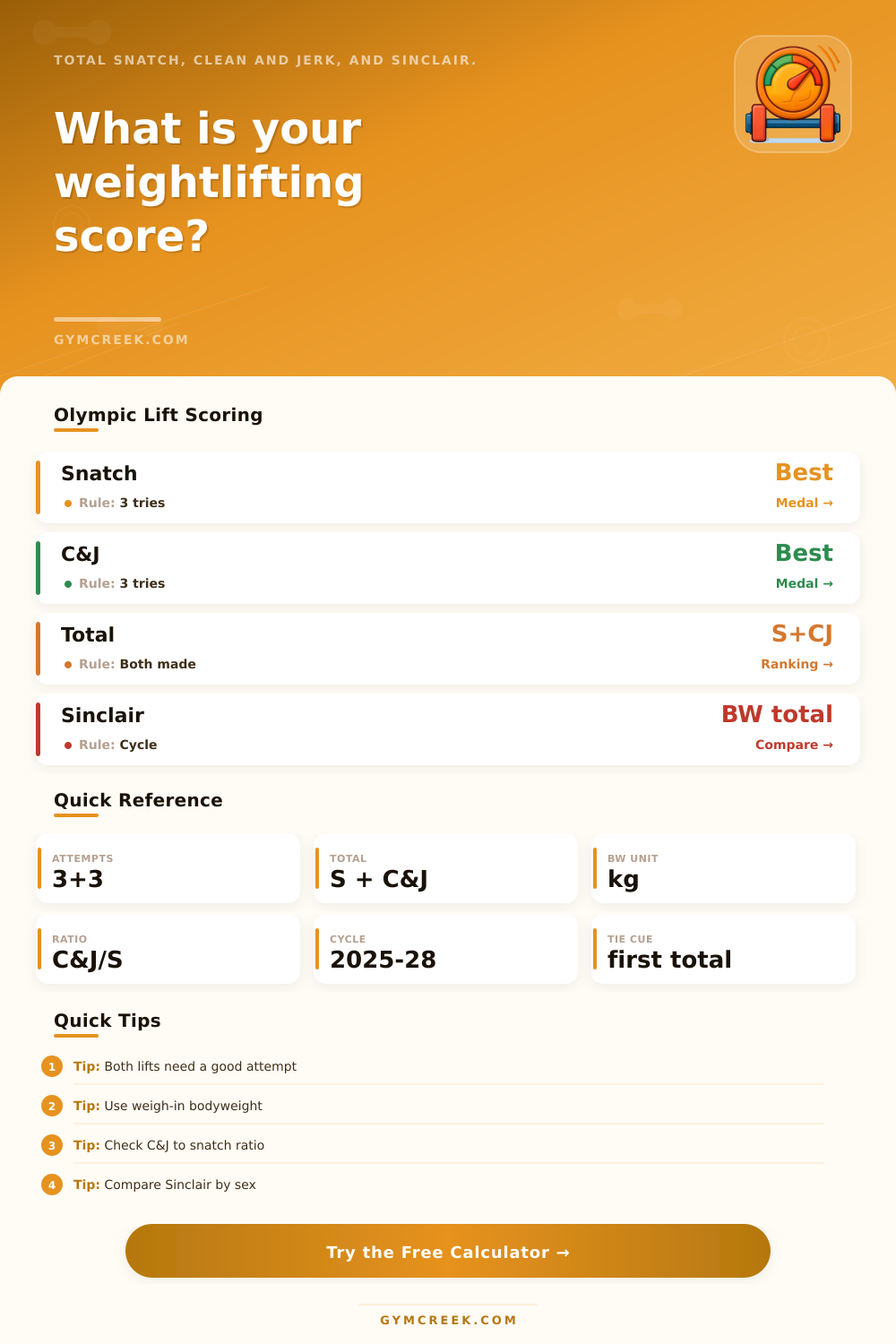
| Score item | How it is calculated | Needs | Calculator output |
|---|---|---|---|
| Snatch result | Highest successful snatch | At least one good snatch | Best snatch card |
| Clean and jerk result | Highest successful clean and jerk | At least one good clean and jerk | Best C&J card |
| Total | Snatch plus clean and jerk | A result in both lifts | Total card |
| Tie reminder | Order of achieving total matters | Competition sequence | Breakdown note |
| Group | Categories | Super class | Use |
|---|---|---|---|
| Men | 60, 65, 71, 79, 88, 94, 110 kg | +110 kg | IWF events |
| Women | 48, 53, 58, 63, 69, 77, 86 kg | +86 kg | IWF events |
| LA 2028 men | 65, 75, 85, 95, 110 kg | +110 kg | Olympic set |
| LA 2028 women | 53, 61, 69, 77, 86 kg | +86 kg | Olympic set |
| Sex | A coefficient | b value | Cycle |
|---|---|---|---|
| Male | 0.700767819 | 201.159 kg | 2025-2028 |
| Female | 0.674107991 | 163.918 kg | 2025-2028 |
| Formula | 10^(A x log10(BW/b)^2) | if BW below b | Coefficient |
| Score | Total x coefficient | if total exists | Compare totals |
| Metric | Typical range | What it suggests | Useful check |
|---|---|---|---|
| C&J / snatch | 1.20 to 1.30 | Balanced Olympic lifts | Compare lift gap |
| Total / bodyweight | 1.5x to 4.0x | Relative strength marker | Track by class |
| Attempt success | 3 to 5 makes | Meet selection quality | Openers and jumps |
| Target percent | 90% to 105% | Qualifier readiness | Total gap |
💡Tips
Competitions in the sport of weightlifting involve several different types of measurement and numbers. The performance of a weightlifter consist of two different lifts, the snatch and the clean and jerk. Each of these lift is scored separately, but the results of the snatch and the clean and jerk can be combined to create a total score for the weightlifter.
Therefore, it is possible for a weightlifter to have a heavy snatch but to fail there clean and jerk attempt; in this case, there would be no total score for the weightlifter. A weightlifting calculator can process the results of each of these lift, which can help to display the relationship between the snatch and the clean and jerk. Coaches often examine the relationship between these two lifts to ensure that the clean and jerk attempts weigh 20-30% more then the snatch attempts.
How Weightlifting Is Measured and Calculated
Any deviation from that percentage indicate that the relationship between the lifts is out of balance, which can indicate the need for additional training in one of the lifts. In addition to the lifts performed by a weightlifter, another important measurement is the bodyweight of that weightlifter. The bodyweight of a weightlifter determine in which weight category the weightlifter will compete in competitions.
At competition, weigh-ins occur at specific time, and the bodyweight of the weightlifter at the weigh-in will be the number used to determine in which weight category the weightlifter will compete. The bodyweight can be entered into a weightlifting calculator to determine if the weightlifter is within their correct weight category. A weightlifter may move to a higher weight category or a lower weight category.
If a weightlifter moves to a lower weight category, the weightlifter may have to cut weight to compete within that category. Another measure of a weightlifters abilities is the Sinclair scoring system. Sinclair scoring use the total number of pounds lifted and the bodyweight of the weightlifter to calculate a single Sinclair score.
The Sinclair score allow for weightlifters of different categories to be compared with one another. This score incorporates a coefficient into the calculation that the Olympic cycle adjusts according to the current cycle. While a high Sinclair score indicates strength of the weightlifter, it doesnt ensure that the weightlifter will win medal in the competitions.
Different weightlifting federations use Sinclair scores to compare lifter from different countries, and to use those scores to determine how to award funding or spots to national weightlifting teams. Another important aspect of weightlifting is target totals. The target total that a weightlifter aim to reach during a competition can be established for a variety of reason.
For instance, a weightlifter may aim for a specific total to qualify for a championship, or to reach a personal benchmark in strength. By inputting the total weight lifted by the athlete into a weightlifting calculator, and by entering the athlete’s target total, the calculator can calculate the percentage of the target total that the weightlifter achieve during the competition. This calculation allow coaches and athletes to determine if the performance was a success, and if the athlete came close to achieving their total target.
The success rate of the weightlifters during a competition are also an important measure of their performance. Each weightlifter have six total attempts during a competition… Three snatch lifts and three clean and jerk lifts.
The weightlifting calculator can be used to calculate the number of “makes” (successful lifts), “misses” (failed lifts), and “passes” (lifts skipped by the athlete). The calculator can determine the success rate of the weightlifter of the competition. A high success rate indicate that the weightlifter may have chosen their opening weights wise for the competition.
If an athlete can make the first two attempts but miss the third, it may indicate that the athlete attempted too heavy of a weight during the third lift. In addition to the lifts and the weight of the lift, there are also different weight category for weightlifters depending off the specific competition. For instance, competitions may be held for senior athlete, master athlete, or youth athlete.
Each of these weight categories have different weight limit. Therefore, it is important to ensure that the weight category is correctly selected for the competition using the weightlifting calculator. The calculator cant measure the noise of the gym or the way that the athlete feel during the competition, but it can calculate the results of the lifts performed during the competition.
Therefore, using a weightlifting calculator can transform the raw numbers into information regarding training and performance of the athlete.