Weightlifting Ratio Calculator
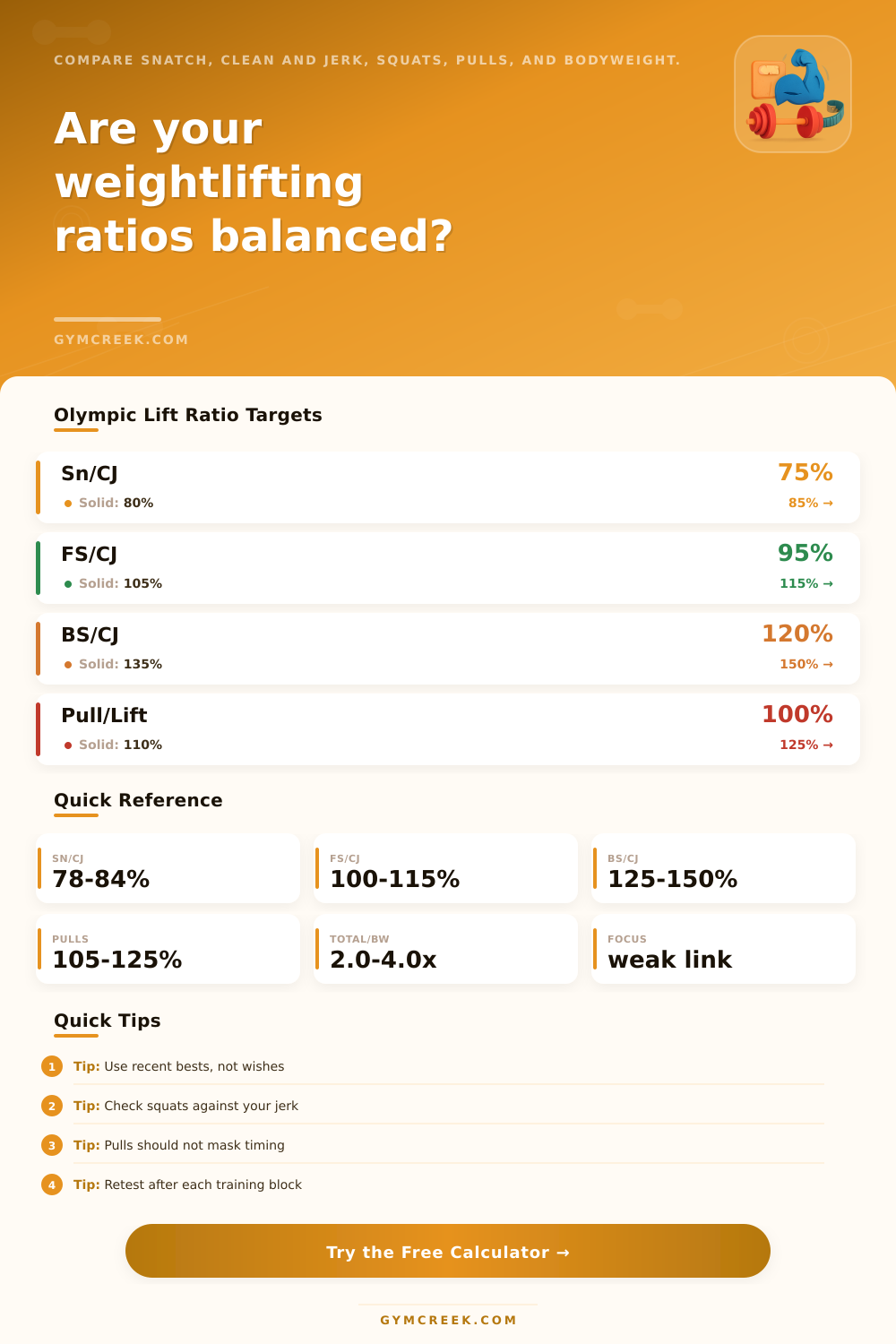
Compare Olympic weightlifting ratios for snatch, clean and jerk, front squat, back squat, snatch pull, clean pull, and bodyweight so your weak link is easier to spot.
📌Presets
Each preset changes bodyweight, classic lifts, squats, pulls, experience, and emphasis. It is meant to show ratio patterns, not official competition scoring.
⚙Calculator
Weightlifting ratio snapshot
Enter current bests to compare classic lifts, squats, pulls, and bodyweight balance.
📊Ratio Metrics
📑Reference Tables
| Ratio | Low signal | Balanced range | High signal |
|---|---|---|---|
| Snatch / clean and jerk | Below 76% | 78% to 84% | Above 86% |
| Snatch / bodyweight | Under 0.8x | 1.0x to 1.5x | 1.8x plus |
| Clean and jerk / bodyweight | Under 1.0x | 1.3x to 2.0x | 2.3x plus |
| Total / bodyweight | Under 1.8x | 2.3x to 3.5x | 4.0x plus |
| Strength ratio | Needs work | Useful range | Watch for |
|---|---|---|---|
| Front squat / clean and jerk | Below 100% | 105% to 120% | Jerk may be limiter if very high |
| Back squat / clean and jerk | Below 125% | 130% to 155% | Technique gap if very high |
| Front squat / back squat | Below 78% | 80% to 88% | Front rack or trunk limit |
| Total / back squat | Below 115% | 125% to 150% | Legs strong but lifts lag |
| Pull ratio | Low reserve | Practical range | High reserve |
|---|---|---|---|
| Snatch pull / snatch | Under 100% | 105% to 120% | 125% plus |
| Clean pull / clean and jerk | Under 100% | 105% to 125% | 130% plus |
| Clean pull / back squat | Under 75% | 80% to 95% | 100% plus |
| Snatch pull / clean pull | Under 70% | 75% to 85% | 90% plus |
| Pattern | Likely read | Confirm with | Calculator flag |
|---|---|---|---|
| Low snatch / CJ | Snatch technical gap | Make rate and turnover | Classic balance |
| Low front / CJ | Clean recovery limit | Heavy front squats | Squat reserve |
| High back / CJ | Strength not transferring | Position and speed | Transfer gap |
| Low pulls / lifts | Pull strength reserve gap | Tempo pulls and blocks | Pull reserve |
💡Tips
A weightlifting ratio calculator is an tool that can help you determine whether your lift are balanced. Despite the fact that many individual feel that they are strong with their lifts on any given day, it is possible that they do not know if their lifts are balanced to each other. A weightlifting ratio calculator will ask for your best snatch, your best clean and jerk, your best squat, and your best pull to show you the relative strength of each of your lift.
The tool will show you if your strength are balanced across each lift. The input that you provide to a weightlifting ratio calculator are each important in determining your strength. For instance, you must provide your body weight.
Use a weightlifting ratio calculator to find your weak lifts
The body weight will help to interpret your lifts as multiple of your body weight rather than kilograms. You must provide your snatch and your clean and jerk lift as these are the two classic lift in weightlifting. You must provide your front squat lift to show your strength in recovering a clean and your back squat to show your raw leg strength.
Additionally, your pull lift must be provided to show whether your upper back and trap are strong enough to perform classic lift. Finally, you can also provide your make-rate and jerk-confidence to adjust your lift accordingly. A weightlifting ratio calculator can provide you with information that help you to adjust your training.
For instance, if your snatch lift is lower than your other lift, you can adjust your training to focus on your turnover and receiving position rather than strength in squat. Another example is with your back squat lift. If your back squat is higher than your pull lift, this may suggest that you have strong leg but poor rate of force production needed for the second pull of a snatch.
These interpretations of your lift can inform your training. The context of your strength and your interpretations of the ratio calculator is also important. For example, a junior lifter will have different ratio than a national level lifter.
Furthermore, a young lifter may have different result than an older lifter due to there strength in specific lift. For these reason, a weightlifting ratio calculator may not replace a coach but it does remove the guesswork in regard to your lift. It is also important to avoid making mistake with the weightlifting ratio calculator.
For instance, if your snatch and jerk lift are lower than your other lift, it could be due to injury. Additionally, if your squat lift are high relative to your classic lift it may be due to a lack of rate of force development. These interpretations are not perfect as they can be.
Therefore, it is only one tool that you use alongside your training note. Another mistake to avoid is attempting to make each of your lift perfect. For instance, attempting to even out each of your lift may not be the best use of your time if your limiting factor is your ability to perform high volume of lift.
Therefore, while the calculator can tell you if there is gap in your strength it cannot indicate if filling in those gap is your priority. This is a decision that only you and your coach can make. Therefore, it is important to use the weightlifting ratio calculator at the end of each training block.
You should not only use it when you feel something are wrong with your lift. By comparing the ratio of your lift every six to eight week you can ensure that you are not allowing for any imbalance to continue. Furthermore, you should use it in order to have a reality check in regard to your training; without updating your lift you may use outdated number that dont truly reflect your lift at this time.
Over time you can use the ratio calculator to track your training. Eventually you will recognize your lift and pattern within your lift. You can use this information to plan your training the following training cycle.
Therefore, the goal is not to have perfect lift but to have an understanding of where to focus your training effort for the upcoming training cycle.