Weightlifting Macros Calculator
Estimate calories, protein, carbs, fats, workout-day carbs, phase adjustments, and recovery pressure for weightlifting prep.
Your weightlifting macro targets
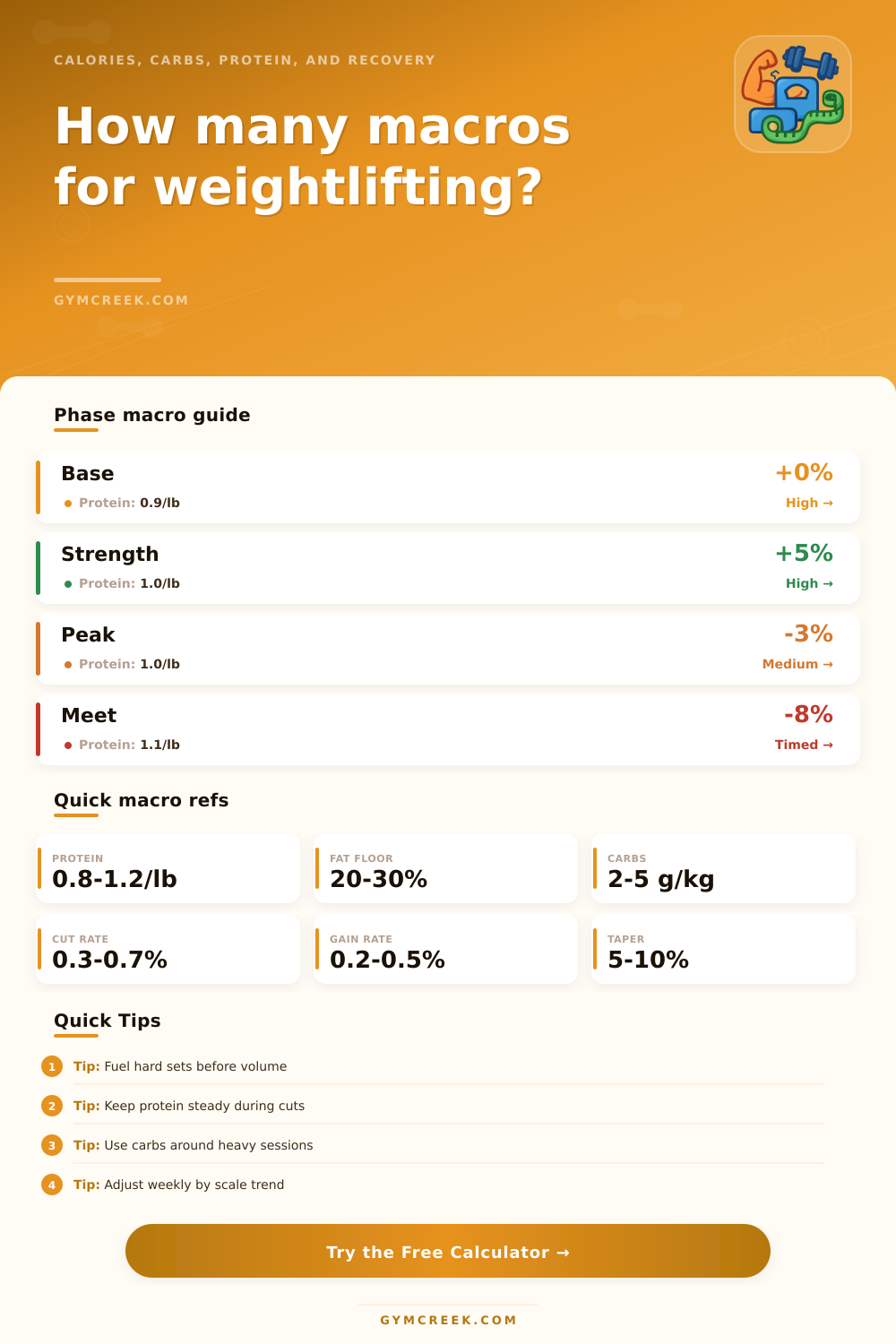
| Training phase | Calorie adjustment | Carb emphasis | Best use |
|---|---|---|---|
| Base volume | Maintenance to +4% | Higher carbs around volume days | Technical practice, muscle retention, work capacity |
| Strength block | +3% to +7% | Carbs support heavy doubles, triples, and back-off sets | Performance-focused blocks away from weigh-in pressure |
| Peaking block | -3% to maintenance | Moderate carbs, less digestive load | Lower volume and heavier singles before competition |
| Meet week or taper | -8% to -2% | Timed carbs before warmups and attempts | Short-term class management and freshness |
| Deload week | -5% to maintenance | Reduced carbs if tonnage drops sharply | Fatigue reduction while keeping protein steady |
| Lifter context | Protein target | Carb target | Fat target |
|---|---|---|---|
| Maintenance strength block | 0.8-1.0 g/lb or 1.8-2.2 g/kg | 3-5 g/kg depending on tonnage | About 25% of calories |
| Weight-class cut | 1.0-1.2 g/lb or 2.2-2.6 g/kg | 2-4 g/kg, timed near sessions | Do not push below 20% for long blocks |
| Lean mass gain | 0.8-1.0 g/lb or 1.8-2.2 g/kg | 4-6 g/kg if training volume is high | 20-30% based on digestion and preference |
| Meet week | Steady at 1.0-1.1 g/lb | Lower residue, more precise timing | Stable foods, avoid aggressive changes |
| Scenario | Main pressure | Macro priority | Watch point |
|---|---|---|---|
| Close to class limit | Making weight without losing bar speed | Moderate deficit, high protein, timed carbs | Do not combine high tonnage with an aggressive cut |
| Far under class limit | Adding useful mass slowly | Small surplus with enough carbs for volume | Scale trend should not outrun performance |
| Peak block fatigue | High neural stress and lower volume | Keep carbs close to heavy sessions | Recovery score should improve during taper |
| High-volume technique block | Lots of total work and repeated positions | Carb availability and hydration consistency | Low carbs can make bar path quality degrade |
| Calculation | Formula basis | Inputs used | Purpose |
|---|---|---|---|
| BMR | Mifflin-St Jeor | Sex, age, height, body weight | Baseline energy estimate before activity and lifting load |
| Lean mass | Body weight x lean percentage | Body weight and body fat estimate | Context for protein and recovery pressure |
| Goal calories | 7,700 kcal per kg weight change | Goal rate and goal direction | Translates weekly body-weight trend into daily calories |
| Workout carbs | Daily carbs x timing percentage | Carb grams and carb timing input | Estimates grams to place before, during, and after lifting |
Training for weightlifting involve more than just lifting heavier bars, because training for weightlifting involves providing your body with the fuel that it need to recover from those heavy bars. You must provide your body with enough fuel to allow you to remains within your weight class. The balance of the calories, protein, carbohydrate and fats that you consume each day will change based off the different training phase that you follow.
If you do not get the balance of the macronutrients that you requires, you may find yourself stalled in your strength development, your bar speed may decline, or you may miss your weight class entirely. Each of the variables in the calculator ask for a specific data point from the lifter. Your body weight and body fat percentage will help your calculator determine the amount of protein that you need to consume.
How to Eat Right for Weightlifting and Recovery
Your tonnage and the amount of training session that you perform each week will help determine your training stress. The training phase that you are following will impact the amount of fuel that your body burn each day. Finally, where you are headed in terms of your body weight and goal will impact the amount of fuel that you will consume to reach your target without damaging your performance.
The amount of protein that you consume should remain the same during each phase of training. The calculator will maintain the amount of protein that you require to perform at your best, but it will allow the amount of carbohydrates that you consume to change according to the demands of your training program. If you consume too few carbohydrates while lifting heavy weight, your bar speed will suffer.
However, if you consume too many carbohydrate while tapering for a meet, your weight may cause you to miss your weight class. By ensuring that a portion of the carbohydrates that you consume is scheduled around your training session, you can protect your performance while burning fewer calorie on days when you rest from lifting. Although it is difficult to measure the degree of recovery pressure that an athlete is experiencing, that recovery pressure will ultimately determine whether an athlete can maintain proper form during the final week of training.
The recovery score calculates the amount of tonnage that an athlete lift per kilogram of body weight, the amount of sessions that an athlete performs, body fat percentage and the rate at which they are losing weight. High scores will allow the athlete to train harder and lift heavier weights. Low scores may indicate that an athlete is experiencing fatigue or losing too much weight too quick, resulting in a decrease in bar speed.
Many athletes who do not pay attention to this score will eventually find themselves missing some of their lift. Many athletes who do not pay attention to this score will eventually require a deload period to recover from the fatigue and missed lift. Another additional factor in calculating the fuel that a weightlifter should consume involves the consideration of the weight class that the lifter will compete in.
Because most weightlifters weigh in slightly more then their target weight for their class, they must make a decision as to how much weight to lose and when to lose that weight. A gradual calorie deficit is better than too rapid deficit in which the lifter begins to feel flat. This score will calculate how many pounds the athlete is above or below their weight class goal.
This number will allow the athlete to maintain realistic adjustments to fuel consumption rather than attempting to achieve these goal through hope alone. Lifter mistake occur in various ways. For instance, many lifters maintain the same amount of calories that they consume while performing a deload.
Additionally, many lifters slash the amount of carbohydrate that they consume while they are training. Finally, many lifters attempt to lose a certain amount of weight each week that may have worked for another lifter, but may not be compatible with the amount of tonnage and strength that those athlete possess. These mistake will result in stalled lifting performance, or they will result in those athletes missing their weight class.
While no calculator can replace the daily measurement of an athlete’s performance, such as bar speed or body fat percentage, it can provide the starting numbers for those daily measurements. Small adjustment to the fuel that is consumed each week will work better for an athlete than dramatic changes to that fuel intake. Thus, while the goal may not be to achieve the perfect number for each variable in the calculator, the goal is to ensure that an athlete continues to train at a high level and remains ready to compete on the competition day.