Weighted Dip to Bench Calculator
Estimate your bench press from weighted dip reps, bodyweight share, rep quality, dip depth, and a realistic dip-to-bench transfer factor.
📌Presets
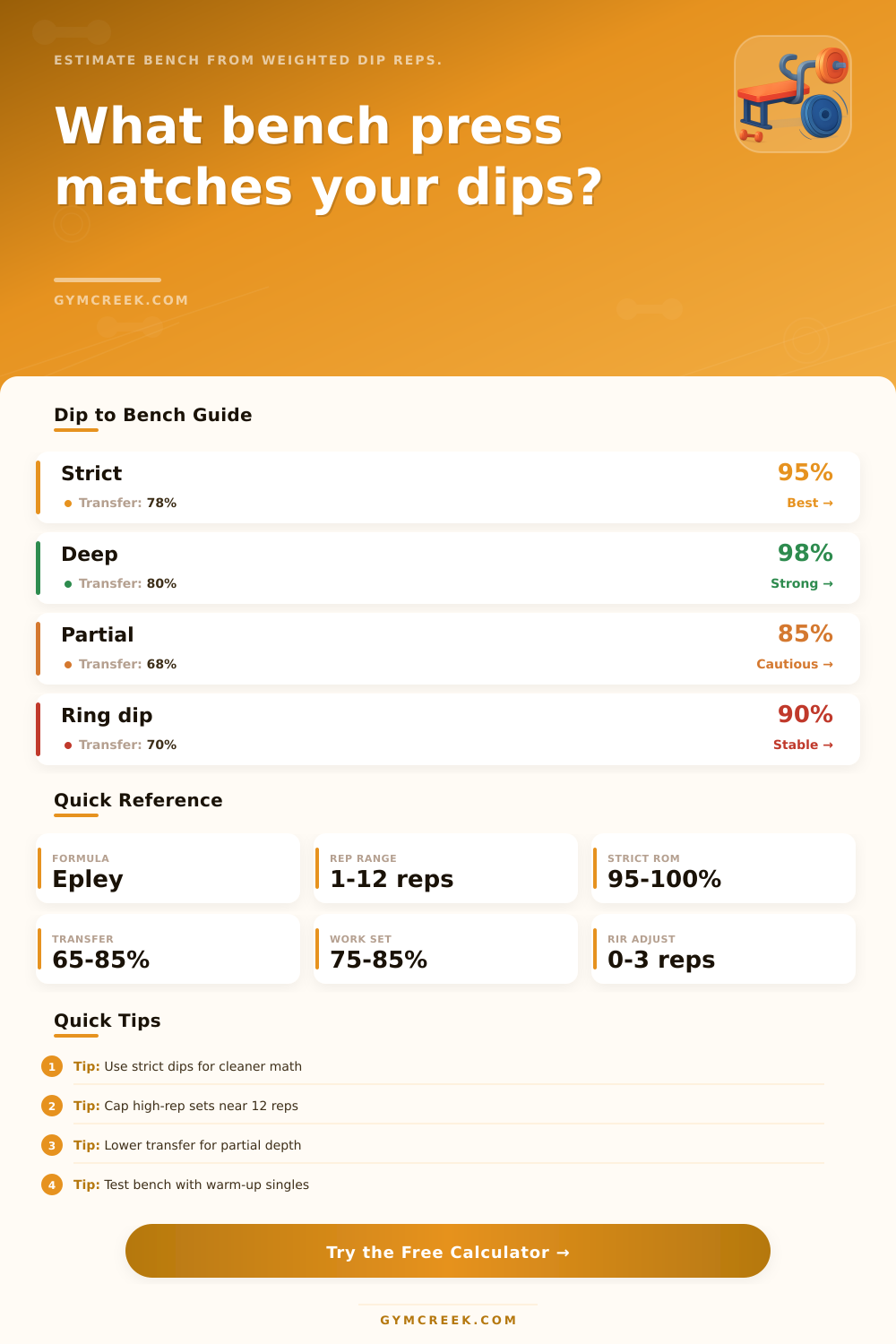
Each preset loads a different dip style and transfer assumption, then recalculates the estimated bench press automatically.
⚙Calculator
Dip to bench snapshot
Enter a weighted dip set to estimate your bench press.
📊Fitness Metrics
📑Reference Tables
| Dip style | Bodyweight share | Transfer range | Use case |
|---|---|---|---|
| Strict parallel | 90-100% | 72-82% | General estimate |
| Deep chest bias | 95-100% | 76-85% | Bench carryover |
| Upright triceps | 88-98% | 65-76% | Lockout bias |
| Ring dip | 85-95% | 62-74% | Stability demand |
| Partial depth | 75-90% | 55-70% | Cautious estimate |
| Rep range | Formula confidence | Adjustment | Notes |
|---|---|---|---|
| 1-3 reps | High | Small | Close to max |
| 4-8 reps | Good | Normal | Best everyday range |
| 9-12 reps | Moderate | Cap RIR | Endurance appears |
| 13+ reps | Lower | Retest heavier | Estimate drifts |
| Bench level | Bench/bodyweight | Dip clue | Interpretation |
|---|---|---|---|
| Novice | 0.75-1.00x | Bodyweight reps | Build base |
| Intermediate | 1.00-1.50x | +25-75% BW | Solid transfer |
| Advanced | 1.50-2.00x | +75-125% BW | Needs skill |
| Elite | 2.00x+ | Very heavy | Specific bench rules |
| Formula piece | Variable | Calculation | Purpose |
|---|---|---|---|
| System load | Dip load | BW share + added | Total moved |
| Epley 1RM | Rep max | Load x (1 + reps/30) | Strength estimate |
| ROM factor | Depth | 1RM x depth | Quality adjust |
| Transfer | Bench | Dip 1RM x transfer | Bench estimate |
💡Tips
Despite the difference between the dip and the bench press exercise, there are some similarity between the two. A person who wish to increase their strength in the dip exercise may wish to know if that strength will also transfer to there bench press strength. While both exercises is considered to be primary exercise for the upper body, the dip can be used as a way of building the muscle necessary to execute the bench press movement.
However, there are some differences between the two exercises that an individual who wishes to accurately predict the strength that they will be able to develop with each exercise must be consider. One of the main difference between the dip and the bench press is in the way in which the body weight is managed during the exercise. During a bench press, the individual manage their body weight by placing a barbell on the bench.
Do Dips Improve Bench Press Strength?
However, during a dip, the body must manage its own body weight. During a dip, the body does not move its arms and torso downward with each repetition. As a result, the body does not have to account for moving 100% of its body weight during a dip exercise.
If an individual ignore this fact about the dip exercise, the individual will have an inaccurate estimation of your bench press strength. Another of the factor that relates to the difference between the two exercises is in the range of motion of the exercise. During a dip, an individual drop their shoulders below their elbows to stretch their pectorals.
This stretch to the pec minor muscles mimic the bottom portion of the bench press exercise. If an individual performs a partial dip with limited range of motion, their pec minor muscles will not be providing the same level of strength as they would with a full dip exercise. Thus, the depth to which an individual dips during a dip exercise can have a major impact based off the transfer of that strength to their bench press strength.
Another of the factor that contributes to the difference between the two exercises is the use of the transfer factor. The transfer factor is a mathematical coefficient that can be used to account for the stability of an individual’s body during a dip exercise versus during a bench press exercise. An individual that perform many dips will develop strong pec minor and triceps muscles.
However, during a bench press exercise, the individual must be able to stabilize the barbell that is placed upon their chest. A barbell can shift during a bench press, and muscular group are required to stabilize that barbell. Thus, an individual has to learn to stabilize a barbell during a bench press exercise, and the individual must account for this factor in the determination of their bench press strength.
In addition to the transfer factor, there are also differences in the type of dips that an individual may perform. For instance, dips on a ring will be different than those performed on a horizontal bar. When performing dips on a ring, an individual must work to stabilize their body.
Because of this instability, an individual will typically move less weight on a ring dip then they can on a horizontal bar. Thus, the type of dips that an individual performs will impact their ability to develop strength for their bench press exercises. Furthermore, the number of repetitions that are performed during a dip will impact the accuracy of the strength calculation that are performed with dips.
The Epley formula is accurate in the determination of an individual’s strength with dips if that individual perform a low number of repetitions with a heavy load of body weight. If an individual performs three repetitions of a heavy dip exercise, the estimation for the one repetition maximum will be accurate. However, if an individual performs twelve repetitions, the dip exercise will be testing the individual’s endurance rather than their strength.
Thus, the calculation of the one repetition maximum will be less accurate if an individual performs a high number of repetitions during a dip exercise. An estimation of an individual’s strength with the bench press is a prediction of that strength. The estimation may indicate that an individual can perform good with the bench press exercise.
However, an individual may struggle with the exercise due to issue in their shoulder stability. To avoid injury during the exercise, the individual should use only a percentage of the strength that is estimated to begin to build their bench press strength. Using only a percentage of the estimated strength ensures the safety of the individual, and allows them to strengthen their bench press without straining their shoulders to the maximum limit.
An individual can also increase their bench press strength by increasing the number of dips that they perform with added weight. By overloading the triceps and lower chest muscle during weighted dips, an individual will find that their barbell feels lighter when performing the bench press exercise. Because an individual can move in a different angle with a dip exercise, their bench press strength can also be built using the dip exercise.
Thus, by increasing the number of dips that are performed with added body weight, an individual can develop their bench press strength.