Weighted Dip Calculator
Estimate how your bodyweight plus external load translates into total dip load, relative pushing strength, a rep-based max, and a more shoulder-friendly next loading lane.
📌Weighted Dip Presets
Nine presets cover bars, rings, moderate and heavy loading, controlled and paused reps, and more protective shoulder setups before you fine-tune your own weighted dip numbers.
⚙Dip Load Inputs
Projected weighted dip snapshot
Enter bodyweight, load, and rep details to estimate your current weighted dip profile.
📊Dip Metrics Grid
📑Reference Tables
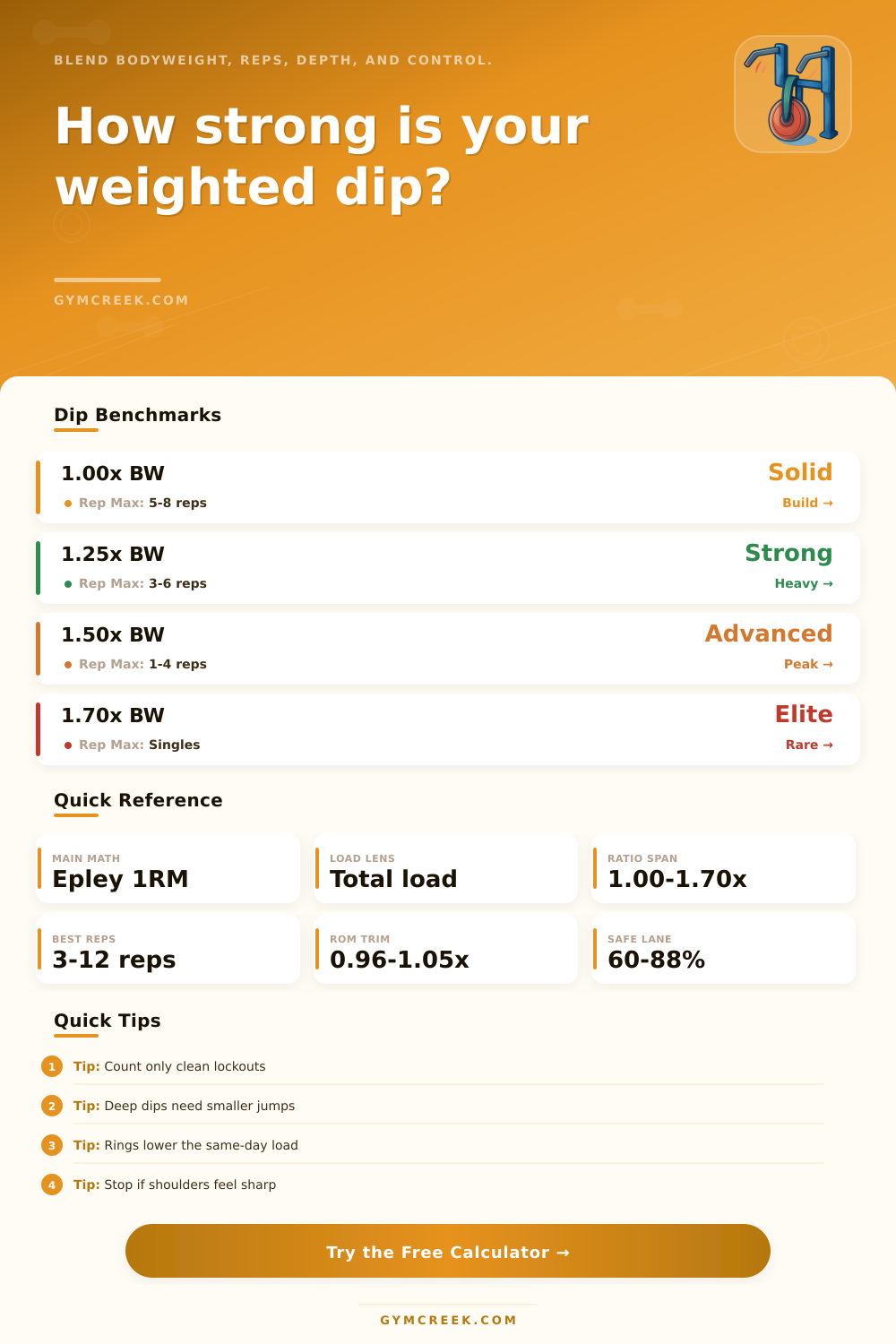
| Ratio | Label | Read | Use |
|---|---|---|---|
| Under 1.00x | Base | Bodyweight range is still the main project. | Build clean volume. |
| 1.00x-1.24x | Solid | You are moving added load with control. | Push steady triples and fives. |
| 1.25x-1.49x | Strong | Weighted dips are a real strength lift now. | Use smaller jumps. |
| 1.50x+ | Advanced | Load rises fast while shoulders need respect. | Protect the bottom position. |
| Choice | Factor | Bias | Read |
|---|---|---|---|
| Parallel bars | 1.00x | Baseline | Best direct comparison point. |
| Rings | 0.96x | Stability | Same weight often feels heavier. |
| Deep and strict | 1.04x | ROM credit | Earns more than a short dip. |
| Paused bottom | 1.03x | Control | Cleaner reps raise estimate quality. |
| Rep target | % of added 1RM | Added load | Read |
|---|---|---|---|
| 1 | 100% | --- | Top single |
| 3 | 93% | --- | Heavy triple |
| 5 | 87% | --- | Strength volume |
| 8 | 80% | --- | Joint-friendlier |
| Lane | Added load | Reps | Use |
|---|---|---|---|
| Easy lane | --- | 8-12 | Grease the groove |
| Build lane | --- | 5-8 | Default progress lane |
| Main lane | --- | 3-6 | Heavier but still repeatable |
| Ceiling lane | --- | 1-3 | Use sparingly |
💡Dip Tips
To calculate the strength an individual develops during weighted dips, the individual must understanding the total load that they can replicate during the exercise. The total load are the individuals bodyweight plus the additional weight added to the dip bars. For example, if an individual weighs 185 pounds and adds 45 pounds of dip weights, their total load is 230 pound.
Weighted dips require an individual to move their bodyweight, hence the importance of understanding their bodyweight. By comparing their total load with their bodyweight, an individual can calculate their relative strength ratio. This measurement of strength is the best overall indicator of strength relative to body size than using only the raw weight of the plates used for the exercise.
How to Measure Strength for Weighted Dips
The one-rep max for an individual performing dips can be estimated with the Epley formula, which use the number of repetitions the individual can complete at a specific load. If an individual can complete five clean dips with a specific load, the Epley formula indicates that an individuals one-rep max is approximately 17 percent higher than that specific load. Many factor can impact an individuals calculation of their strength using this equation.
Factors include the type of exercise station used and the depth of the dips performed. For example, using dip bars indicates a factor of 1.0 for stability. Using exercise rings require an individual to engage stabilizer muscles for control, creating a factor of 0.96 for the rings.
Performing dips to the bottom of the bars increase the range of motion for the exercise, creating a quality factor of 1.04. Pausing at the bottom of a dip also increases the quality factor since the pause remove any momentum for the exercise. Shoulder health is critical to consider when performing weighted dips.
If an individual increase the load of the exercise too quick, they can experience injury to their shoulder. To manage the load that an individual should lift during weighted dips, there are specific intensity lanes an individual can follow based off their strength and goal. For balanced building of strength with weighted dips, an individual should lift between 60 and 88 percent of their one-rep max for five to eight repetitions.
If an individual want to focus on their shoulder health, their range should be between 80 and 92 percent of one-rep max for eight to twelve repetitions. Because deep dips increase the amount of torque placed on an individuals joints, deeper dips will use a smaller increase in the load for the exercise. To measure the strength developed during weighted dips with accuracy, an individual must avoid common mistake.
One common mistake is to count the number of dips that do not include a full lockout of the muscles. In this case, the individual should count the number of repetitions only for those dips that include full lockouts. Another common mistake when performing weighted dips is to use momentum to dip down and up from the bar; an individual should avoid this and replace it with use pauses at the bottom of each dip to ensure that the repetitions have high quality.
A third common mistake is to not weigh oneself in the morning while fasted. The weight of an individuals body can fluctuate throughout the day, and it is necessary to account for this body weight in the calculation of the total load. In addition to calculating the total load and relative strength ratio, there are different metrics for measuring strength for individuals who wish to track their strength over time.
A relative strength ratio of 1.0 to 1.24 indicates that an individual is performing base building with weighted dips. A relative strength ratio of 1.25 to 1.49 indicates that the individual have developed enough strength to use weighted dips as a staple lifting exercise for their routine. An elite individual may reach a relative strength ratio of 1.70 for their performance of weighted dips.
However, reaching a relative strength ratio of 1.70 is quite difficult because it require the individual to perform weighted dips with flawless technique. By calculating the total load, the relative strength ratio, and the quality-adjusted one-rep max, an individual can track their strength for weighted dips systematically, as opposed to guess at their strength.