Weighted Crunch Calculator
Estimate effective crunch resistance, session workload, tempo stress, spinal comfort risk, and the next sensible overload step.
📌Presets
Presets load realistic plate, cable, decline, and machine setups, then calculate the current workload immediately.
⚙Calculator
Weighted crunch snapshot
Enter your load, reps, tempo, ROM, and comfort flag to calculate the session.
📊Session Metrics
📑Reference Tables
| Setup | Load Path | Best Rep Range | Progression Cue |
|---|---|---|---|
| Plate on chest | Close to ribs | 10-20 | Add load after clean top reps |
| Plate behind head | Longer lever | 6-12 | Use smaller jumps |
| Kneeling cable | Constant pull | 8-15 | Match ribs to hips |
| Machine pad | Guided arc | 8-20 | Keep pelvis still |
| Tempo | Rep Feel | Use Case | Watch Point |
|---|---|---|---|
| 2-0-2 | Steady | Skill practice | No bouncing |
| 3-1-2 | Strict | Hypertrophy | Own the squeeze |
| 4-2-3 | Very slow | Control block | Reduce load |
| 1-0-1 | Fast | Pump work | Avoid yanking |
| ROM | Angle | Work Factor | Notes |
|---|---|---|---|
| Short pulse | 30 deg | 0.75 | Light stress, limited range |
| Moderate curl | 45 deg | 1.00 | Good default range |
| Full curl | 60 deg | 1.18 | More time under tension |
| Long decline | 75 deg | 1.35 | Demanding on control |
| Comfort Flag | Meaning | Load Choice | Action |
|---|---|---|---|
| No discomfort | Normal effort | Progress if clean | Add load or reps |
| Mild tightness | Monitor closely | Hold or reduce | Shorten ROM |
| Pinching | Technique issue or irritation | Do not increase | Stop loaded set |
| Radiating | Possible nerve sign | No loaded crunches | Get qualified help |
💡Tips
I think most folks view this as a numbers game. They pile up a bunch of plates on their chest until they feel there abs burning, and boom; it’s a good workout!
Here’s the issue: Not all crunches are created equal. Just because a piece of equipment has a 30lb weight label, doesn’t mean it will stress your core the same way a 30lb cable stack will. It’s all about leverage, continuity of tension, and time under that contraction. Weight on the plate isn’t always the determining factor; calculating the true workload should of being. From there, however, the system do all the work to convert those raw variables into a useful load figure.
How to Do Crunches the Right Way
It incorporates the external weight plus your body mass and then makes allowances for the angle of bench. Because the vector of gravity changes when you perform a steep decline setup versus a flat floor crunch, the demand is going to be different on rectus abdominis. To account for this, the calculator has a leverage factor dependent based off the angle of the bench that you choose.
It will also factor in where you anchor the resistance. If you hold it on your chest, the length of the lever arm is much shorter then if you were to hold it behind your head. Holding it behind your head significantly increase the amount of shear on the spine. The system flags this difference as well so you know that a lighter weight may actualy be more difficult on your tissues than a heavier one on your sternum.
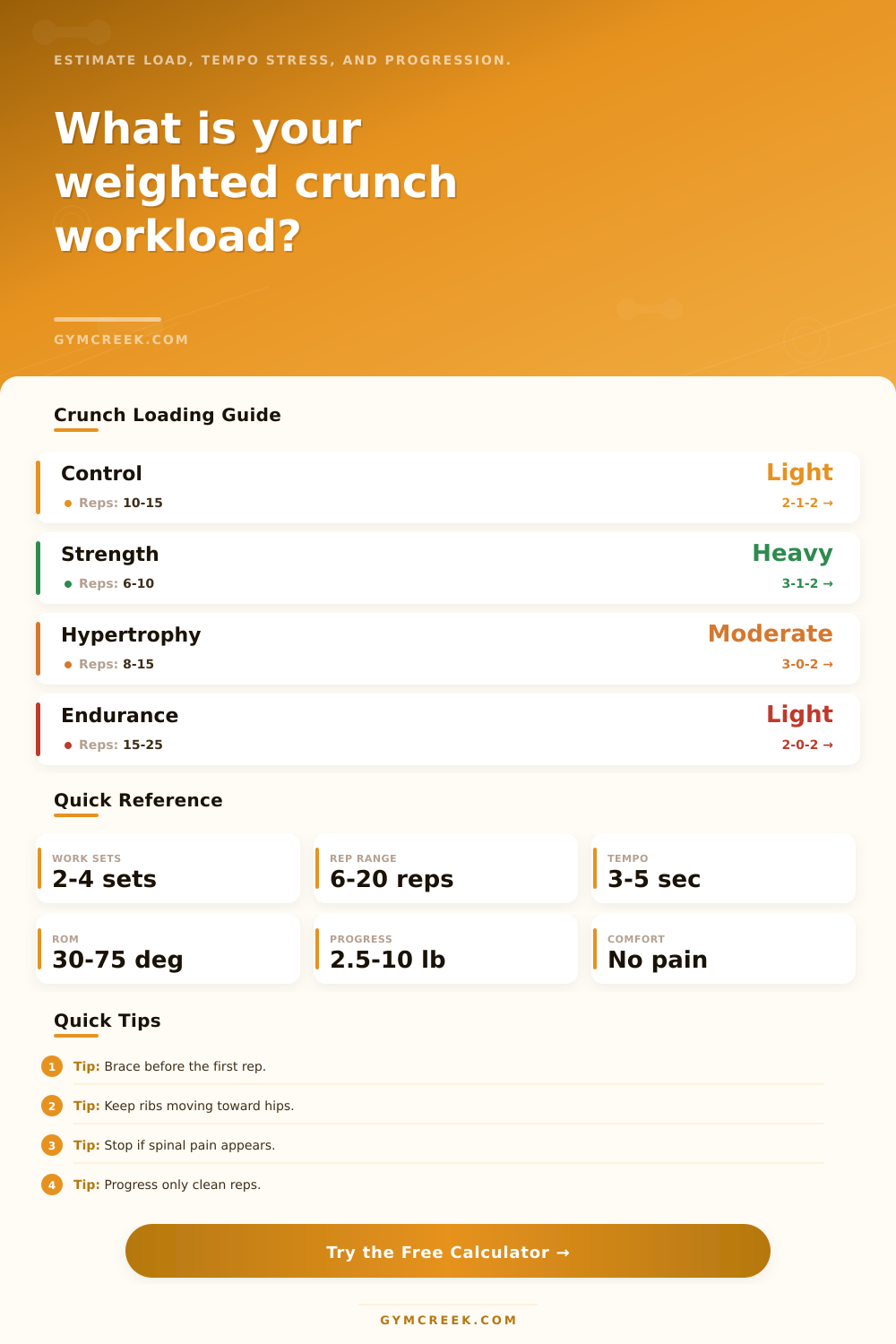
But it’s the tempo part where most programs fall apart. Lowering fast, lifting fast mean less time under tension. This negates the very reason to do hypertrophy work. The calculator splits the rep into eccentric, pause, and concentric phases. So if you take two seconds to squeeze and four seconds to lower, that’s six seconds of work per rep. Do three sets of 12 reps and you’ve got a lot of volume load. Your total workload score come back as a sign of your time under tension. Now you can look at a slow, controlled set versus a fast, heavy set and know which was better without having to guess. The reference tables on the page lay out what common tempo structures looks like across different goals so you can see the difference between a three-zero-two compared with a slower four-two-three block.
There are two inputs I don’t mess with. One is comfort. You don’t train the intervertebral discs, you train abdominal muscles. To handle this, the system has a comfort flag that will change the advice it gives based on what you tell it. So if something feels sharp or pinches, it’ll recommend going to less load or shorter range of motion. Progressive overload is nice but it’s worthless if you’re injuring your lower back.
You can go as high as you want but make sure you keep your pelvis in a neutral position at all times during the move. If you let your hips rock forward, you’ve converted the crunch into a hip flexor exercise; no abs required, just a strained lower back.
Gradual progress is key With each workout, the calculator recommends how much additional weight you should add depending on your reps-in-reserve at the time. Adding a little weight makes sense if you’ve got two reps remaining in the tank. Grinding out the final rep? Bad form? Time to back off. The tool limits the increase so as not to spike up suddenly into a level of intensity you can’t maintain without breaking down your technique. Not a bad way to go; trunk stability is about consistency, not hero sets.
In summary: You want to strengthen the core but not compromise the spine. When done on purpose, the weighted crunch can be an excellant exercise. It allows you to monitor how much effective load you’re working with instead of just how heavy the plates are. No longer do you look at others’ performances while wondering if they were doing it differently (with different tempo, angle, etc). Instead, you pay attention to form; both about safety and quality of the contraction. This is what matters. Maintain proximity with the load, slow the descent, and use the numbers as your guide for achieving a stronger, safer core.