Weight Loss Workout Calculator
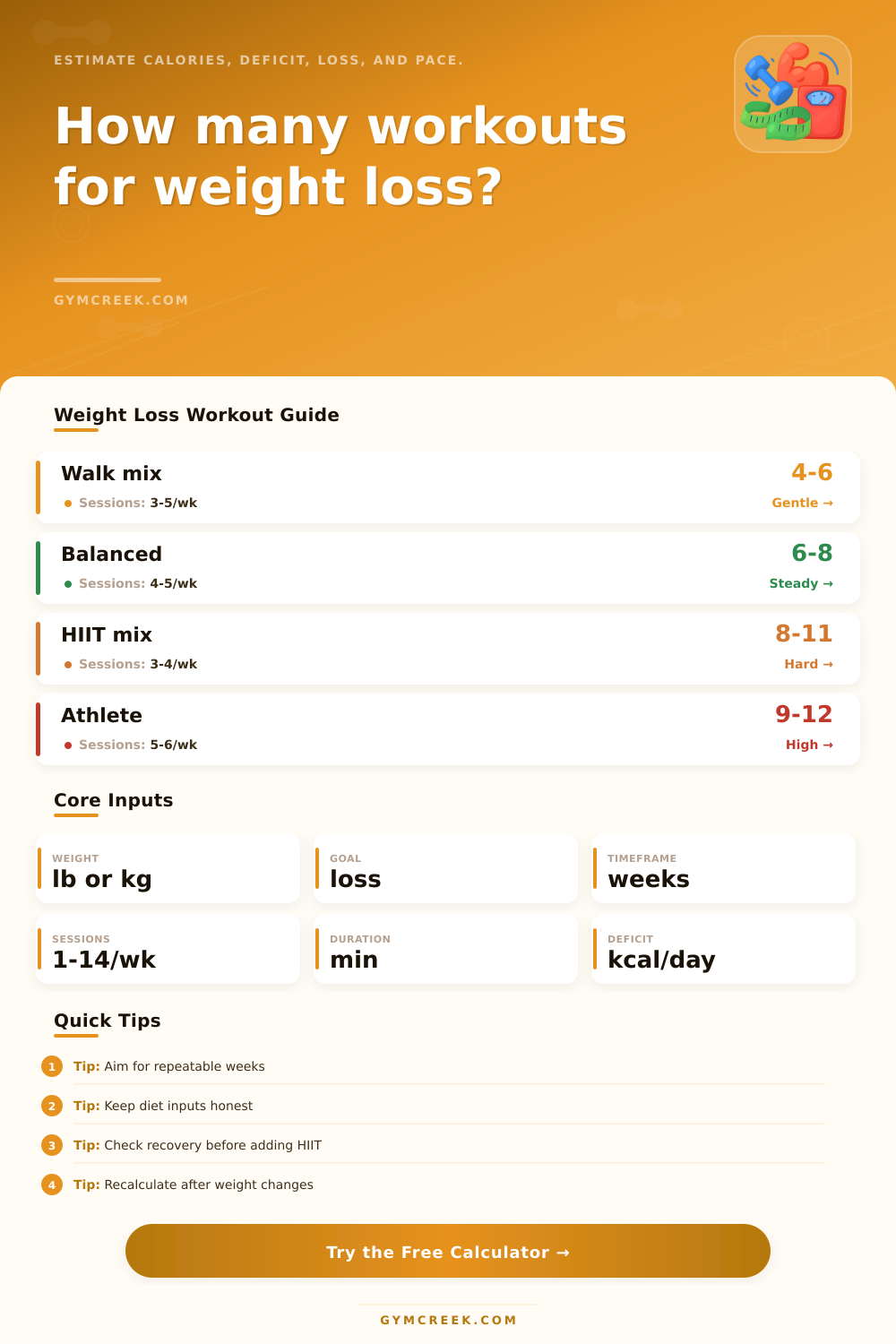
Estimate workout calories, weekly deficit, projected loss, needed sessions, and a sustainability score from body weight, goal loss, timeframe, workout mix, weekly schedule, session length, intensity, diet deficit, and recovery.
📌Weight-Loss Workout Presets
Presets load realistic mixes of body size, goal loss, timeframe, training style, frequency, duration, intensity, diet deficit, and recovery status.
⚙Calculator Inputs
Weight-loss workout snapshot
Enter your body weight, goal, timeframe, workout mix, schedule, intensity, food deficit, and recovery to estimate the plan.
📊Metrics Grid
📑Reference Tables
| Workout mix | Base MET | Typical contents | Recovery demand |
|---|---|---|---|
| Walking plus mobility | 4.2 | Incline walk, easy circuits, mobility | Low |
| Cardio-dominant mix | 7.4 | Bike, rower, jog, stair machine | Moderate |
| Balanced cardio and strength | 6.8 | Lifting, intervals, steady cardio | Moderate |
| Strength plus steps | 5.8 | Weights, carries, walking volume | Moderate |
| HIIT plus strength | 9.2 | Intervals, circuits, compound lifts | High |
| Low-impact machine mix | 6.2 | Elliptical, bike, rower, sled | Low to moderate |
| Endurance cross-training | 8.0 | Runs, rides, long machine sessions | Moderate to high |
| Weekly pace | Score effect | Common feel | Adjustment cue |
|---|---|---|---|
| Under 0.5% body weight | Gentle | Easy to recover from | Good for beginners or maintenance phases |
| 0.5% to 1.0% | Strong | Repeatable for many people | Often the practical target range |
| 1.0% to 1.5% | Aggressive | More hunger and fatigue | Watch training quality and sleep |
| Over 1.5% | High risk | Hard to sustain | Reduce diet deficit or extend timeframe |
| Goal setup | Food deficit | Workout burn | Needed sessions |
|---|---|---|---|
| 5 lb in 10 weeks | 250 kcal/day | 300 kcal | 0 sessions/week |
| 10 lb in 12 weeks | 300 kcal/day | 400 kcal | 2 sessions/week |
| 15 lb in 12 weeks | 400 kcal/day | 450 kcal | 4 sessions/week |
| 20 lb in 10 weeks | 500 kcal/day | 500 kcal | 7 sessions/week |
| Output | Formula | Variables | Use |
|---|---|---|---|
| Workout calories | MET x 3.5 x kg / 200 x min | Weight, mix, intensity, duration | Session burn estimate |
| Weekly deficit | Exercise kcal + diet kcal | Sessions, duration, daily deficit | Combines training and food plan |
| Projected loss | Total deficit / kcal per unit | 3500 per lb or 7700 per kg | Scale trend estimate |
| Needed sessions | Remaining kcal / session kcal | Goal, timeframe, diet, burn | Tests whether the goal pace fits |
| Sustainability | 100 minus risk penalties | Pace, volume, intensity, recovery | Practical plan check |
💡Tips
If the number is far above your available week, extend the timeframe or lower the target loss instead of forcing extra hard workouts.
Machines, watches, and MET tables can all miss. Use weekly body-weight trend, workout logs, and recovery signals to adjust the plan.
Hard intervals can raise calories per minute, but poor sleep and sore joints often reduce consistency more than the extra burn helps.
A lighter body burns fewer calories for the same session, so revisit the plan every few weeks during longer cuts.
A weight loss workout calculator are a tool that will help a persons plan for weight loss through exercise. A weight loss workout calculator take specific information about a person and their goal for weight loss and create a plan for them based on that information. Information to be entered into a weight loss workout calculator may include the person’s current body weight, goal for weight loss, the number of week they have to reach that goal, and the type of training exercises that they will perform.
The information that a person enters into a weight loss workout calculator is important to the creation of the plan. A persons current body weight is one of the important inputs to the calculator; individuals that weigh more will naturaly burn more energy than individuals that weigh less. The types of exercise that are to be performed are another of the important pieces of information to the calculator; different exercise types burn more calories than others.
How to Use a Weight Loss Workout Calculator
Information about how many sessions of exercise a person can perform each week is also important to the calculator; the more sessions that can be performed each week, the more calories can be burned each week. Finally, the number of calories that are to be burned through dieting alone each week is another of the important variable; this determine how many calories will have to be burned through exercise alone. The level of recovery that can be provided to the body each week is also an important variable to consider; poor recovery can impact the ability of the person to adhere to their exercise plan.
The weight loss workout calculator will display for a person the number of pounds that they will lose. Furthermore, it will also display the number of exercise sessions that is required to achieve the goal for weight loss, assuming that the diet remain the same. These numbers can be helpful in that they allow an individual to determine if the number of exercise sessions required to achieve their goal is realistic according to their available schedule.
If the exercise calculator suggest that the number of exercise sessions required for weight loss is more than the number of sessions that that individual can perform, then it may be better for that individual to either extend the timeframe during which they wish to lose weight, or to reduce their target for weight loss. Performing more exercise sessions is not necessarily the best solution to address this issue; the sustainability score that the calculator presents for each suggested plan can help an individual to understand if their suggested exercise plan is likely to be able to be performed over time. It is important for individuals to understand that the numbers regarding calories that are burned through exercise that a weight loss workout calculator presents to them are estimates only.
The number of calories that are actualy burned through exercise may differ from the estimate that the calculator provides to an individual. Therefore, the estimates from the calculator should be used as a starting point for exercise routines. Furthermore, the trend in the actual weight of the individual each week can be used to determine if any adjustment to their diet (more specifically to their food intake) should be made before any adjustments to their exercise program are made.
Many individuals may make the mistake of suggesting very high level of diet deficit and exercise without first ensuring that the individual has good recovery. Both diet deficit and high levels of exercise can have negative effects on the individual’s ability to successfully lose weight; therefore, lowering one of these variables may be the best solution to an individual’s weight loss problem. The reference tables that are provided on the calculator can be used to review the tradeoffs of various variables to weight loss without having to memorize the coefficients for those variables.
For example, the reference tables can provide information about which types of exercise will result in high demand for recovery, and at what percentage rate for weight loss an individual may feel hunger or fatigue. There is no need to study the reference tables in detail, but a review of the pace guide can help to ensure that an individual understand whether their suggested plan is likely to be repeatable over long period of time. One of the main values of a weight loss workout calculator is in the ability to adjust one or more variable to see how that may impact the remaining variables in the calculation.
For instance, changing the timeframe in which an individual desire to lose weight will impact the number of exercise sessions that are required. Increasing the length of each exercise session will have an impact on the sustainability score for the suggested plan. Decreasing the diet deficit will impact the projected weight loss for the individual.
Thus, each of these variables can be adjusted to see how they may impact the others. A weight loss workout calculator create a plan for an individual that can be followed to achieve the goal for weight loss. The calculator can provide information regarding the calories that will be burned through exercise, the diet deficit that an individual can maintain, and the recovery of the individual through exercise.