Weight Loss Rate Calculator
Estimate a sustainable weekly loss rate, daily calorie deficit, target intake, macro floor, diet phase length, and check-in target from your body size, activity, and goal.
◎Presets
Presets load complete scenarios and calculate instantly. Adjust the inputs to match your real scale trend and training week.
⚙Calculator
Weight loss rate snapshot
Enter your stats to estimate loss pace, calories, and timeline.
▦Fitness Metrics Grid
▣Reference Tables
| Profile | Rate | Typical deficit | Best use |
|---|---|---|---|
| Lean or performance focused | 0.25-0.50% | 150-400 kcal | Preserve training |
| General steady cut | 0.50-0.75% | 350-650 kcal | Sustainable pace |
| Higher body fat phase | 0.75-1.00% | 500-900 kcal | Early fat loss |
| Short deadline cut | 1.00-1.50% | 700+ kcal | Brief phases only |
| Level | Multiplier | Typical week | Cutting note |
|---|---|---|---|
| Sedentary | 1.20 | Desk based | Protect steps |
| Lightly active | 1.375 | Steps plus lifts | Small changes |
| Moderately active | 1.55 | Train 3-5 days | Common fit |
| Very active | 1.725 | Daily sessions | Fuel recovery |
| Deficit | Signal | Scale trend | Adjustment |
|---|---|---|---|
| Under 250 kcal | Small | Slow or noisy | Review 21 days |
| 250-500 kcal | Moderate | Gradual loss | Hold steady |
| 500-750 kcal | Assertive | Clear loss | Watch energy |
| 750+ kcal | High | Rapid loss | Use briefly |
| Output | Formula | Inputs | Purpose |
|---|---|---|---|
| BMR | Mifflin-St Jeor | Age, size, sex | Base burn |
| Lean BMR | Katch-McArdle | Lean mass | BF known |
| TDEE | BMR x activity | BMR, factor | Maintenance |
| Loss calories | Loss x 3500 | Weekly loss | Deficit |
◇Tips
You save yourself having to do all of that conversion and coefficient math by plugging in your numbers into the calculator up top. That’s cool and all but what really matters is knowing why those inputs is important. Your metabolism adjusts. Your hunger hormone change And if you aren’t accurately accounting for your activity level, everything you’ve built is based off of poor data.
First, it ask for your height, age, and sex so it can figure out your Basal Metabolic Rate based on the Mifflin-St Jeor equation. That’s how much energy your body use to breathe and pump blood with your eyes closed. It has nothing to do with your willpower.
Why These Numbers Matter
Then it multiples that amount times an activity factor. This is where everyone lie to themselves. I say “moderately active” because I took a walk on Tuesday, but really I sit at a desk all day long. It lays that out right on the page in a reference table; small shifts in activity multiplier has big effects on what your maintenance calories are.
If you overestimate how active you are, you won’t move the scale. You want to under-estimate how active you are and you’ll be starving yourself yet not losing any weight.
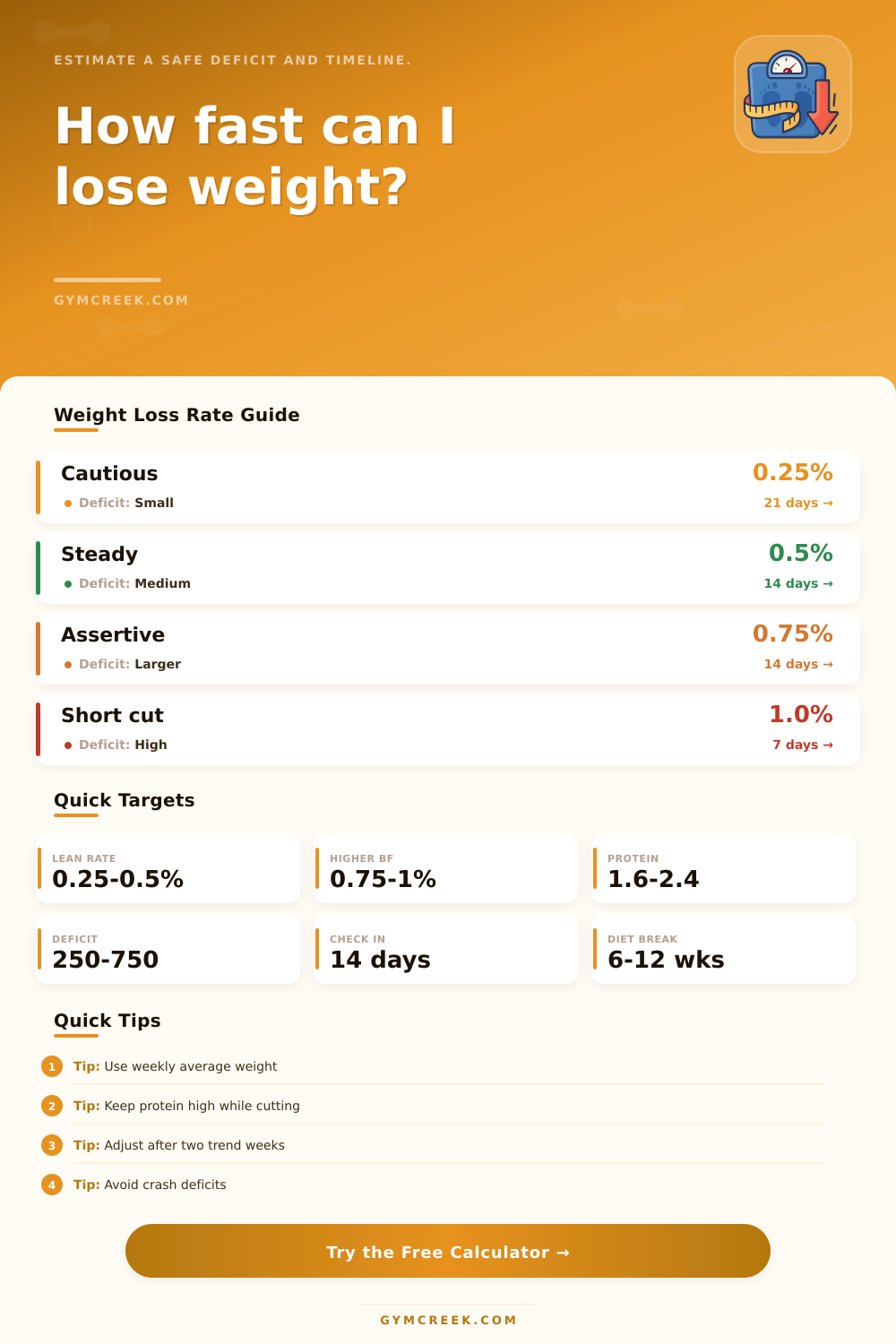
To do that, the calculator wants you to select a strategy: Assertive or Cautious. By “strategy,” I don’t mean how fast you’re going to go; although speed is a factor. I also mean whether you can sustain it. You don’t want to lose more than 0.5 percent of your body weight each week, which (typically) maximizes fat loss while minimizing loss of lean tissue. If you move too quickly, you’ll be dropping both the flab and the lean stuff. Drop it slowly enough though, and you may not get to see results before you lose motivation entirely.
This percentage is turned into a daily calorie burn. This ensures you never dip below the bare-bones level. That level will still provide some fuel for your body to repair itself, especially if you’re strength training.
The other variable it assist you with is how much protein you’re consuming. If you’re in a deficit, your body want to eat away at your muscle for fuel. So eating enough protein tells your body you need those muscles and that it should not break them down for fuel. You can plug in how many grams of protein per pound or kilogram that you’d like to consume. It doesn’t have to be the same every day. It just needs to be around the amount necessary for tissue repair.
You’ll get an exact breakdown of your TDEE and BMR to show how metric grid determines your target calories. The final… And arguably most important, step in this process is reviewing. Typically, I recommend reviewing about once every two weeks, but the calculator provides an interval that might be more appropriate for you. This is about fourteen days because your body weight fluctuate so much from day-to-day with changes in glycogen stores, sodium, and water retention. If you stare at the number on the scale each day, you’ll go insane. Review the trend across the last couple weeks. Is the average down as much as you expect? Great, keep going. Hasn’t budged? Time to make an adjustment. But don’t slash your calories by five hundred just because you’re impatient. Often, making a tiny tweak, like one-hundred calories, is all that’s needed to get things moving again while avoiding any crash in energy.
In conclusion: If you want to lose weight (and I mean lose fat), you need to find a way of eating that’s flexible yet consistent, not a “perfect” diet. The calculator provides a starting point, a rational guess from your existing body size. You’ll have to see how it plays out in the real world. Focus on the trend, not the day-to-day noise. Make gradual adjustments. Understand that you’re trying to create a lifestyle, not just a temporary change to see a different number on the scale. Your commitment makes the math work.