Weight Loss Percentage Calculator
Measure percentage lost from your starting weight, goal progress, weekly pace, BMI change, and the calorie-deficit context behind your current trend.
📌Weight-Loss Presets
Presets load different body sizes, timelines, activity levels, weigh-in methods, and goal weights so the percent output changes realistically.
⚙Calculator
Weight-loss percentage snapshot
Enter start, current, goal, and timeline values to calculate.
📊Progress Metrics
📑Reference Tables
| Metric | Formula | Primary use | Watch point |
|---|---|---|---|
| Percent lost | (Start - current) / start x 100 | Phase progress | Needs same scale routine |
| Goal progress | Lost / planned loss x 100 | Distance to goal | Only works when goal is below start |
| Weekly pace | Percent lost / weeks elapsed | Trend speed | Short windows can be noisy |
| Deficit estimate | Weight lost x 3500 kcal/lb | Energy context | Adaptive changes are normal |
| Pace | Percent per week | Typical read | Calculator flag |
|---|---|---|---|
| Very slow | Under 0.25% | Maintenance-like trend | Plateau check |
| Gentle | 0.25% to 0.50% | Easy recovery pace | Conservative |
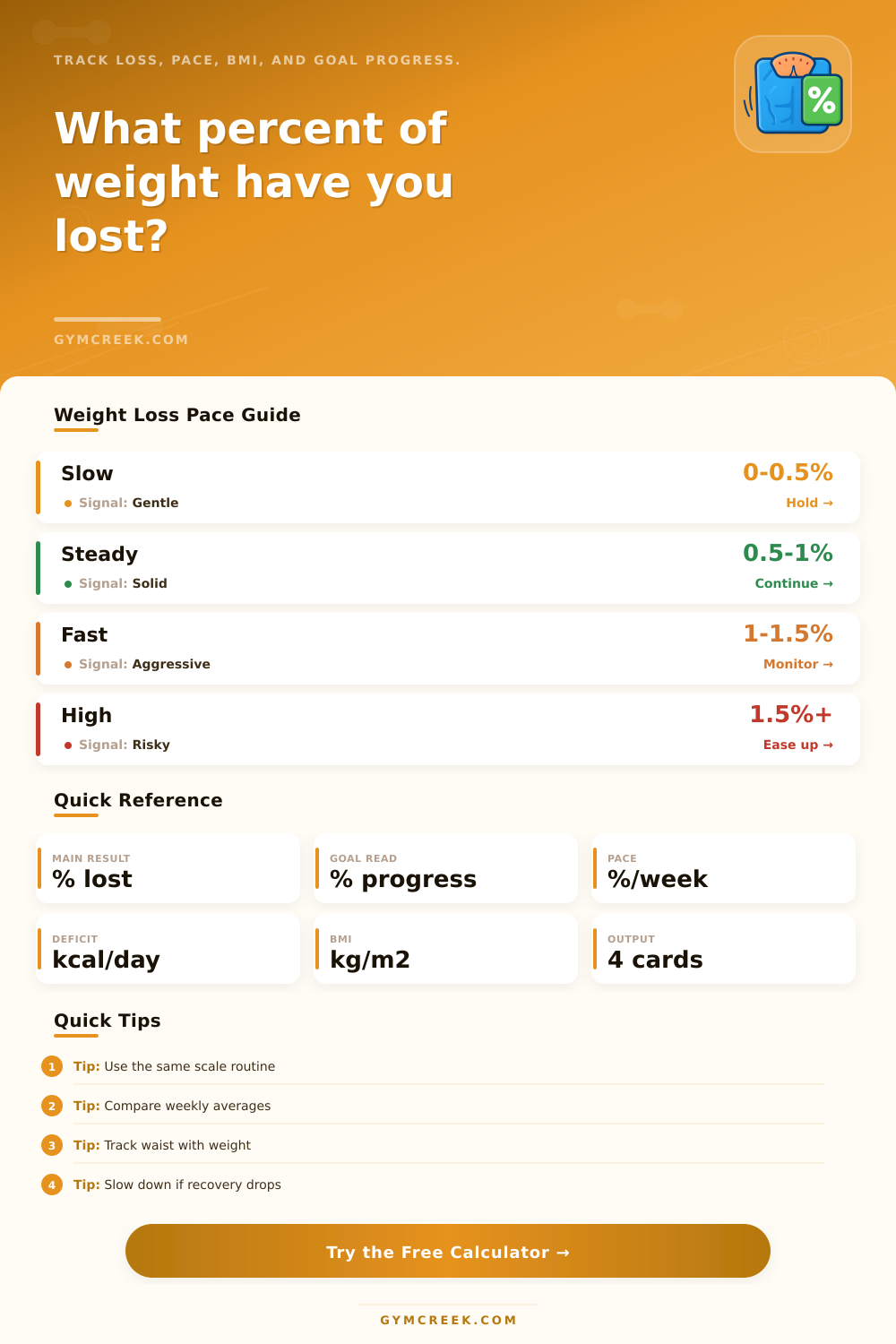
| Steady | 0.50% to 1.00% | Common fat-loss range | Steady |
| Aggressive | 1.00% to 1.50% | Needs closer recovery check | Aggressive |
| Very high | Over 1.50% | May be hard to sustain | High pace |
| BMI band | Range | What it means | Use in this tool |
|---|---|---|---|
| Underweight | Under 18.5 | Low body mass | Health discussion |
| Normal | 18.5 to 24.9 | Population reference range | Context only |
| Overweight | 25.0 to 29.9 | Higher body mass | Trend context |
| Obesity | 30.0+ | Higher health-risk band | Clinical context |
| Method | Noise level | Best use | Calculator note |
|---|---|---|---|
| 7-day average | Lowest | Weekly trend decisions | Best comparison |
| Weekly same day | Moderate | Simple check-ins | Keep routine identical |
| Morning single | Higher | Fast feedback | Expect water swings |
| Clinic weigh-in | Variable | Coached or medical visits | Compare like with like |
💡Tips
A weight loss calculator can help you to understanding your weight loss progress by performing some simple math on the number of pound (or kilograms) that you have lost. While a scale are helpful in that it can show you your weight, it does not provide the context of how much weight you have lost relative to you starting weight. Your weight loss calculator will provide you with this context by calculating the percentage of your starting weight that you have lost.
Using percentage is more helpful then using pounds or kilogram alone in that it provides context for your weight loss in relation to your total body mass. To use a weight loss calculator, you must provide it with several piece of information about yourself and your weight loss process. The calculator will ask for your starting weight, your current weight, and your goal weight.
How to Use a Weight Loss Calculator
Your starting weight are necessary to calculate the percentage of your starting weight that you have lost. Your current weight is use to calculate the extent of your weight loss from your starting weight. You enter your goal weight into the calculator to provide a target that you are attempting to reach.
Additionally, the calculator require the number of weeks that you have elapsed since you started to lose weight. You may also be prompted for the number of weeks that it will take for you to reach your goal weight; this can help the calculator to determine if your current rate of weight loss is fast enough to reach your goal on time. Other pieces of information that may be requested of you include your age and your activity level.
Your activity level will impact your bodys energy expenditure, the more active that you are, the more calories that you will burn each day. The calculator can use your activity level and your age to estimate your daily energy need. These two factor will allow for a comparison between your expected daily energy needs and the changes to your weight to provide context to your weight loss process.
The method that you use to weigh yourself will have an impact based off the data that you enter into the calculator. You can select, for instance, using only a single morning weight to track your weight loss, or you can use the average of your weight every day for a seven-day period. Using a single morning weight can lead to alterations in your weight each day due to changes in your water weight.
Using a seven-day average will smooth out these daily alterations in your water weight. If you change the method that you use to weigh yourself, your data will likely be inconsistently. Your data will only be deemed accurate if you select one method and use that same method each day to weigh yourself.
The weight loss calculator may also provide a metric of the change in your Body Mass Index (BMI). Your BMI calculate the change in your body mass (since your height will remain the same). The change in your BMI may be of interest to you in that it may indicate whether you are moving from one health category to another.
Additionally, you may be able to enter your waist measurement into the calculator. Your waist measurement may be of interest to you in that it may show changes in your body composition. A change in weight does not necessarily indicate a change in body composition if your waist do not change.
Additionally, the calculator may allow for you to provide information regarding your daily caloric intake. The weight loss calculator may use your daily caloric intake to provide an estimate of the calorie deficit that you are create each day. If the information provided to the calculator indicate a weight loss yet the estimated calorie deficit is extreme high relative to the amount of food that you consume each day, you should check the consistency of the measurements that you provide to the calculator.
If the estimated calorie deficit is lower than that which you calculate for yourself, you may wish to investigate potential reason for your slower rate of weight loss. It is recommended that you not rely upon any single number provided by the calculator. You should consider your weight loss percentage, your weight loss pace, your change in BMI, and your waist measurement to gain a complete understanding of your weight loss process.
If each of these metrics indicates a weight loss process that is occurring for you, then you are likely experience steady weight loss. If the different metrics indicate different outcomes for your weight loss process, you may want to investigate your sleep cycle, the intensity of your physical training, or your intake of salt in your diet. The calculator is a helpful tool in that it can provide you with an idea of your rate of weight loss, but the calculator cannot make decision for you regarding the sustainability of that rate of weight loss.
Only you can make that decision based upon how you feel in your body each day and your change in strength.