Weight Loss From Walking Calculator
Estimate walking calories, weekly calorie deficit, expected weight-loss rate, and goal timeline from your body stats, walking pace, incline, frequency, and food-intake consistency.
📌Walking Presets
Presets load realistic walking plans. Change any field after loading one to match your week.
⚙Calculator Inputs
Walking weight-loss snapshot
Enter your stats and walking plan to estimate calories, weekly weight loss, and target timeline.
📊Walking Metrics Grid
📑Reference Tables
| Walk type | Speed | Common feel | Weight-loss use |
|---|---|---|---|
| Easy walk | 2.0-2.9 mph | Conversation is easy | Best for building consistency |
| Brisk walk | 3.0-3.9 mph | Breathing is stronger | Good balance of burn and recovery |
| Power walk | 4.0-4.5 mph | Talking is limited | Higher calorie burn per minute |
| Incline walk | 2.5-3.5 mph | Legs and lungs work harder | Useful when speed is limited |
| Weekly minutes | Typical setup | Expected role | Watch point |
|---|---|---|---|
| 75-120 | 3-4 short walks | Starter habit | Keep it easy enough to repeat |
| 150-210 | 30-45 min most days | Meaningful calorie support | Food intake still drives the trend |
| 240-300 | Longer daily walks | Stronger weight-loss assist | Footwear and recovery matter |
| 300 plus | High-volume walking | Large energy output | Progress volume gradually |
| Weekly rate | Percent body weight | Interpretation | Adjustment |
|---|---|---|---|
| Under 0.25% | Slow | Small deficit or maintenance | Add time or review intake |
| 0.25-0.50% | Moderate | Common sustainable pace | Hold for two weeks |
| 0.50-1.00% | Fast | Often effective for fat loss | Monitor fatigue and hunger |
| Over 1.00% | Aggressive | May be hard to sustain | Use professional guidance |
| Formula | Variables | What it estimates | Why it helps |
|---|---|---|---|
| ACSM walking equation | Speed and grade | Oxygen cost of walking | Better incline handling than flat METs |
| kcal per minute | VO2 and body weight | Walking calorie burn | Scales output to your size |
| Mifflin-St Jeor | Age, sex, height, weight | Resting calories | Checks total daily energy context |
| 3500 kcal rule | Weekly deficit | Fat-loss equivalent | Simple timeline estimate |
💡Tips
I want to lose weight. So, I’m going to walk more. But I haven’t lost any weight in two weeks. Now, I’ve stopped tracking.
It’s a familiar pattern. Why do people give up? Nothing shows on the scale even though they think they’re doing something right. The truth is usualy just a misunderstanding of how much energy walking actualy burns. Most often, it’s because there’s a mismatch between amount of calories burned by walking vs. The number of calories consumed or moved around your home throughout the day.
Why Walking Alone May Not Make You Lose Weight
While walking are great for stress relief and overall health, it won’t magically help you lose weight quickly. If you want it to work, you approach it with precision. Not vague intentions.
This brings us to the calculator on this page. It fills the gap between effort and result, and it measures the variables that most people ignore until it’s too late. You do not have to guess your calorie count based off your weight. Nope. It accounts for terrain, incline, speed, and even your baseline level of activity outside the walk itself.
That matter, because while a brisk power walk up a slight hill might feel like exercise, so does a casual stroll around the park. But one burns a lot fewer calories. To get a realistic baseline for your total daily energy expenditure, it first asks for your sex, age and height. Using standard formulas, it calculates your resting metabolic rate. Then it adds in actual cost of the walking sessions you plan to do. This creates a more accurate picture of your total daily energy expenditure.
People gets surprised when they see one of the inputs. It’s the difference between time spent walking, vs. This is the time spent being otherwise active. Say you have a desk-job where you sit all day, and want to go out and walk an hour each night. Choosing a really high-activity lifestyle multipliers will double-count those hours. This inflates your caloric budget.
The calculator explicitly breaks them apart. You can easily see how many calories your daily life requires, and how much the walking adds on top. It lets you avoid a very typical mistake: thinking, “Oh, I exercise, so now I’m allowed to pig out,” even though walking ten thousand steps a day might still burn less then two large lattes. (Unless you’re factoring the baseline correctly.)
The other lever that flips the equation like a switch is incline. And no, you don’t have to go out running to witness it. While it doesn’t take much energy to walk on level ground at three miles per hour, it will take significantly more energy to walk at the same pace uphill on a five percent incline. The calorie burn and oxygen cost are considerible.
By taking that gradient into account, the tool adjusts its metabolic equivalent. You can plug in a hillier route outdoors (or even mimic it on a treadmill). For those who find it difficult to achieve their high intensity zones while walking, adding incline is an easy alternative to pumping up the speed. It transforms a moderate activity into a vigorous one; but with none of the joint pounding from going faster.
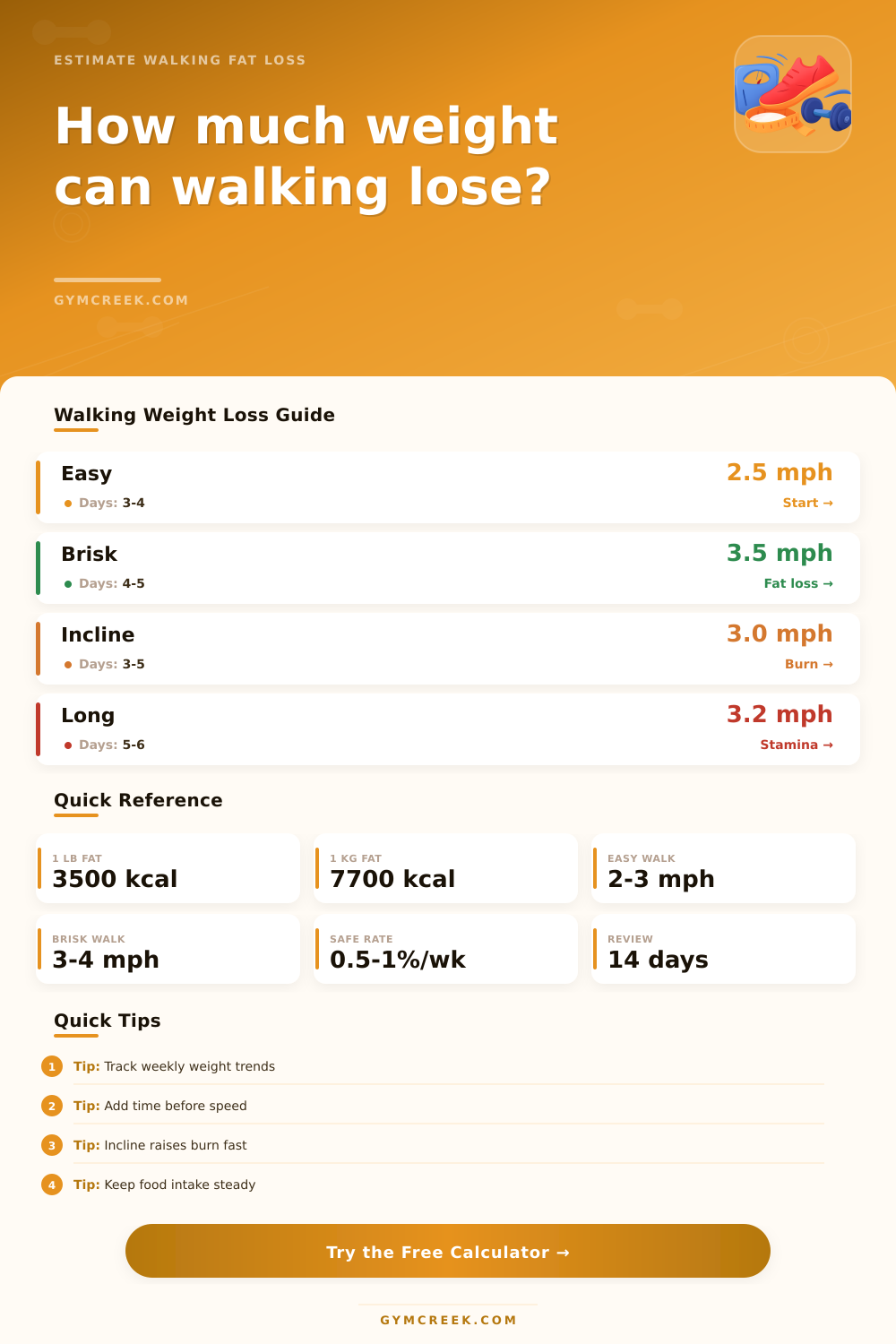
To put those numbers into perspective, the tool comes with reference tables that explain the meaning behind them. For instance, it’s generally agreed that a healthy, sustainable range is to lose half to one percent of your body weight each week. So, if the scale won’t budge, the table will help you keep your expectations in check. Next, the calculator uses the old adage (about 3,500 calories = 1 pound) to estimate how long this will take.
In other words, it’ll give you an approximate date by which you could reach your goal weight. This isn’t a promise; it is just a guide. If the timeline seems unrealistic, you might need to adjust either your walking volume or your dietary intake. Either way, you’ll know whether your diet and/or exercise plan needs tweaking.
Intensity vs. Consistency: In general, consistency beats intensity over time. There are presets here for both aggressive fat loss routines (more) and gentler maintenance walks (less). You don’t have to crank all the variables up to 11 to get results, but you also shouldn’t go in blind about what each variable does or doesn’t do.
For example, newbies building their endurance might want to add time before speed. Adding incline will increase burn rates without necessarily lengthening the workout. The tool lets you play around safely with both. It’ll help you identify a routine that’s not only feasible, but effective.
It’s all about habits, too. You need a calorie deficit and also walking. You know the math; how many calories will that amount of time (speed) over this distance (terrain) at this rate (frequency)? And once you’re there, the numbers don’t stress you out; they give you a roadmap.
It goes from guesswork to strategy. It goes from anxiety to data-driven tweaks. You do what? You take steps. And when you put the proper numbers front and center, those steps start adding up.