Weight Gain Rate Calculator
Estimate a realistic gain pace, daily calorie surplus, target calories, macro split, and timeline using body size, activity, training age, body fat, and goal style.
◎Presets
Presets load complete examples and calculate immediately. Adjust any input to match your own weight trend and training context.
⚙Calculator
Weight gain rate snapshot
Enter your stats to estimate gain pace, calories, and timeline.
▦Fitness Metrics Grid
▣Reference Tables
| Profile | Rate | Daily surplus | Best use |
|---|---|---|---|
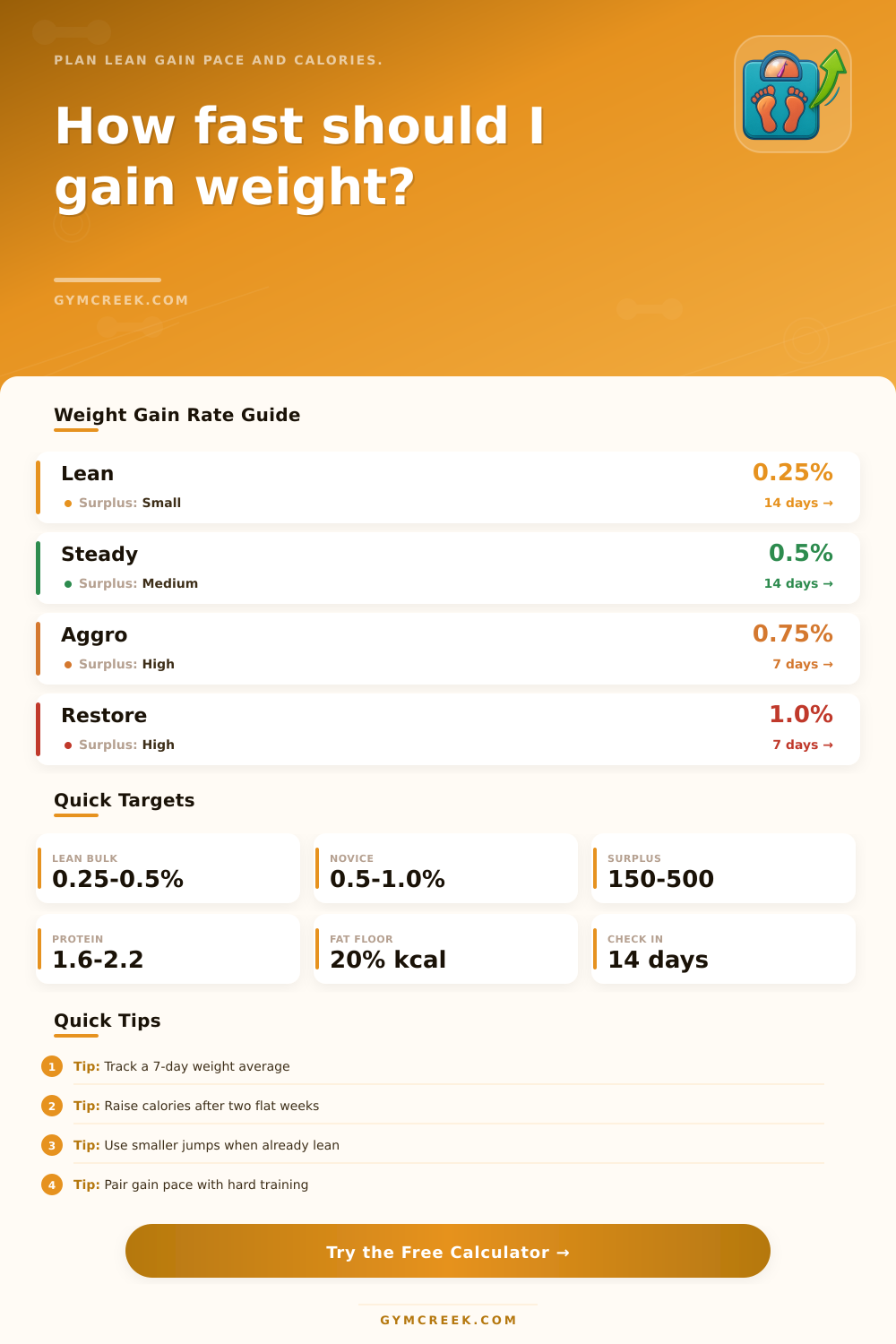
| Advanced lean bulk | 0.10-0.25% | 75-200 kcal | Limit fat gain |
| Intermediate build | 0.25-0.50% | 150-350 kcal | Steady gaining |
| Novice growth phase | 0.50-1.00% | 300-700 kcal | Early lifting |
| Restoration phase | 0.75-1.25% | 500+ kcal | Supervised regain |
| Level | Multiplier | Typical week | Gain note |
|---|---|---|---|
| Sedentary | 1.20 | Desk based | Small surplus |
| Lightly active | 1.375 | Steps plus lifts | Track NEAT |
| Moderately active | 1.55 | Train 3-5 days | Common fit |
| Very active | 1.725 | Daily sessions | Fuel hard days |
| Surplus | Signal | Scale trend | Adjustment |
|---|---|---|---|
| Under 150 kcal | Very small | Slow or noisy | Review 21 days |
| 150-300 kcal | Lean range | Gradual gain | Hold steady |
| 300-500 kcal | Growth range | Clear gain | Watch waist |
| 500+ kcal | Fast range | Rapid gain | Use purposefully |
| Output | Formula | Inputs | Purpose |
|---|---|---|---|
| BMR | Mifflin-St Jeor | Age, size, sex | Base burn |
| Lean BMR | Katch-McArdle | Lean mass | BF known |
| TDEE | BMR x activity | BMR, factor | Maintenance |
| Gain calories | Gain x 3500 | Weekly gain | Surplus |
◇Tips
Weight acts like a dimmer switch. Weight gain is more like a dimmer switch then a light switch.
Understand your body’s needs. Know How Much To Eat (or Not) Build muscle without gaining fat. The calculator uses a combination of standard formulas to estimate your Basal Metabolic Rate (the amount of calories you burn while sedentary) and Total Daily Energy Expenditure (calories burned throughout the day). It consider your sex, age, height, and physical activity level. After all, an average male will burn more energy at 25 years old compared to an average female at 40 years old of equal body mass. It accounts for biological differences, giving you a realistic starting point rather than a generic guess.
How to Use Weight Data to Build Muscle
But most people will look at the scale one time, freak out, and then do something wrong. One day’s number doesn’t tell you much; it can vary based off digestion, sodium intake, water retention etc. Instead, try using a seven-day average. The system suggests… Because that smoothes out the noise and lets you see what’s really happening.
Flat for two weeks? Don’t change your training yet; instead, try eating a few more calorie. Fix the fuel first. Here’s where the reference table comes in: It relates gain speed to calorie surplus. For example, if your goal is a lean bulk, meaning a small surplus of maybe one-hundred-fifty calories over maintenance, you’ll be on a slower but cleaner pace. If you’re going for an aggressive phase that demands a five-hundred (or more) calories’ worth of surplus, you’ll build weight rapidly, but with greater fat gains as well.
You’re faced with a decision here. Are you trying to gain size quickly so you can cut later? Or are you gaining slowly so you don’t have to cut at all? The other variable that affects the equation is training age. Beginners responds well to training and can see a rapid increase in muscle, while experienced lifters gets away with much slower progress due to fewer pieces of low-hanging fruit available to pluck. It takes into account how long you’ve trained for and tweaks expectations to match. This prevents frustration from expecting beginner gains when your body is already used to years of lifting heavy weights.
Whether you’re a novice or an advanced lifter, however, the one thing that doesn’t change: Protein. Your body requires sufficient amino acids to repair itself, and consuming too much won’t cause your body to suddenly grow more muscle than before. The calculator sets a target, according to your bodyweight, that ensures you achieve the minimum requirement for building new muscle tissue while avoiding excess calories used up on unnecessary nitrogen. Fats are for hormones, and maintaining a reasonable percent of those in your overall consumption will help you recover well now and stay healthy over time.
The secret variable of all plans is adherence. People always want to make perfect meal plans, yet no one ever factors that real life gets in the way. Know that you’ll eat out a lot? Know you’ll miss meals? Adjust your daily number upwards accordingly. Better to shoot a bit over on certain days than to constantly shoot under and plateau.
Staying honest about what’s working means checking-in with your results on some kind of regular schedule. You can’t go changing stuff daily, give it the full two weeks as suggested before you know whether the trend continues. Trim back excess if you’re getting too heavy. Bump it up a little if you stall. It’s a feedback loop: adjust, wait, measure.
Gaining weight has more to do with consistency and energy balance than it does willpower. When you know how much you need and make adjustments based on that, you stop guessing and start building. The scale goes from being a judgment call to a data point, which changes everything from spinning your wheels to moving forward.