Weight Belt Size Calculator
Estimate a lifting belt size from your navel waist, measuring method, belt type, buckle style, hole spacing, and cut or bulk plans.
📌Presets
Presets use real sizing situations: competition lever belts, tapered Olympic belts, off-season bulks, cuts, and layered garage-gym warmups.
⚙Calculator
Belt sizing snapshot
Enter your waist and belt setup to estimate a useful size range.
📊Fitness Metrics Comparison
📑Reference Tables
| Belt Size | Common Waist Range | Best Starting Waist | Typical Use |
|---|---|---|---|
| XS | 22-31 in / 56-79 cm | 26-27 in | Small lifter or youth |
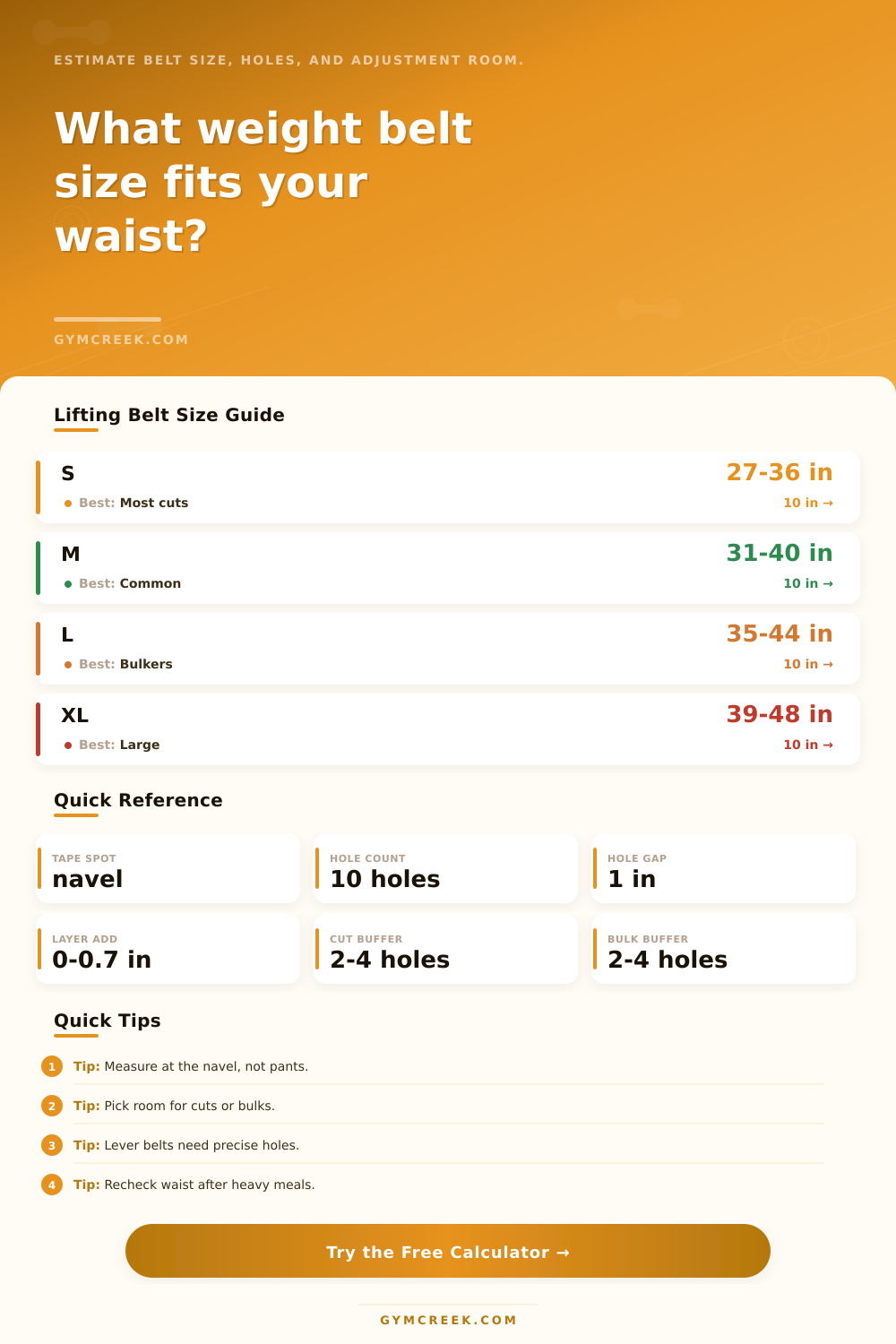
| S | 27-36 in / 69-91 cm | 31-32 in | Lean adult lifter |
| M | 31-40 in / 79-102 cm | 35-36 in | Most common gym fit |
| L | 35-44 in / 89-112 cm | 39-40 in | Large waist or bulk |
| XL | 39-48 in / 99-122 cm | 43-44 in | Big lifter range |
| 2XL | 43-52 in / 109-132 cm | 47-48 in | Very large waist |
| Measurement Method | Adjustment Used | Why It Matters | Best Practice |
|---|---|---|---|
| Snug navel tape | 0 in | Closest to belt position | Measure after normal exhale |
| Relaxed standing tape | +0.3 in | Leaves bracing room | Do not suck in |
| Pants waist tag | +2 in | Pants often understate waist | Retape when possible |
| Over clothes | -0.4 in | Removes extra fabric bulk | Measure base layer too |
| Belt Type | Fit Bias | Hole Strategy | Training Note |
|---|---|---|---|
| 10 mm power belt | Moderate | Middle hole | Works for most strength sets |
| 13 mm stiff belt | Looser | Keep one spare tight hole | Needs bracing space |
| Tapered Olympic | Neutral | Middle to snug | Useful for dynamic lifts |
| Nylon or Velcro | Flexible | Range matters less | Strap overlap is key |
| Weighted dip belt | Loose | Hip clearance | Not a bracing belt |
| Formula | Variables | Result | Use |
|---|---|---|---|
| Sizing waist | Measured waist plus allowances | Adjusted waist | Size choice |
| Hole position | Waist minus size minimum | Starting hole | Fit balance |
| Cut room | Waist minus minimum range | Tighter room | Weight loss phase |
| Bulk room | Maximum range minus waist | Looser room | Weight gain phase |
💡Tips
A leather belt shouldn’t be able to catch you off guard. You’ve been training for years, you’ve got some skill down and you’ve built some muscle. Yet, it can throw you off. Why?
Waist sizes aren’t constant. They change based off things like how much sleep you get, what you eat, or where you are in your training cycle. Sizing charts also differs greatly among manufacturers. If you gets the size wrong, you’ll end up either wasting money by having to return the belt or being uncomfortable because the belt is too loose and doesn’t provide much support.
How to Choose Your Lifting Belt Size
Once you input your measurements into the calculator above, all the math’s done for you. You will no longer wonder how to convert or figure out coefficients; instead, you gets a starting point made just for you.
Lifters rely too much on what their pants is labeled. They don’t realize this has no relevance to their actual waist circumference, while under load, they’re braced. To find out: Stand up, take a normal exhale (don’t suck it in), and wrap tape around your belly button. That’s your true waist measurement. Why does it matter? Because your belt rides higher than your jeans and must has enough clearance for your diaphragm to contract against it.
Most people overestimate how big a belt has to be by looking at their tag or casually wrapping a loose tape measure around them. The tool automatically accounts for all of these measurements. It corrects for our biased measuring habits so you end up with a size that matches your own body, not your closet.
How many holes do I leave open for wiggle room? The answer depends heavily on what stage of the training process you’re in. Are you in a cut and know that you’ll be shrinking down around the waist in the coming months? In this case, you’d prefer additional holes towards the tighter half of the belt.
If you’re bulking, though, you need some slack on the looser side so that you don’t outgrow the equipment before the season’s up. With most good belts, there are approximately a decade of viable hole (each separated by an inch), which leaves you with a total adjustment range of about ten inches. Sounds like a lot, right? But take into consideration the size of your hoodie or shirt, and suddenly the real usable margin becomes much smaller.
Ideally, if possible, you’d like to begin somewhere that still has some buffer space on either end. Another factor here is that some materials will feel different in terms of rigidity. A 13mm power-lifting belt feels stiffer and less forgiving than a similarly sized thin 10mm belt. A thicker belt doesn’t flex as much around your waist and tends to feel more constrictive then a thinner belt.
Likewise, going from something like a nylon material to a leather one can require going up a size or two. Or maybe you’ll go to a slightly looser hole than you’re accustomed to. The calculator takes all of these things into account by changing the desired fit to match the type of material you chose. It’s not purely about width, but how the material reacts against your core under load.
Precision: Lever belts offer precision but lack the micro-adjustments of a prong buckle. In other words, there’s no pulling a lever half an inch to get into that sweet spot. So your first size has to be closer. If you are between sizes, it complicates things. Do you want the snug fit of the smaller size now and know you can only go wider if you bulk significantly? Or do you want the big size to guarantee it lasts throughout a mass gain cycle? It depends on your goal.
There is no right or wrong answer. It just depends on your preference and where you are at.
Remember, you’re measuring what’s underneath the belt! While a simple singlet won’t affect waist measurements much, wearing bulky layers (i.e., layered warmup shirts/hoodies) can increase your apparent waist size by as much as a 1/2 inch. If you want to get the best idea of how the belt will look in action, measure while wearing your workout clothing. This may seem like a small issue, but we’ve all experienced that awkward situation where the belt fits perfectly in your livig room but too snugly at the gym.
To sum up, use a lifting belt to stabilize your core rather than restrict it. If it helps you generate intra-abdominal pressure without cutting off your airways or sliding up your chest during the lift, it’s working correctly. Ideally, use one that fits now but has some leeway so you can get bigger (or smaller) as your lifts dictate. Go by the numbers, modify based off clothing, and think about your future self. A proper fit will feel solid from the moment you grab it, not only after wearing it for several weeks.