Weight Adjusted Rowing Calculator
Compare rowing performances with a body-weight adjustment factor, watts per kilogram, split pace, projected distance time, and training context.
📌Rowing Presets
Presets load realistic erg profiles, distances, body weights, splits, stroke rates, drag factors, and training contexts for immediate comparison.
⚙Calculator
Weight adjusted rowing snapshot
Enter a rowing performance and body weight to calculate adjusted time, watts, and pace context.
📊Rowing Metrics
📑Reference Tables
| Step | Formula | Meaning | Use |
|---|---|---|---|
| Weight factor | (body lb / reference lb)^(2/9) | Body-size multiplier | Lower for lighter rowers |
| Adjusted time | raw time x factor | Comparable time | Same distance only |
| Rowing watts | 2.8 / pace^3 | Erg power estimate | Pace in seconds per meter |
| Watts/kg | watts / kg | Relative power | Body-weight comparison |
| Band | 2k time | Average split | Power note |
|---|---|---|---|
| Elite | Under 6:20 | Under 1:35 | Very high power |
| Competitive | 6:20 to 7:10 | 1:35 to 1:47.5 | Race-ready output |
| Strong club | 7:10 to 8:20 | 1:47.5 to 2:05 | Solid training base |
| Development | Over 8:20 | Over 2:05 | Build consistency |
| Body weight | Approx factor | 7:30 raw becomes | Interpretation |
|---|---|---|---|
| 125 lb / 56.7 kg | 0.843 | 6:19 adjusted | Large light-rower correction |
| 160 lb / 72.6 kg | 0.891 | 6:41 adjusted | Moderate correction |
| 200 lb / 90.7 kg | 0.935 | 7:01 adjusted | Small correction |
| 240 lb / 108.9 kg | 0.974 | 7:18 adjusted | Near reference weight |
| Variable | Keep consistent | Why it matters | Practical check |
|---|---|---|---|
| Distance | Same meters | Adjustment does not normalize fatigue curve | Compare 2k with 2k |
| Drag factor | Similar monitor drag | Stroke feel changes power delivery | Record DF each test |
| Stroke rate | Similar cadence | Load per stroke changes quickly | Note spm average |
| Conditions | Similar setup | Sleep, heat, and warm-up affect output | Repeat test protocol |
💡Tips
Weight-adjusted rowing times is used because the raw erg numbers from athletes dont give a complete picture of each athlete’s performance. Two athletes may have split the same distance with the same time, but one athlete may be heavier then the other athlete. As such, the heavier rower may be moving more mass than the other rower with the same wattage.
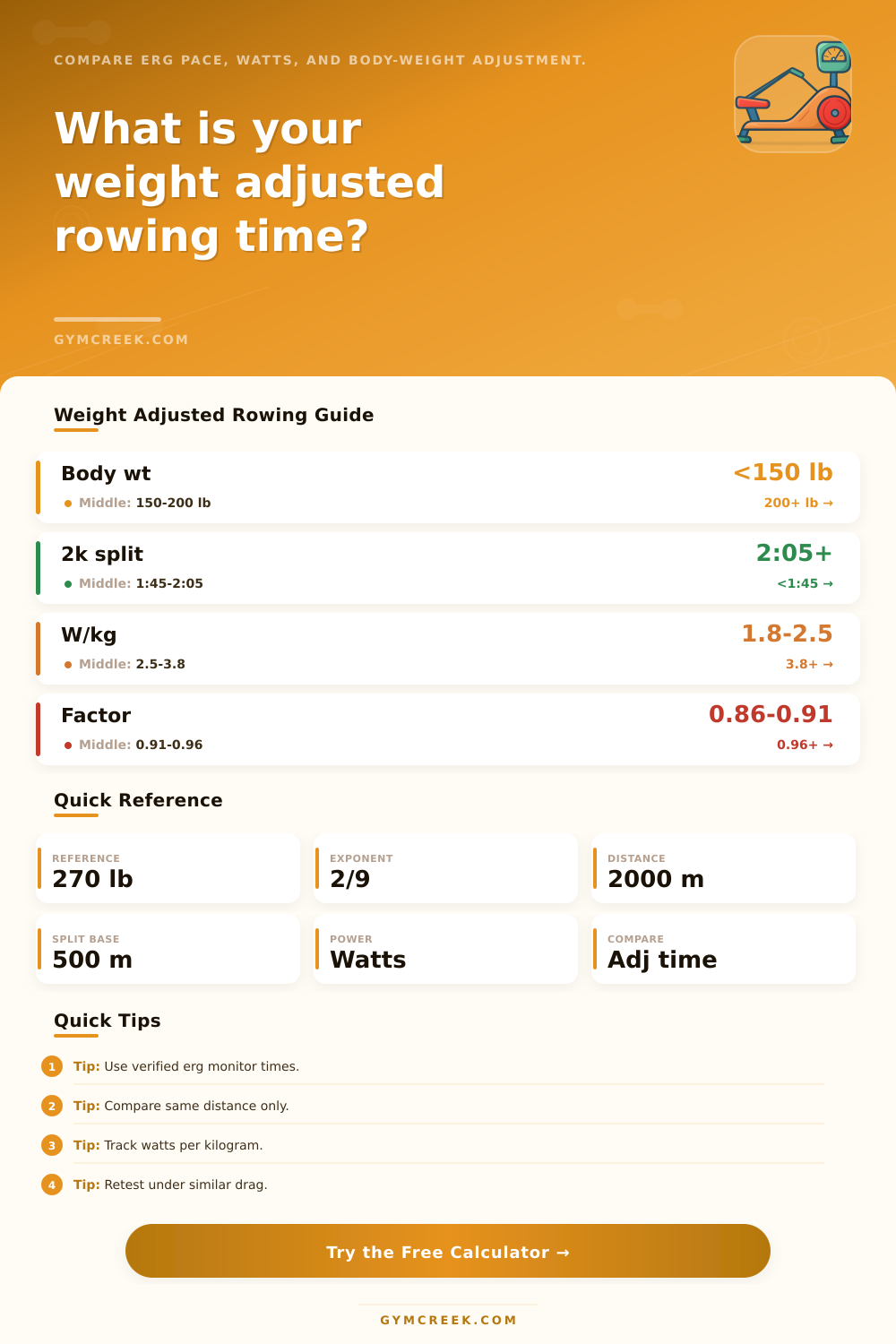
Additionally, if the lighter rower had a lower absolute power output, they may have posted a slower time with the same relative power output. Thus, adjusting each athlete’s time for the effect of their body weight allow for each athlete to be compared with each other regardless of their body weight. To weight-adjust each athlete’s time, an athlete divides an athlete’s body weight by a reference weight (most commonly 270 lbs.).
How Weight-Adjusted Rowing Times Work
The result of this division is raised to an exponent to calculate the weight factor, the most common value for this exponent is 2/9. The 2/9 exponent is used because this reflects the way that power scale with mass for large groups of athletes. As a result, the lighter the athlete, the less absolute force that is required for an athlete to reach the same pace.
Thus, the exponent must be some value between 0 and 1. Once the athlete calculates the weight factor, they multiply it by the athlete’s raw time to calculate the athlete’s adjusted time. This adjusted time can be directly compared with other athletes’ adjusted times.
To calculate the weight-adjusted time for an athlete using this method, the athlete enters their body weight, the distance that they rowed, and their performance data (time, split, or watts). The reference weight default to 270 lbs., but can be changed. The exponent can also be changed, but most rowers will use the 2/9 value for this calculation.
The calculator will display the adjusted time, the weight factor, the athlete’s watts divided by the athlete’s body weight in kg, and the athlete’s adjusted split. In addition to body weight, there are a variety of other variables that may impact an athlete’s erg time. Another variable is the drag factor on the erg.
The stroke rate also impact the load that each athlete must perform. Athletes that row at high stroke rates and moderate watts will have different performance expectations than athletes that perform at lower stroke rates with higher watts. Thus, these two variable should be recorded along with the athlete’s performance data.
While the adjusted time is still useful with only body weight, drag factor, and stroke rate recorded by each athlete, the adjusted time makes an assumption of these variables being similar between athletes. Watts per kilogram is another value that can be calculated from this type of time adjustment. While the absolute watts that an athlete produces can be used to compare each athlete’s performance, the watts per kg value help to indicate how that athlete’s power relates to their body size.
For instance, a lighter athlete may produce two hundred sixty watts, but still have a higher relative power output than a heavier athlete who produce three hundred fifty watts. Thus, both of these values are provided to provide a more complete picture of each athlete’s performance. While body weight is one of the variables that can be adjusted for between athletes, other variables such as age, sex, and activity level is also factors that impact the energy that each athlete can produce.
These variables are additionally used to calculate basic metabolic estimates of each athlete. While these variables do not impact the determination of the adjusted time for each athlete, those values may be used to provide context for athletes who wish to understand variables related to their daily energy. Additionally, the body fat percentage of each athlete is an optional input.
This variable is used to provide an estimate of the lean mass of each athlete. While these variables are not required for calculation of the adjusted time, they are additionally available as inputs to provide additional context to an athlete’s performance. Some of the common mistake in using these calculations are treating the adjusted time as a ranking between athletes.
For instance, the calculation does not account for differences between athletes in the amount of sleep that they get, their level of illness, or even the differences in their rowing technique. Thus, while the adjusted time is useful in comparing the raw abilities of athletes of similar weights, it makes an assumption of similar conditions for each athlete. Another of the reference tables that may be of interest to athletes and coaches is the reference tables that show the effect of body weight on the adjustment calculations.
Additionally, the reference tables also show how 2k pace bands are affected by adjusting the times for body weight. For instance, a 125 lb. Athlete will have a different weight factor than a 200 lb.
Athlete. Thus, lighter athletes must produce more watts per kg to compete with other athletes with raw times. Additionally, the tables indicate the variables that should be held constant between athletes, distance, drag factor, etc.
Rowing is not limited to rowing on the erg.
Additionally, rowing on the water involves other variables, such as the type of boat class, the rig of the boat, and the weight of the crew. Thus, an adjustment for body weight may bridge some of the differences between erg performance and on-water performance. However, the body weight adjusted time is only one data point regarding an athlete’s performance.
Body weight adjusted times may also impact how an athlete set their goals. For instance, the lighter an athlete is, the larger the impact that an increase in raw watts will have on their adjusted time. Additionally, if a heavier athlete decreases their body weight with the same amount of raw power, their adjusted time and raw time will both decrease.
Thus, understanding the effect that changes to body weight will have on the adjusted time can help to indicate if an athlete’s best time results from an alteration in their body weight or if it is an alteration of their raw power. Additionally, another value of the body weight adjusted time is that it can be used to perform repeated tests by an athlete. For instance, an athlete that rows the same distance at the same drag factor will have the same body weight input each time that they perform the test.
In this case, their adjusted time may reveal their improving raw power or any plateaus in their performance. Thus, the calculator for the adjusted time removes the athlete from having to perform the calculation to reveal any trends in an athlete’s performance. While the adjusted time is still not the final word on an athlete’s performance, it removes one of the sources of noise that exist in erg time interpretation for athletes and coaches alike.