Weekly Weight Change Calculator
Compare seven daily weigh-ins against your goal pace, estimated energy balance, and short-term water swing so your weekly trend is easier to interpret.
◎Presets
Presets load a complete body profile and seven-day weigh-in pattern, then calculate instantly.
⚙Calculator
▦Seven-Day Weigh-In Log
Use morning weights after the bathroom when possible. The calculator reports both first-to-last change and smoothed trend change.
Weekly weight change snapshot
Enter your weigh-ins and calculate the weekly trend.
▣Fitness Metrics
▤Reference Tables
| Weekly signal | Scale pattern | Likely meaning | Review cue |
|---|---|---|---|
| Trend matches target | Within 0.25% | Plan is aligned | Keep steady |
| Faster loss | Below target | Deficit may be high | Check recovery |
| Flat trend | Near 0% | Maintenance or water | Watch 14 days |
| Fast gain | Above target | Surplus or retention | Audit intake |
| Goal mode | Typical rate | Calorie bias | Best review |
|---|---|---|---|
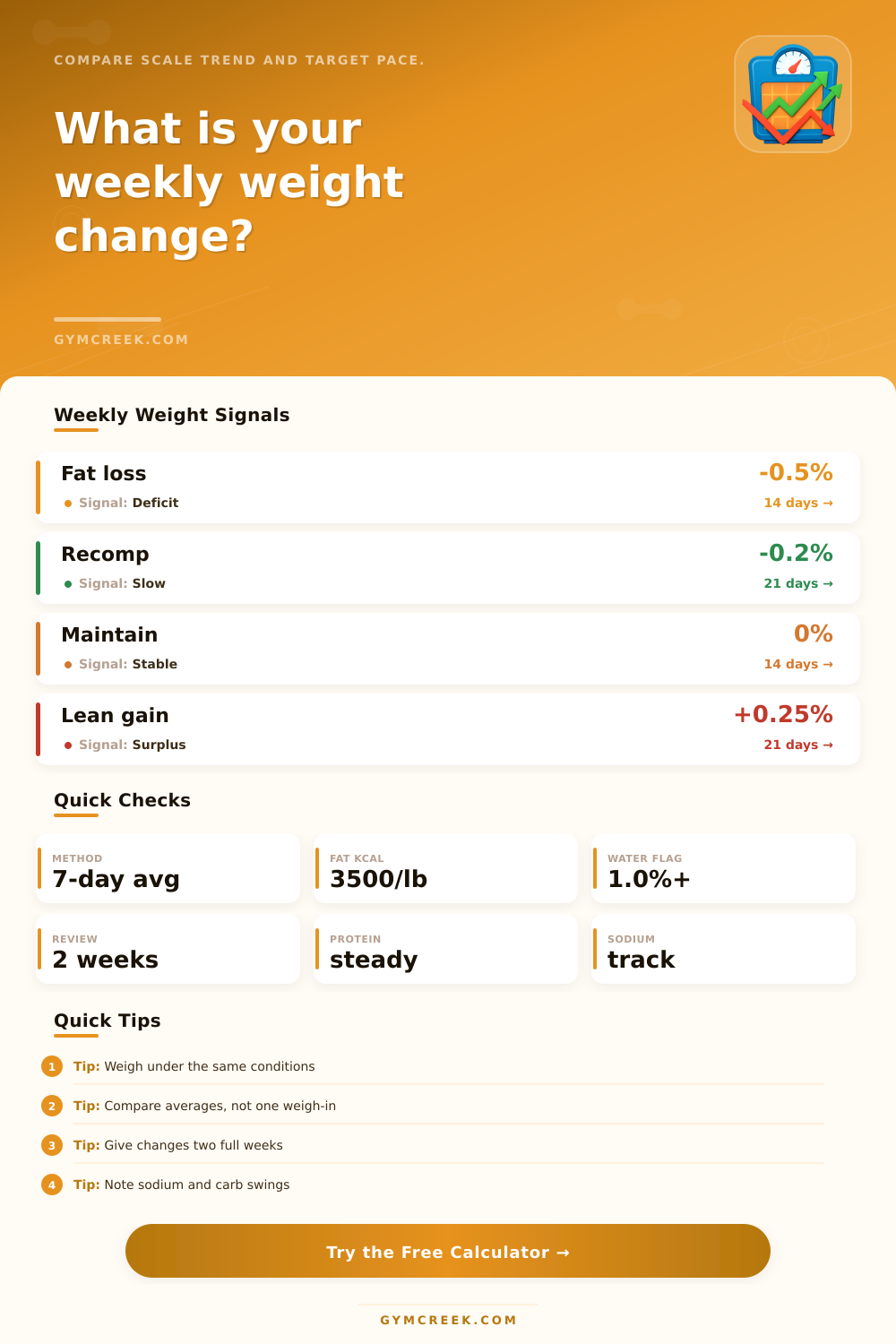
| Fat loss | 0.25-1.0% down | Deficit | 14 days |
| Recomposition | 0-0.25% down | Small deficit | 21 days |
| Maintenance | Within 0.25% | Neutral | 14 days |
| Lean gain | 0.1-0.5% up | Small surplus | 21 days |
| Water factor | Common trigger | Scale effect | Interpretation |
|---|---|---|---|
| Sodium jump | Restaurant meals | Up next day | Do not panic |
| Carb increase | Refeed or event | Glycogen water | Use averages |
| Hard training | Soreness | Inflammation | Wait 48-72 hr |
| Low fluids | Travel or heat | Temporary drop | Rehydrate first |
| Formula | Inputs | Output | Used when |
|---|---|---|---|
| Mifflin-St Jeor | Age, size, sex | BMR | Body fat unknown |
| Katch-McArdle | Lean mass | BMR | Body fat known |
| Energy balance | Calorie gap | Fat trend | Intake known |
| Moving average | Daily weights | Trend | Noisy scale data |
◇Tips
You hop on the scale in the morning and don’t understand what you’re seeing. Sure, you moved around more today than you did three days ago, sure you ate less then you did yesterday, but the number on the scale is higher. Your natural reaction is to freak out. You think all those calories were stored as fat. You think your metabolism have stopped. This makes sense, but it’s nearly always incorrect.
Here’s why: the scale doesn’t reflect progress in real-time. It reflects a mix of water retention, digestive load, glycogen storage, and other forms of tissue change. Most people take daily fluctuations as data points when they should of taking them as noise. When you can learn the difference between noise and signal, you’ll be able to follow your nutrition plan while avoiding loss-of-mind that accompanies being so fixated on scale.
Why Your Weight Fluctuates Daily
That’s what the weekly weight change calculator on this page was designed to help you see through. It filters out the noise so you can focus on the signal. The only way to make sense of a few data points is as a unit, not as a stream of individual judgment calls. It’ll ask you for seven weigh-ins in a row, all in roughly the same conditions. And it needs you to do that, because if there’s any shifting around with water, one number by itself mean nothing.
That’s why most people who track don’t bother doing this step; most tracking methods simply ignore the smoothing part and go about their business. Now they’re stuck reacting to whatever weird spike happened somewhere in the middle of week, not some real shift in metabolism. The calculator do the math for you, so you never need to sit down and worry about averaging out seven days worth of numbers again on Sunday night.
The way salt and carbs impact water weight also commonly gets folks tripped up. Adding two or three pounds in water weight overnight isn’t fat gain, it’s what happens when you eat a big meal high in sodium or suddenly increase your carbs. To account for this, the calculator has spaces where you input carbohydrate change and sodium swing. So if your baseline level was 500 mg of sodium but you topped off at a thousand milligrams, the calculator takes that into account and adjusts how it interprets the trend of your scale. You can see that even though your scale isn’t going down, you’re not necessarily “stalling” if you’re holding onto water for whatever reason (whether through diet shifts or menstrual cycle-related factors).
In addition, our intuitions is also flawed when it comes to calorie math. We tend to think that we’ll lose one pound a week if we’re in a 500-calorie-a-day deficit, but fail to account for how our metabolisms adjust actively and the energy cost of those adjustments. This calculator uses your weight, height, sex, age, and activity level to estimate your total daily energy expenditure (including everything like eating), sitting at your desk, fidgeting, and all other activities. It will then calculate the theoretical weight change you should expect based off comparing your calorie intake (the amount you report) with this expenditure. When your scale trend differ dramatically from this prediction, it flags the discrepancy. This mismatch typically indicates an error in tracking or an adjustment in non-exercise activity thermogenesis, not a failure of your diet plan.
Just as important are the when’s as much as the what’s. Too many reviews can cause you to keep tweaking and prevent you from getting consistant results in the long term. The tool has reference tables that recommend you wait 14-21 days before major changes. That way, you’ll have collected enough data points to get a solid sense of direction without being affected by short-term changes. Two weeks should be plenty of time to see if a certain number of calories is right (or wrong) for you. Anything less than that won’t do much good. It will probably hurt more then help because it takes your body some time to settle into its new environment before it shows changes on scale.
This is the takeaway. But really, there’s not much importance placed on the poundage; it’s how this number affects your behavior that matters. Once you realize a heavy morning isn’t a failure… That it probably reflects glycogen or water, then you’re no longer beating yourself up by following an impossible deficit. You want to hit a sustainable pace, one that doesn’t feel like too much and yields solid results not just within a couple weeks, but across several months. Looking at weekly averages and accounting for outside factors like carbs or salt helps keep the process as emotionless as possible. Stepping onto the scale becomes not an act of self-judgment, but a measurement of the direction your plan is headed. It’s a subtle change in mindset, but keeps you on track.