Weekly Volume Calculator
Estimate weekly hard sets, tonnage, effective muscle volume, and recovery fit from your current training plan.
📌Weekly Volume Presets
Each preset fills a complete weekly setup with muscle target, exercise type, frequency, sets, reps, load, RIR, training age, indirect overlap, and recovery status.
⚙Calculator
Weekly volume snapshot
Enter your set structure to estimate weekly volume and recovery fit.
📊Fitness Metrics Comparison
📑Reference Tables
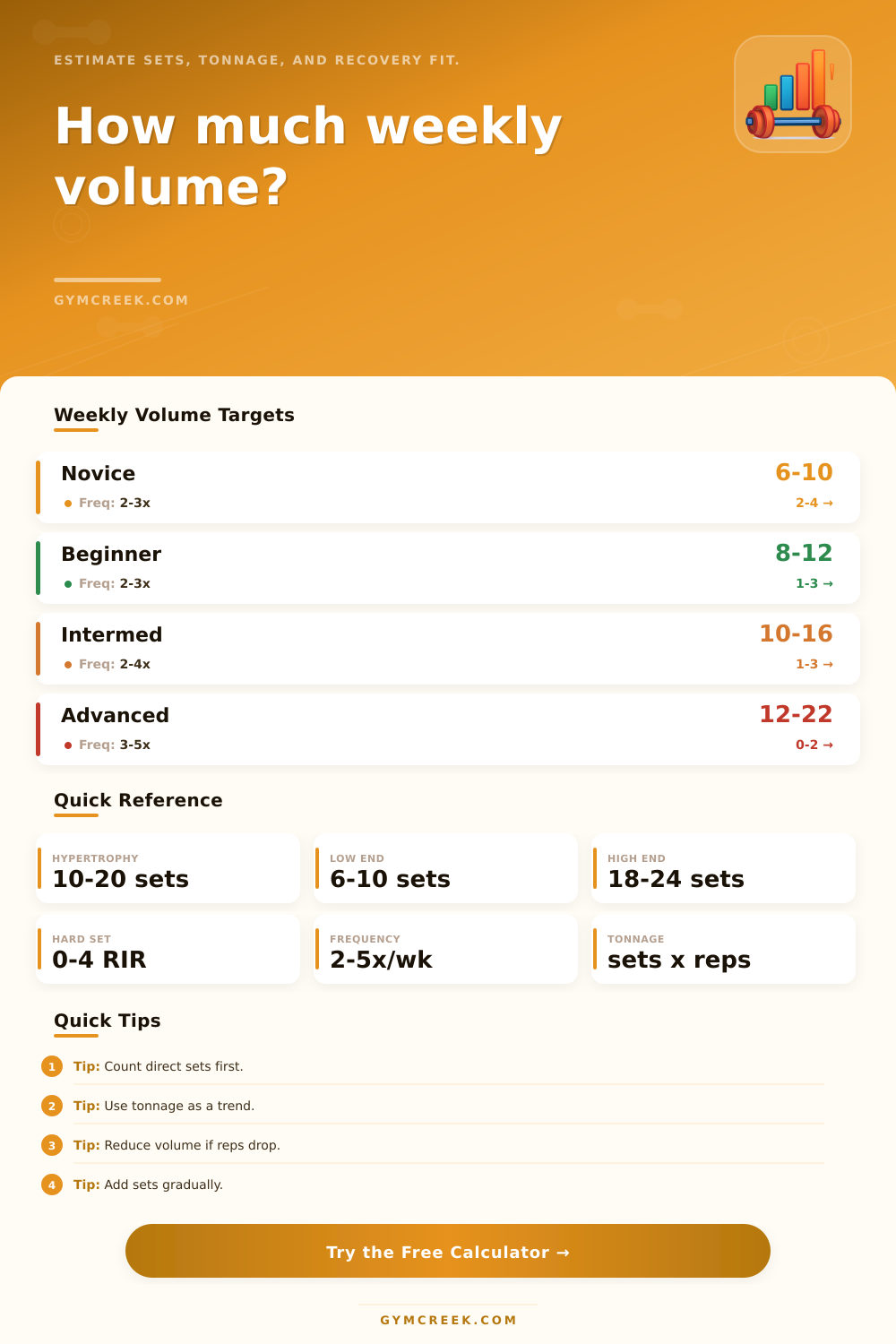
| Training Age | Typical Weekly Sets | Frequency | Common RIR |
|---|---|---|---|
| Novice | 6-10 hard sets | 2-3 exposures | 2-4 RIR |
| Beginner | 8-12 hard sets | 2-3 exposures | 1-3 RIR |
| Intermediate | 10-16 hard sets | 2-4 exposures | 1-3 RIR |
| Advanced | 12-22 hard sets | 3-5 exposures | 0-2 RIR |
| Muscle Group | Conservative Range | Growth Range | High End |
|---|---|---|---|
| Chest, back, quads | 8-12 sets | 10-18 sets | 20-24 sets |
| Hamstrings, glutes | 6-10 sets | 8-16 sets | 18-22 sets |
| Delts, arms, calves | 8-14 sets | 12-22 sets | 24-30 sets |
| Abs or trunk | 6-10 sets | 8-16 sets | 18-24 sets |
| Exercise Type | Volume Credit | Fatigue Cost | Use Case |
|---|---|---|---|
| Main compound lift | Full credit | Moderate-high | Primary strength and size work |
| Stable machine compound | High credit | Moderate | Adding volume with control |
| Isolation movement | High direct credit | Low-moderate | Specializing small muscles |
| Power or heavy hinge | Lower hypertrophy credit | High | Low-rep neural or hinge work |
| Metric | Formula | What It Shows | Best Use |
|---|---|---|---|
| Hard sets | Sets per session x sessions | Simple weekly exposure | Programming baseline |
| Tonnage | Sets x reps x load | External work trend | Tracking load changes |
| Effective sets | Sets x RIR x exercise x target share | Likely muscle stimulus | Comparing exercises |
| MRV proximity | Effective sets / recovery cap | Recovery pressure | Deciding when to deload |
💡Weekly Volume Tips
Training volume is a variable that tracks the amount of work that an individual perform during there training. Training volume is important to track because training volume determine whether or not an individual experiences an increase in their performance with their muscle groups or whether their performance stall. Training volume is dependent upon the amount of work that reaches a specific target muscle group and how much of a work up that an individuals body can recover from the work performed with there muscle.
To calculate training volume, an individual must track the amount of work that each exercise provide to each specific target muscle group. For instance, squats will provide work for the quadriceps muscle groups, but also provide work for the gluteus muscle and the lower back muscles, as well. An individual must select an overlap level for each exercise as this determines the amount of credit that an exercise will be given for each target muscle.
How to Track Your Training Volume
Many compound lifts will work many different muscle at once, so the overlap level credit ensure that the training volume calculation reflect this. The recovery status of an individual is another of the inputs that will impact the results of the training calculation. An individuals recovery status will impact how much training volume that they are able to handle by the body.
An individual that is recovering good from there training may be able to incorporate more training volume than an individual that feel sore after there training sessions. This recovery status will impact the calculation of the recoverable cap for training volume, which will allow an individual to see if its training volume is too high for their body. Tonnage is one of the measurements that can be calculated with this training volume calculator that determine the amount of work that an individual perform during there training.
The user calculates tonnage by multiplying the number of sets, the number of repetitions that are performed for each set, and the load that is used for those repetitions. The tonnage value will reveal a single number that represent the total amount of work that was performed during training. However, tonnage will not necessarily show the amount of work that was performed for each target muscle.
The work may have been high for performing squats, for instance, but the work may have been low for the gluteus muscles. Within the training volume calculator are reference tables that show the number of sets that should be performed for each level of training age. An individual that is new to lifting may require fewer sets of training than an experienced lifter, and an experienced lifter will require more sets than an individual that is beginning to lift weights.
You should not treat every exercise set as the same amount of work for each muscle group. For instance, sets of deadlifts may create a different amount of fatigue within the body different than sets of lateral raise exercises. Each type of exercise will provide a different amount of stimulus for the muscles that are performing those exercises.
As a result, different factor are applied to calculations based off the exercise type that is being performed. Frequency determine how many training sessions that you perform each week. For instance, you may choose to perform three training sessions that include four sets for each exercise, or you may perform two training sessions that include six sets each for each exercise.
Each of these option will provide the same number of sets for each exercise, but the body may feel different about each of these frequencies. The training volume calculator will reveal this difference through the density metric that is provided for each training frequency option. Effective training volume is another of the measurements that this training calculation tool provides.
The effective training volume will provide a single number for training volume that accounts for the number of sets performed to the point of failure, the loading of each exercise for the target muscle, and the overlap credit for each exercise. While not a perfect measurement for training volume, this number does allow for the comparison of different sets of exercises and the benefits of each. In order to make the best possible decisions regarding training for each body and performance goal, an individual should track the actual training that occurs for that individual instead of the thought training.
The training volume calculator will provide the calculations for each of these variable once the individual selects each appropriate input. However, the individual must decide if the output of the calculator match the individuals current feelings regarding there performance, as well as their ability to continue to increase there performance without feeling sore or experiencing stalled period of recovery.