Weekly Calorie Average Calculator
Compare seven days of calorie intake against your estimated maintenance, goal target, and projected weight trend so one high or low day does not distort the whole week.
◎Presets
Presets fill a complete seven-day log and recalculate instantly.
⚙Calculator
▦Seven-Day Intake Log
Enter total calories for each day. The calculator compares the weekly average with your target, not a single day.
Weekly calorie snapshot
Enter your seven-day intake log and calculate the weekly average.
▣Fitness Metrics
▤Reference Tables
| Average signal | Daily gap | Weekly meaning | Action cue |
|---|---|---|---|
| Close to target | Within 100 kcal | Likely on plan | Hold steady |
| Small miss | 100 to 250 kcal | Noticeable over time | Adjust one meal |
| Large miss | 250 to 500 kcal | Trend may drift | Review habits |
| Major miss | 500+ kcal | Goal conflict | Reset target |
| Goal mode | Target bias | Common rate | Review window |
|---|---|---|---|
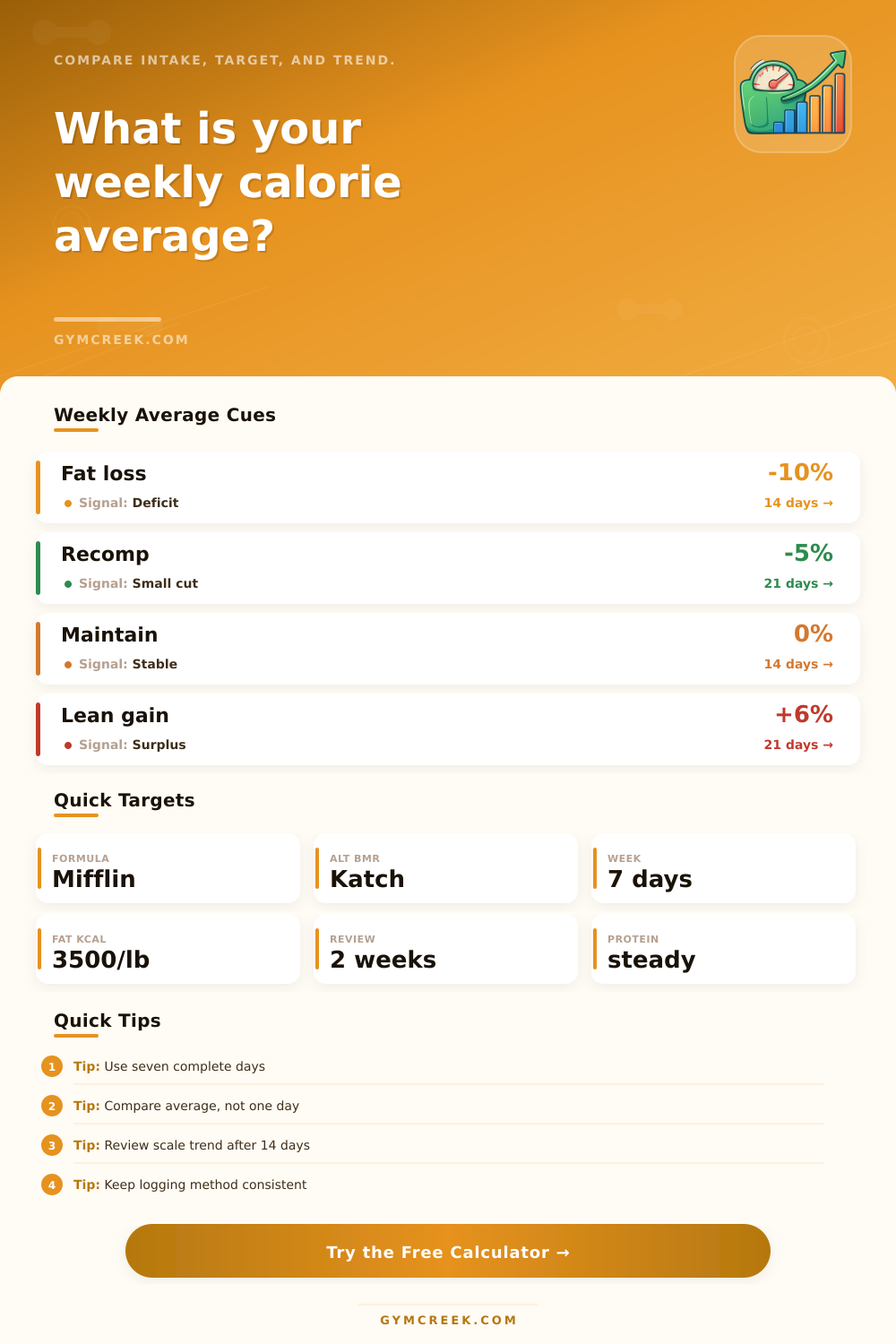
| Fat loss | Deficit | 0.25-1.0% BW | 14 days |
| Recomposition | Small deficit | 0.1-0.4% BW | 21 days |
| Maintenance | Neutral | 0% BW | 14 days |
| Lean gain | Small surplus | 0.1-0.5% BW | 21 days |
| Activity level | Multiplier | Typical week | Average note |
|---|---|---|---|
| Sedentary | 1.20 | Desk based | Steps matter |
| Light | 1.375 | Some training | Track weekends |
| Moderate | 1.55 | 3-5 sessions | Good baseline |
| Very active | 1.725+ | Daily output | Fuel recovery |
| Formula | Inputs | Used for | Best when |
|---|---|---|---|
| Mifflin-St Jeor | Age, size, sex | BMR baseline | Most users |
| Katch-McArdle | Lean mass | BMR alternate | Body fat known |
| Activity factor | BMR x level | TDEE estimate | Planning target |
| Energy balance | Weekly gap | Trend estimate | Average review |
◇Tips
On Monday morning, you weigh yourself and are happy with how well you hit your protein targets for the past three days. On Saturday, you go to a wedding and eat a lot of food. Then on Sunday, you have brunch. Now that perfect streak feel like a myth. Most folks quit there. They get hung up on perfecting each day instead of tracking towards consistency across the week.
Nutrition becomes a chore and struggle to control every meal. But it’s not that complicated. Your body isn’t stressed by one low-carb lunch or one high-calorie dinner. Instead, it evens out the day-to-day fluctuations and reacts to overall energy balance over time.
Why Weekly Tracking Works Better Than Daily Tracking
But most of those tracking apps reports the previous day’s result, leading to false confidence when you think you did well by eating less and fear when you suspect you ate too much. Neither is full picture. Enter your week into the calculator above to do math for you and remove the emotion associated with any single outlier day. It transforms data from something you feel judged by into something you’re measured against.
And yes, there will be variation in how you eat throughout the week; just type it all in, and recieve an accurate average based off what you really did, not what you wished you had done. Self-assessment is key here, especially when it comes to inputting activity level. We all think we work out harder then we do, and then we eat more to make up for it later. That’s why the tool allows you to log extra exercise burns separately from your base metabolic rate.
Because while we know when we’re going to work out at the gym, we don’t know if we’ll snack spontaneously after dinner. Not sure if you’re logging correctly? There’s a confidence slider for that. It recognizes that logging is a guess. I.e., it’s not a science experiment that exists on its own.
After this, it averages everything out and shows you how your daily intake compares to your goal. You may think 100-200 extra calories here or there isn’t much, but it adds up over time. These bounds are represented in the reference tables provided with the tool. They show you what’s considered “normal” and when you need to take corrective action versus when you do not. You should of not bother if it is within margin of error. This way, you avoid type of excessive tweaking which eventually causes burnout.
It’s all about managing energy, not moral purity Calorie-counting on a per-week basis turns eating into something that’s managed, as opposed to feared. If you’re going to an event or party, you get to eat whatever you want without feeling guilty, knowing that overall it’ll even out in the week. It reduces your stress and makes it easier to stick with compared to strict daily boundaries.
Patience (often) makes the difference between success and failure. You don’t react to day-to-day fluctuations, so you just wait for trend to reveal itself. Remember: Your body composition changes slowly. And that’s why you shouldn’t check yourself too early, so you don’t make a poor choice about calories. According to most experts, you should wait two weeks, since this allows water weight and glycogen stores to stabilize so you can see your actual fat changes rather than just daily fluctuations. That way, it will give you better idea of where you stand.
The calculator takes those common caloric equivalencies (based on normal body composition) and projects what your current habits will likely produce. In other words, it’ll take an abstract goal… “I want to lose weight”. And convert it into specific results, keeping you going when the slog sets in. Let’s face it, that usually happens around week three of any body recomposition plan.
The framework maintains a fixed level of protein, because no matter your energy balance, you’re going to preserve your muscles. Maintaining the same protein levels prevents lean-tissue loss during weight loss. This metric is displayed right next to your calorie data in the tool to remind you that eating fewer calories isn’t everything. Eating those calories correctly is important too.
Likewise, the fiber goals provides a baseline measure of diet quality, encouraging you to make better food choices (even if calories aren’t being restricted). To conclude. Consistency trumps intensity all day long. It doesn’t matter if you’re perfect one day or not. All that matters is that you’re consistent throughout the week.
When you focus on the average, you take the pressure off of having to be perfect each day and put yourself in position for realistic and manageable expectations. You let numbers speak for themselves over time. You don’t react to what happened yesterday or let the weekly trend dictate next move.