Weak Point Ratio Calculator
Compare bench, squat, deadlift, overhead press, and pull strength against bodyweight and lift-to-lift balance targets.
📌Presets
Presets load realistic strength profiles and recalculate the weakest ratio automatically.
⚙Calculator
Weak-point snapshot
Enter your current lifts to compare strength balance.
📊Lift Ratio Grid
📑Reference Tables
| Lift | Novice Target | Trained Target | Advanced Target |
|---|---|---|---|
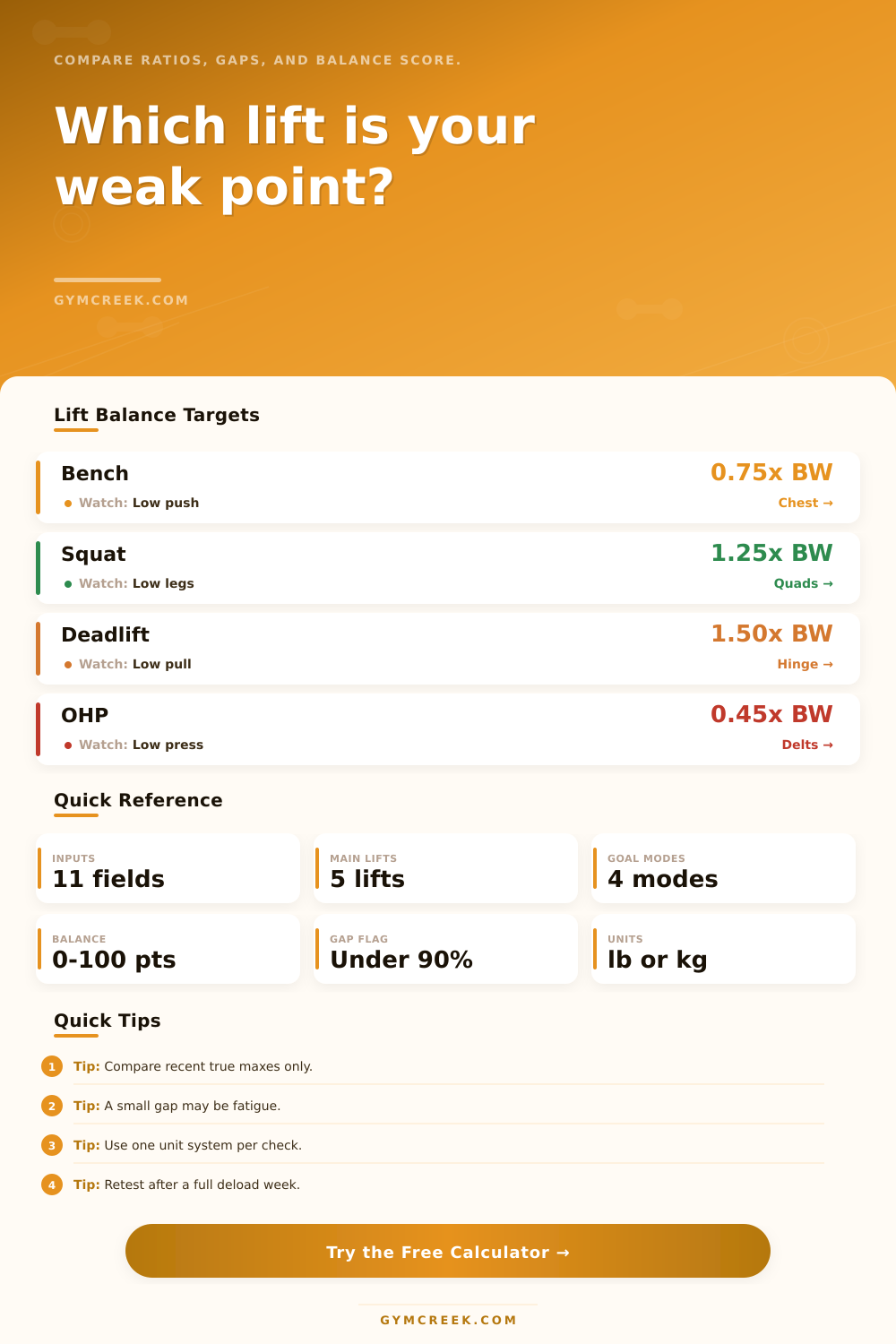
| Bench press | 0.75x BW | 1.15x BW | 1.55x BW |
| Back squat | 1.00x BW | 1.55x BW | 2.05x BW |
| Deadlift | 1.20x BW | 1.85x BW | 2.40x BW |
| Overhead press | 0.45x BW | 0.70x BW | 0.95x BW |
| Row or pull | 0.75x BW | 1.10x BW | 1.45x BW |
| Ratio | Balanced Range | Low Signal | High Signal |
|---|---|---|---|
| Bench / squat | 0.68-0.78 | Press lag | Leg lag |
| Deadlift / squat | 1.10-1.30 | Hinge lag | Squat lag |
| OHP / bench | 0.42-0.52 | Shoulder lag | Bench lag |
| Pull / bench | 0.90-1.10 | Back lag | Push lag |
| Weak Score | Flag | Meaning | Priority |
|---|---|---|---|
| 98-110 | Balanced | Near target | Maintain |
| 90-97 | Mild gap | Small lag | Monitor |
| 80-89 | Clear gap | Train focus | High |
| Below 80 | Major gap | Main limiter | Top |
| Formula | Inputs | Output | Use |
|---|---|---|---|
| Lift / BW | Lift, weight | BW ratio | Strength level |
| Lift / lift | Two lifts | Balance | Weak points |
| Target score | Actual, target | Percent | Gap size |
| Spread index | All scores | Balance pts | Overall check |
💡Tips
And, this is where most of us find out you can gain 50 pounds on your bench press and lose 50 pounds on your squat. It happens to nearly every weightlifter out there. We go for the mirror muscle. We go after whatever lift we feel strong doing at the time and we end up with a strength profile that appears impressive on paper but falls apart when it’s under pressure.
To truly identify your weak points, compare those numbers to one another. Don’t look at them individually. It’s simple math, but try doing it in your head after a workout when your brain is fried, and you’ll get it wrong. Get your latest one-rep max for your bench, squat, deadlift and overhead press and compare that number to your bodyweight as well as each other. That will give you an accurat picture of balance.
How To Find Your Weak Lifts
When you’re a balanced athlete, you move weight more efficient because you’re not overusing any particular muscle group or having one hold you back. All you gotta do is punch your numbers into the calculator above, and it’ll do all the math work for ya… No guessing whether a gap means something or nothing.
Your weakest lift probably isn’t what you think. You might have a weak deadlift because your hips are tight, not necessarily because your back is weak. It’s usually not your quads that needs more strengthening for the squat. Instead, it could be your ankles which don’t have anything to do with quad strength. Standardized ratios helps the tool separate weakness from structure.
For instance, most beginners should be squatting about equal to their body weight and bench pressing about 75% of their bodyweight. If you’re way outside those numbers in opposite directions, you’ve got an imbalanced training split on your hands. The number isn’t everything; context is important too. Of course, a basketball player will have a lower squat-deadlift ratio different than a powerlifter. That’s because the squat and deadlift play very different roles in their respective sports.
By allowing you to choose your strength goal, the calculator takes this into account. Now instead of getting a red flag where there isn’t one, you won’t be held up to an irrelevant standard when you see your squat percentage. You don’t care about what “optimal” looks like for another person who competes in a different sport. You want to know what “optimal” look like for you.
The ratios gets distorted with fatigue too. You’ll take your bench on Monday and then your deadlift on Friday after a heavy leg workout, and what do ya know? Your numbers will be lying to you. Always make sure to compare lifts that you’ve tested in similar levels of freshness. Maybe you need a rest instead of more pulling work; maybe something else has happened. That’s why we have a fatigue factor in the tool.
You can’t just use data, data needs to be honest. When you’re burnt out, you’ll notice the balance score is off. If you act on that bad data, you stall progress or get injured. Check out the reference tables in the interface. They explain exactly what each range means when it comes to your own experience level.
Maybe you’re a novice and there’s a massive gap between your deadlift and squat, but all that really means is you could of used some coaching on hinge mechanics. Or maybe you’re an advanced lifter and there’s a similar gap, which suggests there’s something about your body specifically that needs some targeted accessory work. Knowing whether you are a novice, trained, or advanced helps you understand where you stand and what your results mean for you. What was a scary number becomes an actionable plan.
You don’t just throw out your strong point in order to fix your weak one, either. You don’t want to be neglecting all your important work just to shore up your pulling strength for the rest of eternity. It’s simply maintaining it with a little more focus on the weaker side. If your back lags behind, add an extra set of rows. Continue to keep bench heavy but back off a bit on the frequency. Make this subtle adjustment for a couple months and you can catch up quite a bit while still not losing the strength you’ve gained elsewhere.
Be patient and consistent. Ultimately, it’s all about system strength. One weak link makes the entire apparatus groan. If you’re careful enough to check your ratios on an ongoing basis, your foundation stays strong. No more vanity lifts, just genuine resilience.
Next time you get under barbell, you’ll have a clear idea of what needs improvement and where you’ve got some room to use your strength. And that knowledge is priceless; far more valuable than a personal record here or there.