Watts to METs Calculator
Convert cycling, bike erg, and arm ergometer watts into ACSM METs, oxygen cost, calorie burn, work output, and intensity markers.
📌Presets
Presets load real cycling and ergometer scenarios, including different body weights and ergometer equations.
⚙Calculator
Watts to METs snapshot
Enter body weight, watts, and ergometer type to estimate intensity.
📊Ergometer Metrics Grid
📑Reference Tables
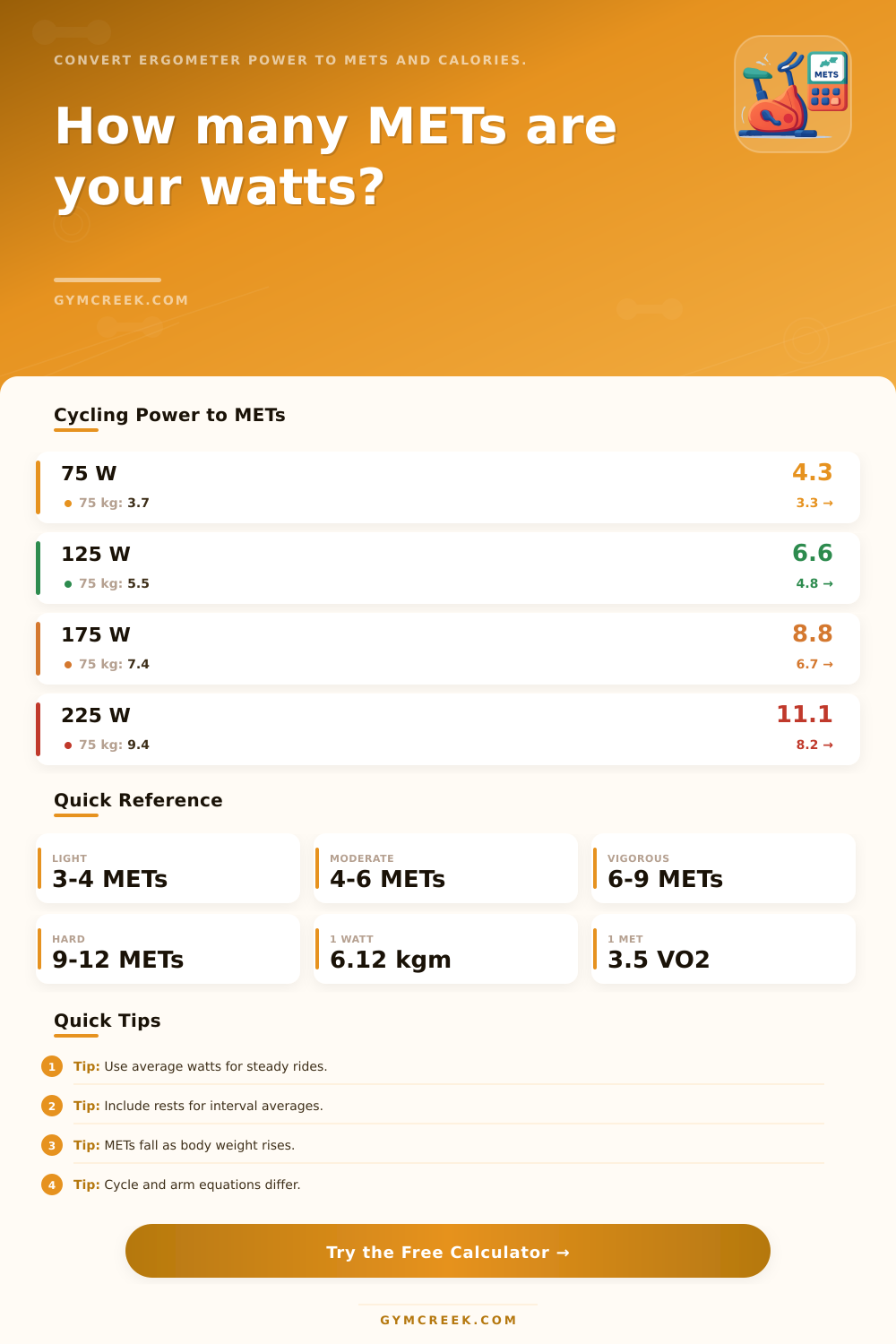
| Power | 60 kg rider | 75 kg rider | 90 kg rider |
|---|---|---|---|
| 75 watts | 4.3 METs | 3.7 METs | 3.3 METs |
| 125 watts | 6.6 METs | 5.5 METs | 4.8 METs |
| 175 watts | 8.8 METs | 7.4 METs | 6.7 METs |
| 225 watts | 11.1 METs | 9.4 METs | 8.2 METs |
| MET range | Intensity | Typical erg feel | Session use |
|---|---|---|---|
| Under 3 | Very light | Warm-up, easy spin, gentle rehab pace | Movement and circulation |
| 3 to 6 | Moderate | Breathing rises but conversation stays possible | Base aerobic conditioning |
| 6 to 9 | Vigorous | Strong steady effort with short phrases only | Tempo and fitness testing |
| Over 9 | Hard | High strain, race, threshold, or interval work | Performance training blocks |
| Equation | Formula | Best input | Notes |
|---|---|---|---|
| ACSM cycle | VO2 = 10.8 x kgm/min/kg + 7 | Leg cycling watts | Gross oxygen cost including rest |
| ACSM arm | VO2 = 3.0 x kgm/min/kg + 3.5 | Arm crank watts | Lower mechanical power for high strain |
| MET conversion | METs = VO2 / 3.5 | Any VO2 estimate | Standard resting oxygen equivalent |
| Calories | kcal = MET x 3.5 x kg x min / 200 | Body weight and time | Estimate, not direct calorimetry |
| Scenario | Power input | Best mode | Interpretation |
|---|---|---|---|
| Indoor bike steady ride | Average watts for full session | ACSM cycle | Best match for classic cycle ergometer testing |
| Intervals with coasting | Time-weighted average watts | ACSM cycle | Include easy minutes to avoid inflated METs |
| Arm bike therapy | Arm crank display watts | ACSM arm | Do not compare directly with leg cycling watts |
| Mechanical efficiency check | External watts and efficiency | Mechanical | Useful when comparing work and energy output |
💡Calculation Tips
On your bike screen you see one-hundred-fifty watts. It’s a specific-sounding number. It is scientific number. But how many watts can you translate into your own body? Do they signify that you’re increasing endurance, burning fat, or simply spinning in a moderate zone and going nowhere fast? Because power measures the amount of external work done, and fitness resides within our metabolic system, knowing the wattage isn’t enough. There has to be a way to connect the dots between the mechanical output and biological cost.
That’s where METs come in. Metabolic equivalent of task is known as METS. It is a metric that measures how much more oxygen you consume than at rest. Sitting quietly in a chair? That’s one MET. Doing some serious work? Try five or six METs. The math here works out to a ratio. So while the machines measure something different, the calculator above converts it for you, no need to slog through any physics equations yourself!
What Are METs and Why Do They Matter?
Plug in your body weight and your average power, and it will translate those raw watts into universal measure of effort. That way you can see how hard a workout on the spin bike was compared to a brisk walk outside, even if the machines measure different things. Weight (your own) is the X factor in this equation. A hundred watts is a hundred watts. They don’t care who makes them: they’re absolute. METs, however, are relative. Because they divide your work by your weight, they reflect how hard your body’s working for each kilogram of tissue. It doesn’t matter if two cyclists is putting out the same wattage; depending on their own weights, they may be experiencing vastly different intensities. Since your body only weighs so much, the lighter guy will have more mass moving through friction and gravity, hence his higher MET number. That’s why it’s important to take weight into consideration when trying to zone your workout correctly. You could be red-lining your heart rate and believe you’re riding easy relative to your size.
Here’s another subtlety: What kind of ergometer are you on? Sure, you can produce watts by using an arm crank or pedaling a cycle. But that doesn’t mean they’re equivalent. For the same mechanical output, your upper body burns through oxygen at a different rate. It will also fatigue sooner because it lacks as many large muscle groups to distribute the effort. The tool takes this into account and provides distinct equations for arm and leg work. If you use incorrect equation, your intensity reading and following calorie estimates can be skewed a lot. Match the input mode with what you’re actually doing. If not, you will make an unfair comparison. This will lead to false conclusions about your fitness level.
Efficiency is also a factor. Not every watt is metabolically equal. Some cyclists are more mechanically efficient and can output high power while borrowing little oxygen. Other folks waste energy due to tension or poor body position. The calculator assumes a normal gross efficiency range (from the ACSM equations) and a reasonable level of fitness for most people. So if you’re an exceptionally good cyclist with great pedaling mechanics, your true METs may actualy be a bit below what’s estimated because you’re wasting less energy. On the flip side, if you’ve never ridden before and you’re really fighting it, your true metabolic cost could be greater. Use the tool as a realistic starting point, the center of a range where you can deviate up or down depending on how the effort feels.
How are you setting up your workouts? When it comes to interval training, your power will spike when sprinting but drop nearly to zero when at rest. Plug in your maximum power and your MET score appears super high. This doesn’t reflect the fact that you’re recovering between efforts so you can repeat. A time-weighted average power over the duration of your workout is best. It smooths out those peaks and valleys to paint an accurate picture of your true average workload. It translates a spiky graph of highs and lows into one single meaningful number, which is the overall stress to your body.
Last up, take a glance through the reference tables on the interface. It breaks down intensity bands ranging from light movement to hard threshold work. This helps put some context into that raw MET number. Below three is hardly more than standing around. Above nine starts to get into high-intensity interval training and competitive racing. Knowing those ranges will let you have a better balanced program that not only includes stress, but also recovery. If all your sessions feel maximal you can’t train effectively. Adaptation comes from variety. The zones give you some context so you know when you’re not always in the middle, where you are tired enough to feel it but not tired enough to get better.
It’s about clarity. When you know what your watts cost your body, you can begin to spend it intentionally instead of guessing. You should of used this sooner.