Wathan 1RM Calculator
Estimate a one-rep max with the Wathan exponential formula, then translate the result into training maxes, relative strength, and target-load rep planning.
📌Wathan Test Presets
Presets use only the Wathan equation: 1RM = 100W / (48.8 + 53.8e^(-0.075R)). They fill different loads, reps, readiness scores, and planning buffers.
⚙Calculator Inputs
Wathan strength snapshot
Enter a tested set to estimate your one-rep max and planning loads.
📊Wathan Metrics
📑Reference Tables
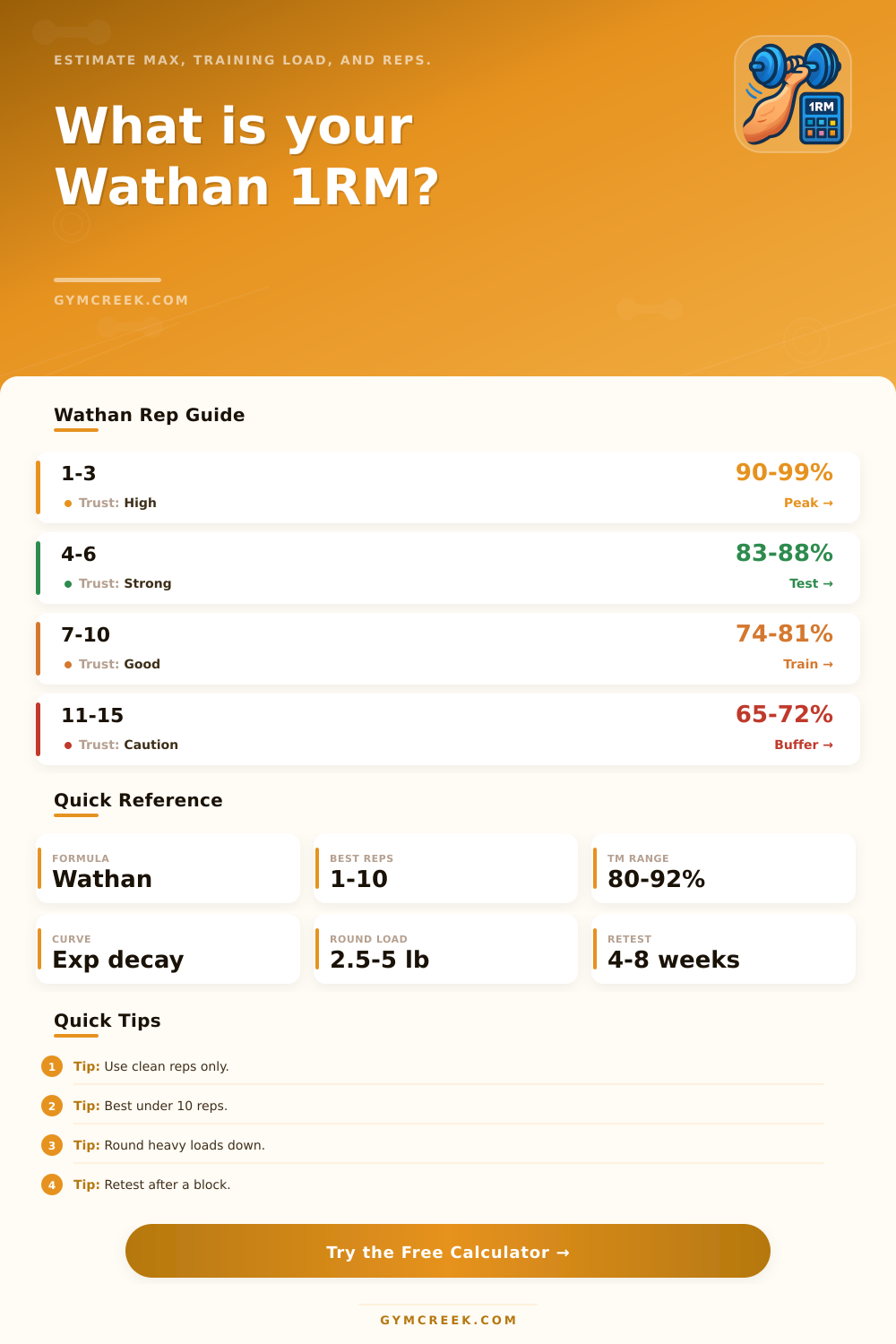
| Clean reps | Wathan load share | Approx multiplier | Planning note |
|---|---|---|---|
| 1 | 98.7% of 1RM | 1.013 | Very close to a true max |
| 3 | 91.7% of 1RM | 1.091 | Strong low-rep estimate |
| 5 | 85.8% of 1RM | 1.165 | Common testing range |
| 8 | 78.3% of 1RM | 1.277 | Good if reps stay clean |
| 10 | 74.2% of 1RM | 1.347 | Fatigue begins to matter more |
| 15 | 66.3% of 1RM | 1.508 | Use a conservative training max |
| Load as % of max | Wathan reps | Best use | Practical caution |
|---|---|---|---|
| 95% | About 2 reps | Heavy exposure | Needs solid setup and spotter practice |
| 90% | About 4 reps | Strength triples or fours | Stop before form breaks |
| 85% | About 5 reps | Primary strength sets | Good balance of load and accuracy |
| 80% | About 7 reps | Back-off strength volume | Fatigue management matters |
| 75% | About 10 reps | Volume or technique work | Estimate gets more endurance-sensitive |
| Signal | Higher confidence | Lower confidence | Adjustment |
|---|---|---|---|
| Rep count | 1-6 reps | 12+ reps | Use lower TM after high reps |
| Readiness | Sharp warm-up and bar speed | Poor sleep or rushed setup | Reduce confidence load factor |
| Fatigue | Fresh top set | After heavy volume | Treat as a floor estimate |
| Lift type | Stable barbell lift | Loose rows or machines | Keep context in the notes |
| Output posture | Typical % range | Best fit | Use when |
|---|---|---|---|
| Conservative restart | 75-83% | Return from break | The test set was uncertain |
| Balanced block | 84-90% | General strength | The rep set was recent and clean |
| Assertive block | 90-93% | Focused progress | Technique and recovery are stable |
| Short peak block | 92-95% | Experienced peak | Heavy singles are already familiar |
💡Wathan Notes
The Wathan formula are a method for estimating a one-rep max for a given exercise. Specifically, the Wathan formula use a single set of repetitions to calculate the one-rep max for that exercise. The Wathan formula use an exponential curve to calculate an estimate of how much of a one-rep max a person have already performed during the set of repetitions.
Thus, the Wathan formula calculates an estimated one-rep max for a person based off the work that the person has already performed during the set. In order to calculate the one-rep max for a person using the Wathan formula, several different input are required. The two primary inputs is the weight that the person is to be lift during the exercise and the number of repetitions for which the person performed the exercise.
How to Use the Wathan Formula to Find Your One-Rep Max
In addition to these two inputs, other information that is required includes the bodys weight of the person performing the exercise, there state of readiness for the exercise, their level of fatigue, and the percentage of the calculated one-rep max that will be used as the training max for that individual. These settings dont mathematically change the Wathan formula, but they do allow an individual to determine if they wish to utilize a conservative or more aggressive training plan. The outputs of the Wathan formula include the estimated one-rep max for the strength of the individual, the training max for the exercise based on the percentage of the one-rep max that is chose, the estimated number of repetitions for any target load that is entered into the Wathan formula, and the reliability score for the estimated one-rep max. The reliability score indicate to the user the level of trust that should be placed in the calculated one-rep max. For instance, three repetitions performed while the person is fresh will have a higher reliability score then twelve repetitions performed while the individual is fatigued.
Thus, the reliability score change based upon the number of repetitions performed and the fatigue level of the individual performing the exercise. Tables are provided on the page that contains the Wathan formula that allow individuals to translate the calculated values of the formula into more usable information. One table illustrate the different percentages of load share that exist within different ranges of repetitions.
A second table illustrate what various percentages of the one-rep max will feel like in terms of the number of repetitions that the individual will be performed with that strength. The most common mistake made with the Wathan formula is to treat the calculated one-rep max as an immutable value. The one-rep max of an individual can change based upon the amount of sleep that they get, the amount of stress that they experience, and the number of repetitions that they practice with a specific movement.
Because of the recommendation of using lower percentages of repetition in the Wathan formula, errors that the formula may be introduced into the calculation are minimize. Thus, even with the accuracy of the Wathan formula, the calculated value is still only an estimate of an individual’s strength. Individuals should regularly (every four to eight weeks) retest their one-rep max, and should not attempt to adjust their estimated one-rep max for each training session.
The buffer and posture settings for the Wathan formula are used to reflect the physical condition of the individual. A conservative estimate of the number of repetitions can be performed after a period of time away from the gym versus an assertive posture that state that the individual is ready to perform at high rates of repetition. Thus, the posture that an individual is selected for an individual allow for the load to be matched to the current condition of the individuals body.
The Wathan formula does not incorporate the strength of an individual’s muscles, whether they are injured, or how well they rest during the past several nights. Thus, an individual has to use their own judgement to determine the appropriate settings. By repeatedly using the Wathan formula, an individual will eventually learn which repetitions provides the most trustworthy data about there strength.
The Wathan formula calculator performs the math for the individual, but the individual has to learn to account for the variable that the formula cant account for.