Warmup Set Calculator
Build a lift-specific warm-up ramp from working weight, target reps, exercise type, training max, readiness, ramp style, bar weight, plate jumps, and rest times.
📌Warm-Up Presets
Presets load real lifting contexts with different ramp speeds, rest targets, readiness scores, exercise demands, and bar or implement weights.
⚙Calculator Inputs
Balanced lifting ramp
Enter your working set and readiness to build a specific warm-up sequence.
| Set | Load | Reps | Rest | Intent |
|---|---|---|---|---|
| Calculate to see the warm-up plan. | ||||
📊Warm-Up Metrics Grid
📑Reference Tables
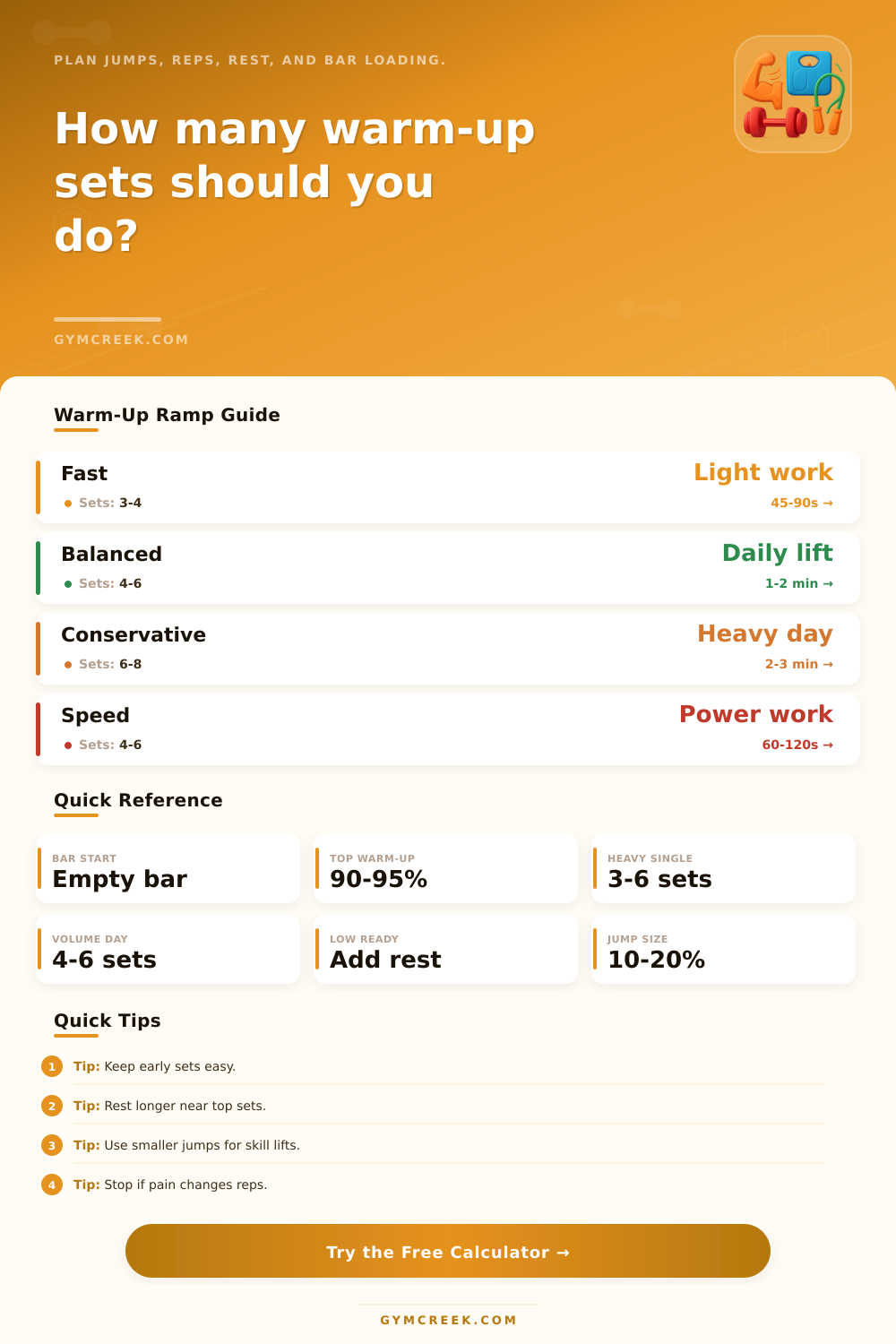
| Ramp Style | Typical Sets | Top Warm-Up | Best Use |
|---|---|---|---|
| Fast minimal ramp | 3 to 4 | 82% to 88% of work weight | Light work sets, short sessions, familiar movements |
| Balanced default ramp | 4 to 6 | 88% to 92% of work weight | Normal strength and hypertrophy training days |
| Conservative heavy ramp | 6 to 8 | 92% to 96% of work weight | Heavy top sets, older joints, cold rooms, low confidence |
| Speed and technique ramp | 4 to 6 | 78% to 86% of work weight | Power cleans, jumps, speed pulls, crisp singles |
| Peaking or meet warm-up | 5 to 7 | 90% to 95% of opener | Low-rep exposure without draining the first attempt |
| Exercise Type | Ramp Bias | Rep Bias | Practical Note |
|---|---|---|---|
| Squat variation | Add one middle set when heavy | Moderate early reps | Hips, knees, and bracing often need gradual exposure |
| Bench press | Moderate jumps | Low final warm-up reps | Shoulders like practice, but triceps fatigue quickly |
| Deadlift or pull | Fewer reps near the top | Singles late | Limit warm-up fatigue before heavy pulls |
| Olympic or speed lift | Smaller technical jumps | Singles and doubles | Every ramp set should move fast and sharp |
| Dumbbell lift | Fewer total sets | Higher practice reps | Implement changes are often larger than barbell jumps |
| Readiness | Ramp Choice | Rest Bias | Session Read |
|---|---|---|---|
| 8.5 to 10 | Normal or slightly faster | Keep planned rests | Warm-ups should feel snappy and predictable |
| 7 to 8 | Balanced | Add small rests near the top | Use the plan and watch bar speed |
| 5 to 6.5 | Add one smaller jump | Add 15 to 30 seconds | Do not rush the final warm-up |
| Below 5 | Conservative ramp | Add 30 to 60 seconds | Consider lowering the work set if warm-ups grind |
| Metric | Formula | Use | Interpretation |
|---|---|---|---|
| Work intensity | Working weight / training max | Heavy-day context | Higher percentages need more specific warm-ups |
| Top warm-up gap | Work weight - final warm-up | Ramp finish check | A small gap builds confidence without making another work set |
| Warm-up volume | Sum of load times reps | Fatigue estimate | Deadlift and peaking days should keep this restrained |
| Rest estimate | Early rest to top rest blend | Time planning | Later warm-ups receive more rest than early practice sets |
| Plate rounding | Nearest available jump | Bar loading | Loads are rounded to match real plates or dumbbells |
💡Warm-Up Tips
Your warm-up shouldn’t be a checklist; it’s more of a thinking exercise that prepares your body for what upcoming lift will demand. How does your first work set feel? Do you notice the difference between a hurried bar and one that was thoughtful? Too many times we see people rush into heavy squat or technical clean without being prepared enough, only to find the bar moving slower then they would like. Before actual work has begun, your technique is already suffering.
After plugging in your readiness score, training max, working weight and ramp style, the calculator do the math. It will determine how much rest goes between sets and how many total set are necessary. The ramp style selection does this. If joints feel stiff or top weight is heavy, use a conservative ramp with more sets. If day’s weight is light and movements is familiar, use a fast ramp to move faster while maintaining quality.
How to Plan Your Warm-Up
Training max, working weight and readiness score do that part. A higher readiness score (nine) indicate go-go, so it adds a little extra rest at the top. Seven mean go slow and take a little extra rest. Exercise type also changes this equation. Because of taxing nature of deadlifts, for example, it’s best to keep the number of reps lower on those latter warm-up sets. Similarly, since Olympic lifts focus more on speed then weight, make the jump less aggressive and focus more on speed. Bench press falls roughly in middle here. While shoulders like to be practiced with, you don’t want to get triceps too fatigued by pushing a bunch of reps too near your work weight.
On the page, they also have a few ramp style reference tables that lay it out. The tables illustrates how exercise demands shift the plan. For example, a hypertrophy day might use more volume in warm-ups while a meet opener keeps the final warm-up closer to the opener itself. It’s there to help explain why the warm-ups need to be more volume-based for hypertrophy and closer to the opener for a meet.
I am always seeking to make the last warm-up feel like a confidence check, not just another work set. When people skip warm-ups, that’s a common mistake. They might copy someone else’s numbers because it worked well for them last time. But not taking into account how ready they are that day is a common mistake too. Going too heavy is a waste of energy. Not going heavy enough fails to show the nervous system what’s coming in the work ahead. There’s a sweet spot in-between those two things. You need enough exposure to groove your technique without unnecesarily fatiguing yourself.
But that’s where the calculator kicks in. You can see exactly what all of those inputs is controlling. And when it runs the numbers, you immediately know what tradeoffs have been made: How much total prep time are involved? Is there a lot of time between work set and final warm-up? Will everything fit within the window you have available? When you finally “get” what the outputs mean, they go from being some mystical number to something that makes immediate practical sense for upcoming workout.
And then there’s reading yourself. Learning to read your daily mood. Adjusting the plan accordingly. The smaller jumps and extra rest aren’t an admission of weakness when you’re ready but the room is cold or you’re simply not feeling it. Those are adjustments… Keeping the work set sharp. And that type of thinking takes a simple ramp and makes it something that really protects performance. It is something far more than just filling time until first plate clangs.