Wall Sit Percentile Calculator
Compare a wall sit hold against age, sex, bodyweight, height, knee angle, stance, load, and test setting.
📌Presets
Presets load realistic wall-sit testing cases across ages, sizes, training levels, knee angles, and loading choices.
⚙Calculator
Wall sit percentile snapshot
Enter a wall sit hold and calculate your adjusted score.
📊Metrics Grid
📑Reference Tables
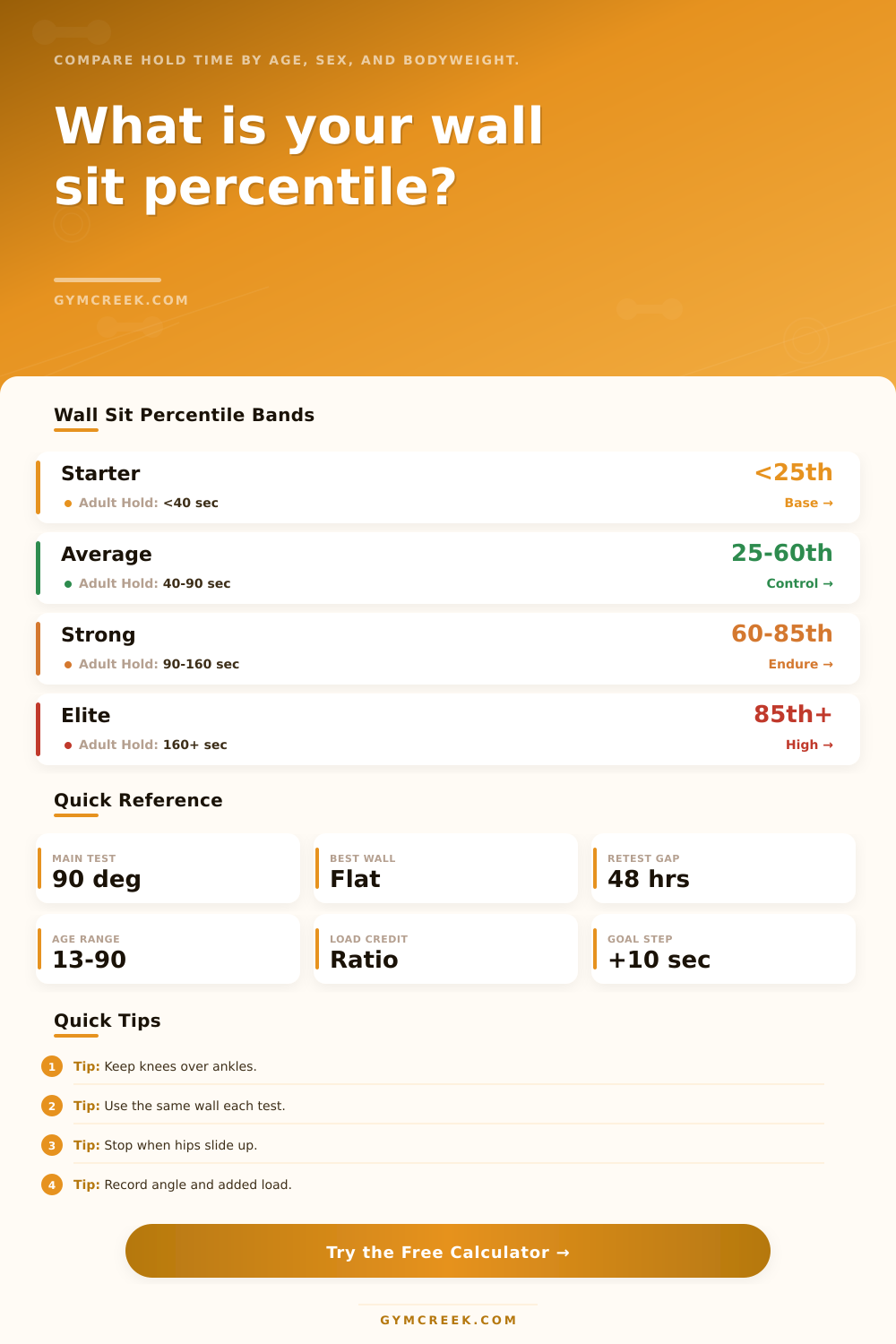
| Band | Percentile | Meaning | Next Step |
|---|---|---|---|
| Starter | Under 25th | Below peer median | Add short holds |
| Average | 25th-60th | Usable quad base | Build consistency |
| Strong | 60th-85th | Good endurance | Hold true depth |
| Advanced | 85th-95th | High control | Add load carefully |
| Elite | 95th+ | Exceptional hold | Retest strictly |
| Age | Male Median | Female Median | Spread |
|---|---|---|---|
| 18-29 | 92 sec | 78 sec | Wide |
| 30-39 | 82 sec | 70 sec | Moderate |
| 40-49 | 70 sec | 60 sec | Moderate |
| 50-59 | 58 sec | 50 sec | Wide |
| 60+ | 44 sec | 39 sec | Wide |
| Setup | Factor | Use Case | Form Note |
|---|---|---|---|
| 90 degrees | 1.00x | Standard test | Thighs level |
| 80 degrees | 1.18x | Deeper hold | Harder depth |
| 100 degrees | 0.86x | Higher hold | Less quad load |
| 110 degrees | 0.68x | Partial hold | Not standard |
| Loaded | Ratio | Vest or plate | Record load |
| Factor | Formula Role | Range | Why It Matters |
|---|---|---|---|
| Age | Median curve | 13-90 | Compares peers |
| Sex | Base median | M/F | Sets reference |
| Bodyweight | Mass factor | 40-500 lb | Adjusts demand |
| Height | Lever factor | 48-90 in | Estimates torque |
| Knee angle | Depth factor | 80-110 deg | Normalizes setup |
| Added load | Load ratio | 0-300 lb | Credits loading |
💡Tips
The wall sit has become synonymous with torture, which is exactly what makes it so effective. Within half a minute, your leg muscles burns while you sink down into a squat. Wait until the clock runs out. It sucks in all the right ways, but it works.
A ninety-second wall sit tells you very little unless you know who else is doing it and under what conditions. An elite hold are more than will power, it’s leverage and biomechanics. It’s hard to compare people directly based off their physique. What does it mean if a 110-pound runner can hold a position for the same amount of time as a 200-pound weightlifter? They’re facing different mechanical realities due to there size and mass.
How This Calculator Works
That’s where this calculator comes into play. It will adjusts your hold time by looking at your height, bodyweight, sex, and age. You know what all those inputs go into so you can trust the answer it provides. It provides a true ranking based on your hold time compared to other human; not some vanity metric.
Few recognize that static squat performance vary by a person’s height. Because taller folks has longer femurs, their leverage (or “lever arm”) on the knee joint is greater, requiring additional torque to maintain position. The tool accounts for this mechanical disadvantage when you input your height. A five foot four athlete of equal strength could have a lower percentile than a six foot athlete due to greater effort needed to reach the same angle.
It also takes into account bodyweight, since anyone with higher mass put more strain on their quadriceps. They don’t necessarily improves at the same rate. That’s where the load ratio comes in. By adding weight (whether that be a vest or otherwise), it recognize the change in relative standing compared to others when you put on extra weight. It avoids unfairly punishing people for being bigger but understands that there’s something objectively difficult about lifting greater loads.
And if uncorrected, knee angle skews results. You start pulling further into the zone of poor leveraged quads and it really kicks in big time when you drop below ninety-degrees. A very shallow partial squat feels far easier then holding at eighty-degrees. To make this apples-to-apples, the tool includes certain depth factors which even out those attempts. Your deep hold is rewarded for its difficulty, rather than just being counted in raw seconds that mean different things depending on how deep you go.
How does this relate to stance? Wide or narrow stances recruit different muscle to handle the load. Narrow (isolation of quads) vs. Wider stances involves the hips and glutes to help share the work. For instance, if during one workout you stand shoulder-width apart, then next time you go staggered, don’t expect those two sets of times to be directly comparable. Keeping your setup consistent will allow you to track progress over time. Not changes in form but endurance.
You can’t just test in whatever condition you’re in, or your results will be skewed. If I’m fresh on a rest day then it’s different than trying to do a wall sit right after doing a hard leg workout. Holding when tired also gives you partial credit for your level of fatigue. It recognizes how much work you put into it, even though the clock stopped early.
Static endurance sports has very steep age curves. You’ll typically peak somewhere in your late twenties to early thirties, and then decline gradually over time. You get realistic context by knowing how you rank against others your own age. It’s not fair and it’s not even necessary for you to beat a twenty-year-old if you’re fifty. You should of be beating your peers. The page shows the bands clearly in reference tables that help you know exactly where you land.
With solid shoes on a flat wall, begin by holding at a right angle (ninety degrees). Maintain a neutral spine, no leaning forward or backward; keep knees over feet to prevent injury. Honestely record results and stop when you lose proper form. Take 48 hours off between tests to see how you’re trending. If it’s a clean technique, slow progress is still progress. The burn will go away but your legs will take much longer to heal.